What Are Sleep Strips? (Dissolving Melatonin Strips vs Mouth Tape vs Nasal Strips)
Last updated: July 1, 2026
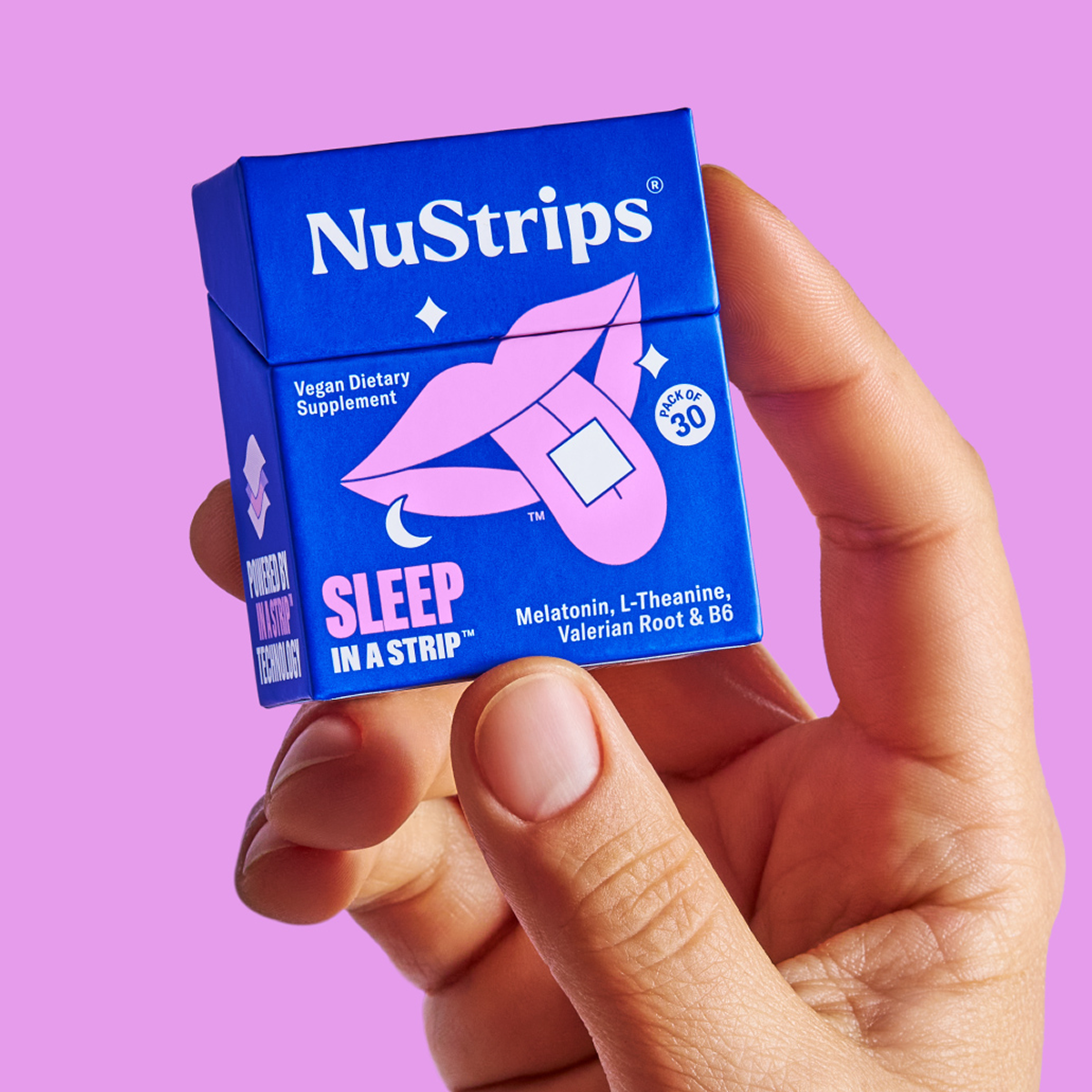
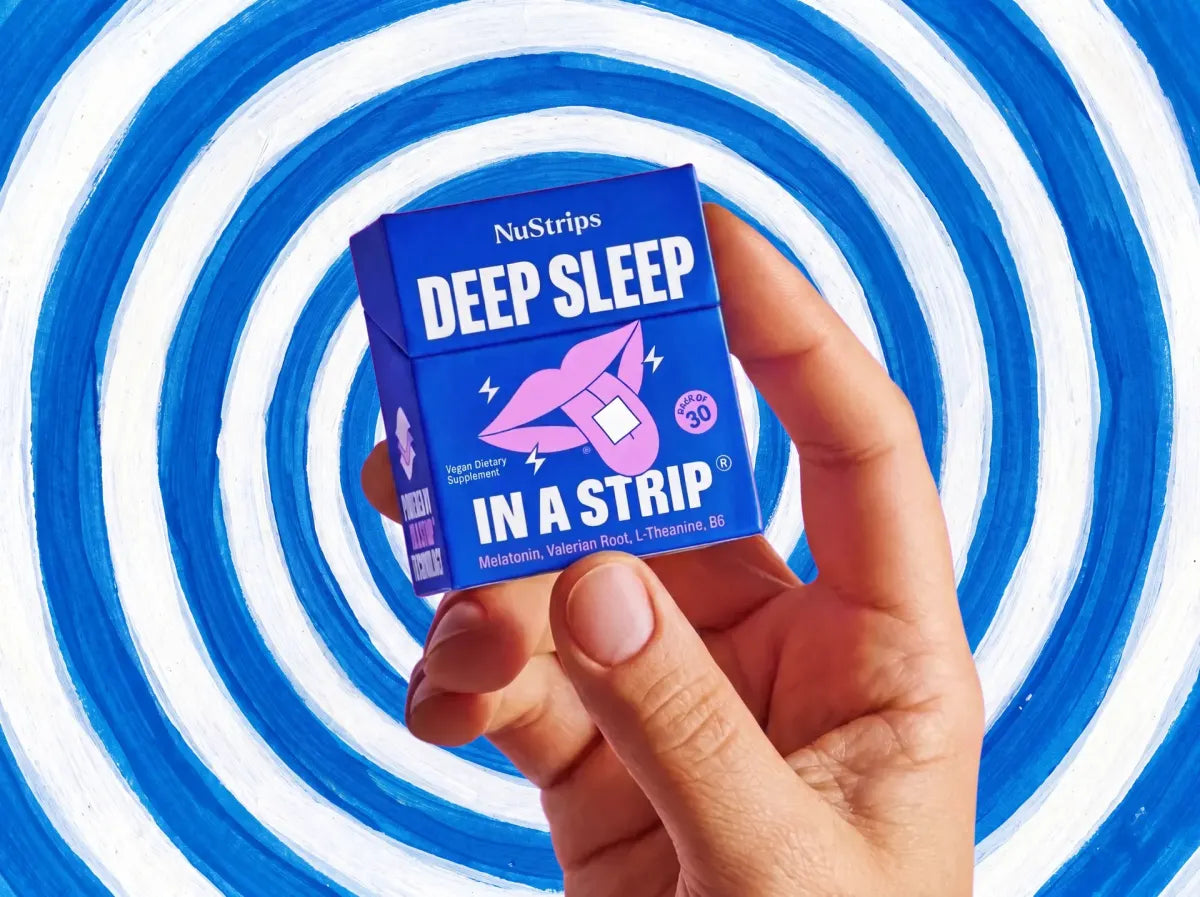
Dissolving sleep strips are thin, fast-melting oral films that carry a measured dose of melatonin and calming ingredients. You place one on your tongue, it dissolves in about 30 seconds with no water, and the ingredients absorb through the tissues in your mouth. NuStrips makes this kind of strip.
Search "sleep strips" and you'll find three products that have almost nothing in common. Most people mean dissolving melatonin strips — a paper-thin film that melts on your tongue in about 30 seconds and delivers melatonin plus calming ingredients, with no water and no gulping down pills. The other two are physical: mouth tape (a strip worn over your lips to keep your mouth closed) and nasal strips (an adhesive band that props your nostrils open). This guide untangles all three, then goes deep on the dissolving kind — how oral absorption works, what's inside NuStrips Sleep, whether the research actually backs it up, and who should skip it.
Key takeaways
- "Sleep strips" can mean three unrelated things: dissolving melatonin strips, mouth tape, and nasal strips.
- Dissolving strips deliver melatonin through the tissues in your mouth; melatonin taken as a pill loses most of its dose in the liver, with only about 3–15% reaching your bloodstream.†
- One NuStrips Sleep strip has 5 mg melatonin, 10 mg L-theanine, 15 mg valerian root extract, and 5 mg vitamin B6 — with zero sugar.
- Melatonin helps people fall asleep roughly 7 minutes faster on average in pooled trials; it's a wind-down signal, not a knockout sedative.†
- Strips aren't for loud snoring or suspected sleep apnea (that's a breathing issue), and the 5 mg adult dose isn't for young children without a pediatrician's OK.
What exactly are "sleep strips"?
The confusion is worth clearing up in one place. Three separate products share the "sleep strip" nickname, and they solve completely different problems.
- Dissolving melatonin strips — a thin oral film loaded with melatonin and calming botanicals. It dissolves on your tongue, and the ingredients are absorbed through the tissues in your mouth. This is what NuStrips makes, and it's what most people are picturing when they type the phrase.
- Mouth tape — a gentle adhesive strip placed over your lips at night. It contains nothing; it physically nudges you to breathe through your nose instead of your mouth.
- Nasal strips — a spring-like band (think Breathe Right) that sticks across the bridge of your nose and mechanically pulls your nasal passages open to ease congestion and some snoring.
Here's the quick side-by-side:
| Product | What it is | How it works | Best for |
|---|---|---|---|
| Dissolving melatonin strips | Oral thin film with active ingredients | Dissolves on your tongue; oral absorption | A racing mind, falling asleep faster† |
| Mouth tape | Adhesive strip over the lips | Keeps the mouth closed for nasal breathing | Mouth breathing, dry mouth, light snoring |
| Nasal strips | Adhesive band across the nose | Physically opens the nasal passages | Congestion, snoring from a blocked nose |
Notice the split: mouth tape and nasal strips are about how you breathe. Dissolving strips are about what your body gets — the melatonin and calming ingredients that help quiet your head at bedtime.† The rest of this guide is about that third kind. If you want the research-first version of everything below, our science page lays it out in full.
How do dissolving melatonin strips work?
A dissolving strip is an oral thin film — a flexible layer roughly 50 to 200 microns thick (about the width of a few sheets of paper) that carries a precise dose of active ingredients. Place it on your tongue and it dissolves in around 30 seconds. No water. No choking down capsules.
Taking one is a three-step routine most people finish in under a minute:
- Peel — tear open the single-serve pouch.
- Dissolve — place the strip on your tongue. It dissolves in about 30 seconds — no water, no chewing.
- Absorb — nutrients pass through the tissues in your mouth directly into your bloodstream. No stomach. No liver. No waste.
The interesting part is where the ingredients go. The tissues in your mouth are rich with blood vessels sitting just beneath a thin surface, so a portion of the dose can be absorbed directly through your mouth rather than making the full trip through your stomach and gut. That matters most for one ingredient in particular: melatonin.

When melatonin goes down as a pill, most of it never reaches your bloodstream. It's broken down in the liver first — a process called first-pass metabolism — and studies put the amount of oral melatonin that actually makes it into circulation at just 3 to 15%, with wide variation from one person to the next. On-your-tongue absorption is designed to sidestep some of that breakdown, so more of the melatonin you take can reach your system.
One honest caveat we'll never fudge: oral absorption is a genuine edge for melatonin specifically, because melatonin is hit so hard by first-pass metabolism. It is not a magic "90% absorption" upgrade for every vitamin on earth — that blanket claim gets thrown around a lot and it isn't true. For melatonin, though, the format is a real advantage. Curious how quickly it kicks in? We break the timing down in how fast melatonin strips work.
What's the story behind In A Strip®?
NuStrips created the oral strip supplement category — 20M+ strips sold since 2020. We didn't slap melatonin onto a breath-mint film and call it a day. The In A Strip® format is protected by a granted U.S. patent (No. 11,981,491). The hard part isn't the melatonin — it's engineering a strip that dissolves fast, tastes good, holds an exact dose, and stays stable on a shelf without refrigeration.

That layered anatomy is why the strip is the hero here, not a footnote. A gummy or a capsule is a delivery vehicle you've seen a thousand times. A film that melts on your tongue and delivers a clean, sugar-free dose in 30 seconds is a genuinely different way to take a supplement — which is the whole point. Every batch is made in a US FDA-registered facility, produced under NSF-certified cGMP standards, third-party lab-tested by Eurofins, and individually sealed for dosage, safety, and quality.
What's actually in NuStrips Sleep?
No hidden blends here — every dose is printed on the label. One Sleep strip (there are 30 in a container) contains four active ingredients:
| Ingredient | Amount per strip | What it's there for |
|---|---|---|
| Melatonin | 5 mg | Helps regulate your sleep-wake cycle† |
| L-Theanine | 10 mg | Promotes calm without heavy sedation† |
| Valerian Root Extract | 15 mg | A traditional herb long used for sleep support† |
| Vitamin B6 (as Pyridoxine HCl) | 5 mg (295% DV) | Supports your body's own melatonin-making pathway† |

The 5 mg of melatonin is the workhorse for your circadian rhythm. L-theanine — the calming amino acid found in green tea — encourages a relaxed, quiet-minded state without knocking you out.† Valerian root has a long track record as a sleep herb. And vitamin B6 is a behind-the-scenes helper: your body needs it to convert its own building blocks into serotonin and then melatonin.
The rest of the strip is a short, readable list: pullulan and cellulose (the film itself), sunflower lecithin, natural blueberry flavor, and monk fruit plus steviol glycosides for a touch of sweetness. That means zero sugar — unlike most sleep gummies, which lean on 2 to 4 grams of it per serving. Want the deeper ingredient-by-ingredient breakdown across brands? See our guide to the best melatonin strips.
Do sleep strips actually work?
Fair question — and the answer depends entirely on which of the three "sleep strips" you mean. Here's the honest, evidence-first read on each.
Dissolving melatonin strips
The strongest evidence is for the active ingredient, melatonin. A meta-analysis of 19 randomized studies found that people taking melatonin fell asleep about 7 minutes faster on average, slept a bit longer, and rated their sleep quality higher than those on placebo. The effect is real but modest — melatonin is a gentle wind-down signal, not a sledgehammer.† Valerian root has a supportive track record too: a meta-analysis of 16 trials found people were more likely to report improved sleep (relative risk 1.8), though the authors flagged uneven study quality. L-theanine rounds it out by nudging you toward a calmer, quieter-minded state.† NuStrips uses smaller complementary doses of valerian and L-theanine than the large clinical-trial doses, so think of them as support players around the 5 mg of melatonin.
Mouth tape
Here we stay skeptical. A 2025 systematic review looked at the available mouth-taping studies and rated all of them low quality, concluding the data does not support mouth taping as a safe, proven fix for mouth breathing or sleep-disordered breathing in the general population. A couple of small studies hinted at benefit for mild obstructive sleep apnea, but researchers warned it can be risky for some people. Translation: interesting, unproven, and not something to self-prescribe if you snore heavily.
Nasal strips
Nasal dilator strips reliably make your nose feel more open, which many people find pleasant. But a systematic review and meta-analysis found they did not meaningfully improve apnea-hypopnea scores or the snoring index in people with obstructive sleep apnea. They can ease the sensation of congestion; they are not a treatment for a sleep disorder.
Bottom line: of the three, dissolving melatonin strips have the clearest evidence for helping you fall asleep — and even then, the honest framing is "modest help with timing and a racing mind," not a cure.†
Are melatonin sleep strips safe? Side effects and interactions
For most healthy adults, melatonin is widely used and generally well tolerated for short-term use. When side effects do show up they're usually mild — think next-morning grogginess, headache, dizziness, mild nausea, or unusually vivid dreams — and they tend to ease if you lower the dose. Because melatonin signals "wind down," it's smart to take it only when you can actually go to sleep, and to avoid driving or operating machinery afterward.
Melatonin can also interact with several classes of medication. According to the Mayo Clinic, you should talk to your doctor before combining melatonin with:
- Blood thinners and antiplatelet drugs (for example, warfarin) — melatonin may add to their effect.
- Antidepressants, especially fluvoxamine — it can sharply raise melatonin levels by blocking the enzyme that clears it.
- Blood pressure medications — melatonin may interfere with blood-pressure control.
- Diabetes medications — melatonin can affect blood-sugar levels.
- Seizure medications (anticonvulsants) — melatonin might blunt their effect in some people.
- Immunosuppressants — melatonin may work against them.
- Sedatives and other CNS depressants — combining them can add to drowsiness.
This isn't the full list, and it isn't medical advice. If you're pregnant, nursing, managing a health condition, or taking any prescription medication, talk to your doctor or pharmacist before starting a melatonin strip. Start with one strip, see how you feel, and don't stack it with other sleep aids without professional guidance.
Are sleep strips safe for kids?
This is the most important safety section, so we'll be blunt: NuStrips Sleep is formulated as a 5 mg adult dose and is not designed for young children. The American Academy of Pediatrics urges parents to talk to a pediatrician before giving any child melatonin, to build solid sleep habits first, and — if a clinician does recommend it — to use the lowest effective dose, often just 0.5 to 1 mg, rather than an adult amount.
The caution is grounded in real data. The CDC reported that pediatric melatonin ingestions logged by U.S. poison-control centers rose 530% between 2012 and 2021, and a 2023 analysis in JAMA found that the actual melatonin content of gummy products ranged from 74% to 347% of what the label claimed — so "5 mg" on a bottle didn't always mean 5 mg in the product. NuStrips prints an exact, lab-verified dose on every strip, which removes the labeling guesswork — but an accurate 5 mg dose is still an adult dose. If you're considering melatonin for a child, that's a conversation for your pediatrician, not a strip you hand over on your own.
Sleep strips vs. gummies vs. pills: which should you choose?
Each format has real trade-offs, and pretending otherwise would insult your intelligence.
Gummies taste great and feel familiar — that's their genuine appeal. The downside: added sugar (often 2 to 4 grams per serving), and because they go through your gut like any food, the melatonin takes the full first-pass route through your liver. We compare them head-to-head in melatonin strips vs. gummies.
Pills and capsules are usually the cheapest per dose and about as familiar as it gets. But they need water, they're slower to break down, and most of the melatonin is lost before it reaches you — a real issue when more than a third of adults say they have trouble getting tablets down in the first place. The full comparison lives in melatonin strips vs. pills.
Strips win on onset, no water, travel-friendliness, zero sugar, and precise dosing. They're usually pricier per dose than a bottle of generic pills, and if you love the ritual of a chewy gummy, a strip won't scratch that itch. A fair trade for most people — but you know your own preferences best. For a wider view of gentle options, our best natural sleep aid guide covers the field.
Who should use sleep strips — and who should skip them?
Dissolving melatonin strips are a great fit if you:
- Hate gulping down pills with water, or gag on capsules — more than a third of adults report trouble getting tablets and capsules down, so you're in good company.
- Have a brain that won't shut up at 2am and want something to help it quiet down.†
- Travel a lot — a strip needs no water, survives your carry-on, and fits in a wallet.
- Want a precise, lab-verified dose and no added sugar.
And here's where we stay honest: a melatonin strip is not a treatment for a medical sleep disorder. If your problem is loud snoring or you stop breathing at night, that's a breathing issue — mouth tape, nasal strips, or a doctor's visit are the tools to look at, not melatonin. If you suspect sleep apnea, see a clinician. Melatonin strips help with the mind-and-timing side of falling asleep, not the mechanics of airflow. Plenty of people have already made the switch — you can read unfiltered experiences on our reviews page (rated 4.36★ across 5,034 reviews, part of 10,000+ verified reviews site-wide).
Not sure it's for you? Sleep strips come with a 60-day money-back guarantee — melt one, sleep on it, and get a full refund if it's not for you. Free U.S. shipping over $40, and orders ship within 24 hours.
Frequently asked questions
Are sleep strips the same as mouth tape?
No. Mouth tape is an adhesive strip you put over your lips to encourage nasal breathing at night — it contains no ingredients. Dissolving sleep strips like NuStrips Sleep are thin films that melt on your tongue and deliver melatonin plus calming ingredients. Different products, different jobs.
What are dissolving sleep strips made of?
The film itself is made from pullulan and cellulose, with sunflower lecithin, natural blueberry flavor, and monk fruit plus steviol glycosides for sweetness. The four active ingredients in NuStrips Sleep are melatonin, L-theanine, valerian root extract, and vitamin B6. There's zero sugar and no hidden blends — every amount is printed on the label.
How much melatonin is in a sleep strip?
One NuStrips Sleep strip has 5 mg of melatonin, plus 10 mg L-theanine, 15 mg valerian root extract, and 5 mg vitamin B6. Every dose is printed on the label and third-party lab-tested — no hidden blends.
Do melatonin strips work better than pills?
For melatonin specifically, the format has a real edge. Melatonin taken as a pill is largely broken down by the liver first, so only about 3 to 15% reaches your bloodstream. On-your-tongue absorption is designed to sidestep some of that. It's not a universal "better absorption" claim for every vitamin, though — just an honest one for melatonin.
Do dissolving sleep strips actually work?
The evidence is clearest for melatonin: pooled trials show people fall asleep about 7 minutes faster on average and rate their sleep quality higher, though the effect is modest.† Valerian and L-theanine add supportive calm. Melatonin is best thought of as a gentle wind-down signal for a racing mind and off timing — not a cure for a medical sleep disorder.†
Do sleep strips have sugar?
NuStrips Sleep strips have zero sugar — they're sweetened with monk fruit and steviol glycosides. That's a key difference from sleep gummies, which often carry 2 to 4 grams of added sugar per serving.
How fast do sleep strips work?
The strip dissolves on your tongue in about 30 seconds, and most people take one 20 to 30 minutes before bed. Melatonin acts as a wind-down signal rather than a knockout sedative, so expect a gentler drift into sleep.† See how fast melatonin strips work for the full timeline.
Are melatonin sleep strips safe to take every night?
Melatonin is widely used and generally well tolerated for short-term use, and pooled data suggests its benefit doesn't fade with continued use. Any side effects — grogginess, headache, vivid dreams — are usually mild and ease at a lower dose. Because everyone's body is different, start with one strip, avoid driving after taking it, and talk to your doctor about long-term nightly use, especially if you take other medication.
Can I give a sleep strip to my child?
Not on your own. NuStrips Sleep is a 5 mg adult dose. The American Academy of Pediatrics advises building good sleep habits first and talking to a pediatrician before giving any child melatonin — and if it's recommended, using a much lower dose (often 0.5 to 1 mg). Always check with your pediatrician before giving melatonin to a child.
Do melatonin strips interact with any medications?
They can. Melatonin may interact with blood thinners, some antidepressants (especially fluvoxamine), blood pressure and diabetes medications, seizure medications, immunosuppressants, and other sedatives. This isn't a complete list. If you take any prescription medication or are pregnant or nursing, talk to your doctor or pharmacist before using a melatonin strip.
References
- DeMuro RL, et al. "The Absolute Bioavailability of Oral Melatonin." Journal of Clinical Pharmacology (2000). Oral melatonin at 2–4 mg showed absolute bioavailability of approximately 15%. https://pubmed.ncbi.nlm.nih.gov/10883420/
- Andersen LPH, et al. "Pharmacokinetics of oral and intravenous melatonin in healthy volunteers." BMC Pharmacology and Toxicology (2016). Median oral bioavailability was ~3%; time to peak ~41 minutes; elimination half-life ~54 minutes. https://pmc.ncbi.nlm.nih.gov/articles/PMC4759723/
- Ferracioli-Oda E, et al. "Meta-Analysis: Melatonin for the Treatment of Primary Sleep Disorders." PLoS ONE (2013). Across 19 studies, melatonin reduced sleep-onset latency by ~7 minutes vs placebo and improved sleep quality. https://pmc.ncbi.nlm.nih.gov/articles/PMC3656905/
- Bent S, et al. "Valerian for Sleep: A Systematic Review and Meta-Analysis." The American Journal of Medicine (2006). Meta-analysis of 16 RCTs; relative risk of improved sleep = 1.8 (95% CI 1.2–2.9), with noted study-quality caveats. https://pmc.ncbi.nlm.nih.gov/articles/PMC4394901/
- Hidese S, et al. "Effects of L-Theanine Administration on Stress-Related Symptoms and Cognitive Functions in Healthy Adults." Nutrients (2019). L-theanine reduced anxiety and improved sleep scores in a randomized trial. https://pmc.ncbi.nlm.nih.gov/articles/PMC6836118/
- Drugs in R&D (2023). Oral melatonin spray designed to limit first-pass hepatic metabolism, since vascularization is highly developed in the oral tissues, allowing a faster time-to-peak than a prolonged-release tablet. https://pmc.ncbi.nlm.nih.gov/articles/PMC10439092/
- Schiele JT, et al. European Journal of Clinical Pharmacology (2013). General-practice survey (n=1,051): 37.4% reported difficulty getting tablets and capsules down. https://pubmed.ncbi.nlm.nih.gov/23052416/
- Camacho M, et al. "Nasal Dilators (Breathe Right Strips and NoZovent) for Snoring and OSA: A Systematic Review and Meta-Analysis." Pulmonary Medicine (2016). Nasal dilators improved nasal breathing but did not significantly change apnea-hypopnea index or snoring index in OSA. https://pmc.ncbi.nlm.nih.gov/articles/PMC5187471/
- Rhee J, et al. "Breaking social media fads and uncovering the safety and efficacy of mouth taping in patients with mouth breathing, sleep disordered breathing, or obstructive sleep apnea: A systematic review." PLOS ONE (2025). All included studies rated low quality; data does not support mouth taping for the general population. https://pmc.ncbi.nlm.nih.gov/articles/PMC12094774/
- American Academy of Pediatrics. "Melatonin for Kids: What Parents Should Know." HealthyChildren.org. Advises talking to a pediatrician first and using the lowest effective dose (often 0.5–1 mg). https://www.healthychildren.org/English/healthy-living/sleep/Pages/melatonin-and-childrens-sleep.aspx
- Lelak K, et al. "Pediatric Melatonin Ingestions — United States, 2012–2021." MMWR (CDC, 2022). Pediatric melatonin ingestions reported to poison-control centers rose 530% over the period. https://www.cdc.gov/mmwr/volumes/71/wr/mm7122a1.htm
- Cohen PA, et al. "Quantity of Melatonin and CBD in Melatonin Gummies Sold in the US." JAMA (2023). Actual melatonin content ranged from 74% to 347% of the labeled amount; 22 of 25 products were inaccurately labeled. https://jamanetwork.com/journals/jama/fullarticle/2804077
- Mayo Clinic. "Melatonin." Drugs and Supplements reference. Lists potential interactions with anticoagulants, anticonvulsants, blood pressure and diabetes medications, immunosuppressants, contraceptives, CNS depressants, and fluvoxamine. https://www.mayoclinic.org/drugs-supplements-melatonin/art-20363071
† These statements have not been evaluated by the Food and Drug Administration. This product is not intended to diagnose, treat, cure, or prevent any disease.