How Fast Do Melatonin Strips Work? Onset Times vs Pills & Gummies
Last updated: July 1, 2026
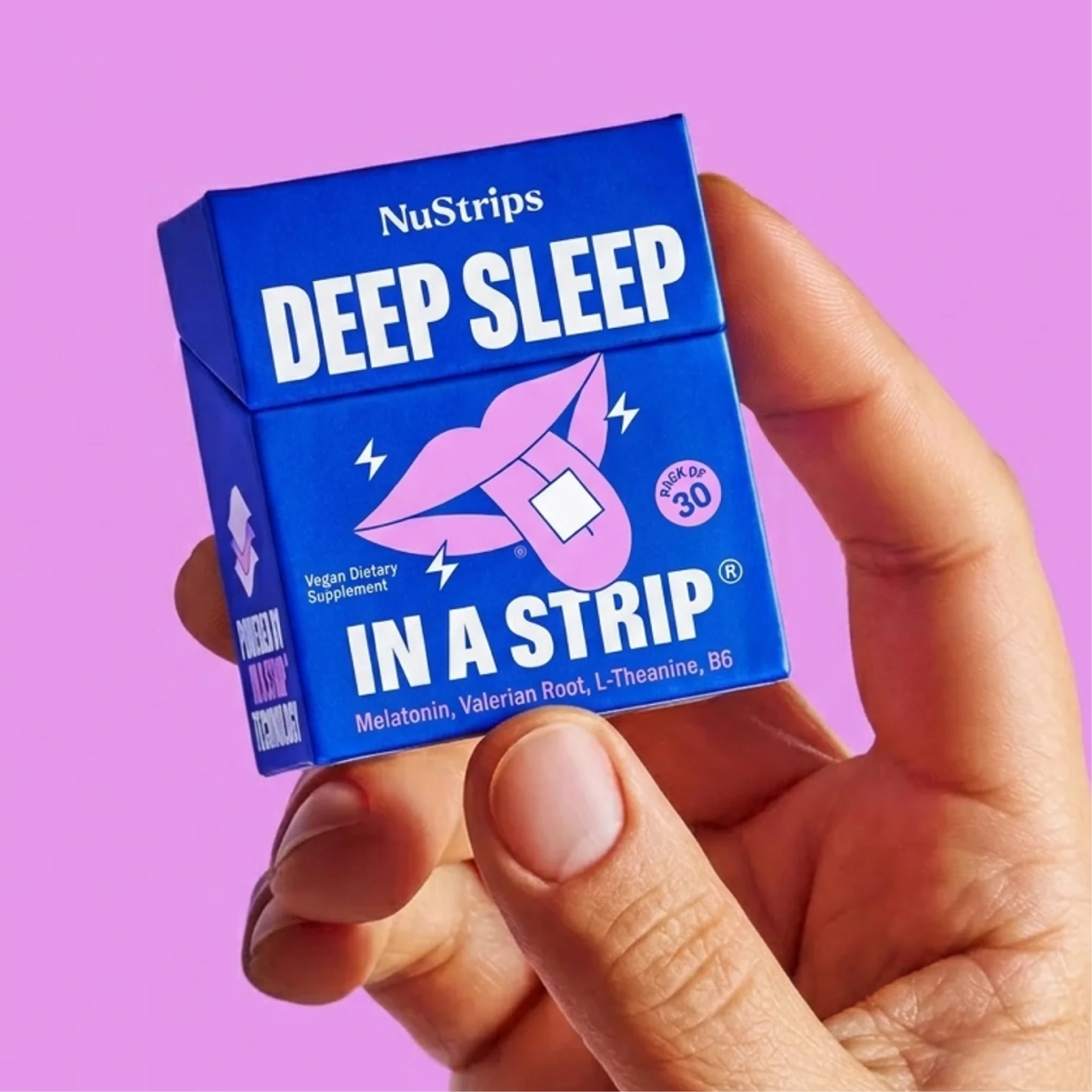
Fast — and faster than a pill or gummy. A NuStrips Sleep strip dissolves on your tongue in about 30 seconds, and because a real share of its 5mg of melatonin absorbs through the tissues in your mouth, it reaches your bloodstream within minutes instead of waiting on your stomach and liver.
Take one about 30 minutes before bed and most people feel the wind-down as they settle in.† Below: the honest minute-by-minute, how strips beat pills and gummies on speed, exactly when to take one — and the one time a strip is the wrong call.
Key takeaways
- Dissolves in about 30 seconds on your tongue — no water, no chewing, nothing to gulp down.
- Most people feel it in 15–30 minutes, versus roughly 30–60 minutes for a melatonin pill or gummy that has to be digested first.†
- Reaches your blood within minutes because part of the dose absorbs through the tissues in your mouth and skips the first-pass liver detour.
- Take it about 30 minutes before bed. Melatonin’s half-life is only around 45 minutes, so timing matters as much as dose.[5]
- Only 3–15% of a gulped-down melatonin dose reaches your bloodstream — the format is why so much pill melatonin goes to waste.[1][2]
How fast do melatonin strips work?
Here is the short version, then the honest detail. A NuStrips Sleep strip dissolves on your tongue in about 30 seconds. Because part of its melatonin absorbs through the tissues in your mouth, it starts reaching your bloodstream within minutes, and most people feel the wind-down about 15–30 minutes after taking it — noticeably sooner than the 30–60 minutes a pill or gummy usually needs, since those have to be digested and filtered by your liver first.†
The simplest way to picture it is a timeline:
- 0:00 — strip goes on your tongue.
- 0:30 — it has fully dissolved — no water, no chewing.
- ~2–15 min — melatonin is crossing into your blood and climbing.
- 15–30 min — the drowsy wind-down signal shows up.†
- ~1 hour — melatonin reaches its peak in your blood.[5]
Those three physical steps take all of half a minute:



What happens after a melatonin strip dissolves on your tongue?
Zoom in on that same half hour and here is what is actually happening, second by second:
- 0–30 seconds — it melts. The strip dissolves on your tongue. No water, no chewing, nothing to gulp down.
- While it dissolves — absorption starts. The tissues in your mouth are packed with blood vessels sitting just beneath a thin surface, so some of the melatonin begins crossing straight into your bloodstream, skipping the digestive detour a pill has to take.
- Within minutes — melatonin reaches your blood. Because part of the dose bypasses your stomach and liver, levels start climbing quickly — faster than a time-release tablet that has to break down first.[4]
- ~15–30 minutes — the wind-down signal. Melatonin tells your brain the sun has gone down and it is time to sleep.† That is why we suggest taking a strip about half an hour before you want your head to hit the pillow.
- Through the night — the supporting cast. L-Theanine and Valerian Root come along to help quiet a busy mind — more on those below.†
How fast do melatonin strips work compared to pills and gummies?
All three deliver melatonin. The difference is the route it takes to your blood — and that route decides both speed and how much of the dose actually counts. When you gulp down a melatonin pill or chew a gummy, it travels through your stomach and gets processed by your liver before the leftover melatonin reaches your bloodstream. That “first-pass” step is brutal for melatonin: studies put the share of an oral dose that actually reaches circulation at just 3–15%.[1][2] A strip sidesteps part of that bottleneck by absorbing through the tissues in your mouth.
| Format | How it is absorbed | Typical onset | Melatonin that reaches your blood | Added sugar |
|---|---|---|---|---|
| NuStrips Sleep strip | Dissolves on your tongue in ~30 sec; part of the dose absorbs through the tissues in your mouth | ~15–30 min (in your blood within minutes) | More of the dose, since part skips the first-pass detour | Zero |
| Melatonin pill / capsule | Gulped down with water; digested, then filtered by the liver | ~30–60 min | Only 3–15% of an oral dose[1][2] | Usually none |
| Melatonin gummy | Chewed and gulped down; same digestive + liver route | ~30–60 min (chewing adds time) | Same first-pass route as a pill | ~2–4 g per gummy |
The chart below shows why that onset gap exists — blood-melatonin climbing over the first 90 minutes for a strip versus a pill versus a gummy:
Credit where it is due: gummies taste great and feel familiar, and plain pills are usually the cheapest melatonin you can buy. If flavor or a rock-bottom price is your only priority, they have a case. But for getting melatonin into your system quickly, with no sugar and no glass of water on the nightstand, the strip wins on the things that matter at bedtime. We break the matchups down further in melatonin strips vs pills and melatonin strips vs gummies.
Why does a strip absorb faster than a pill you gulp down?
It comes down to plumbing. A pill has to dissolve in your stomach, get absorbed through your gut, and then pass through your liver — which breaks melatonin down fast using an enzyme called CYP1A2 — before whatever survives reaches your bloodstream. The tissues in your mouth are different: rich in blood vessels sitting just below a thin surface, so melatonin can pass almost directly into circulation. That is why levels climb within minutes, and why a mouth-absorbed dose reaches its peak faster than a prolonged-release tablet.[4]
NuStrips created the oral strip supplement category, with 20M+ strips sold since 2020, and the format is the whole point: it works with your body’s plumbing instead of against it.
Honest caveat: a strip is not 100% mouth-absorbed. Some of every strip mixes with saliva and goes down the normal way, so we would never claim a magic “90% absorption” number. What we will say is that a meaningful share skips the first-pass bottleneck — and that is enough to change how fast, and how reliably, you feel it. The full mechanism, with the studies behind it, lives on our sleep science page.
One more honest note on individual variation. Melatonin behaves differently from person to person — one review measured oral bioavailability ranging from about 10% to 56% across healthy adults.[3] Body weight, age, caffeine metabolism, and even your genes all nudge how fast you personally feel a dose. So treat “15–30 minutes” as the typical window, not a stopwatch guarantee.
How long does melatonin from a strip stay in your system?
Not long — and that is by design. Melatonin has a short elimination half-life of roughly 45 minutes, meaning your body clears about half of a given dose every three-quarters of an hour.[5] After a fast-acting dose like a strip, blood levels typically peak within about an hour and then taper over the next several hours, so an ordinary 5mg dose is largely cleared within roughly four to five hours.[5]
Why that is good news: a fast-in, fast-out profile is exactly what you want from a bedtime sleep aid. You get the wind-down signal when you need it, with far less lingering the next morning than you would get from long-acting prescription sedatives. It is also why timing matters more than piling on a bigger dose — a strip taken 30 minutes before bed lands its peak right as you are trying to drift off. If mornings still feel foggy, the fix is usually a smaller dose or earlier timing, not a stronger one.
When should you take a melatonin strip?
Timing is where most people get melatonin wrong. Match it to the scenario:
Your normal bedtime
Take one strip about 30 minutes before you want to be asleep.† Then dim the lights and put the phone down while it kicks in — bright light is melatonin’s natural off-switch, so a glowing screen works against the strip you just took.[6]
Jet lag and red-eyes
Flying across time zones? Take your strip at your destination’s bedtime, not your home clock’s — that way the wind-down signal lands when you actually want to sleep.† A strip is handy here for the obvious reason: it fits in your pocket, clears TSA as a solid, and needs no water on the plane.
The 3am wake-up (proceed with caution)
This is the one time to think twice. If you jolt awake at 3am and have to be up at 7, a full 5mg dose can leave you groggy for your alarm — melatonin does not know your morning meeting exists. For a middle-of-the-night wake-up with only a few hours left, you are usually better off with calm, screen-free habits than a fresh dose. Save the strip for when you have a full night ahead.
Why isn’t my melatonin working?
If a strip (or any melatonin) does not seem to do much, the format is rarely the problem — the setup around it usually is. The four most common culprits:
- Light and screens. This is the big one. Room light and phone screens in the hour before bed actively suppress your body’s own melatonin — in one controlled study, ordinary room light before bedtime shortened nightly melatonin production by about 90 minutes.[6] A strip cannot out-argue a bright screen six inches from your face. Dim the room and put the phone down.
- Afternoon caffeine. Caffeine blocks the “you’re tired” signal (adenosine) in your brain, working directly against melatonin’s wind-down cue — and it lingers for hours. If sleep is the goal, cut coffee after early afternoon.
- Wrong timing. Melatonin is a timing signal, not a knockout drug. Taken too late — or right as you start a stimulating activity — it has nothing to work with. Take it about 30 minutes before a genuine wind-down routine.
- Too big a dose. More is not better with melatonin. An oversized dose is more likely to leave you groggy than to knock you out faster, and it can blunt your own rhythm. A modest 5mg, well-timed, is the sweet spot for most adults.
And one strip-specific tip: do not eat or drink for a few minutes after it dissolves, so it is not washed down before it finishes absorbing. A heavy, fatty dinner right before bed can drag things out too. If sleep trouble sticks around despite the basics, talk to your doctor — it can be a sign of something worth checking.
What is actually in a NuStrips Sleep strip?
One strip, four actives, zero added sugar:

- Melatonin, 5mg — the sleep-timing signal, delivered so more of it counts.†
- L-Theanine, 10mg — an amino acid from tea that encourages calm without knocking you out.†[8]
- Valerian Root Extract, 15mg — a traditional sleep herb; a meta-analysis of 16 trials found people were meaningfully more likely to report better sleep on valerian than on placebo.†[7]
- Vitamin B6, 5mg — a helper your body uses to make its own melatonin.†
Zero added sugar (sweetened with monk fruit and stevia), blueberry flavor, 30 strips a pack — nothing to gulp down. New to the format? Start with what sleep strips are, see how ours rank in the best melatonin strips, or compare them against the best natural sleep aids.
Do people actually feel them work fast?
Speed is the thing buyers mention most — and our audience skews toward adults 45+ who have tried everything for a racing mind at night. A few verified reviews:
- “Sweet, sweet sleep in minutes… I can’t still get over how quickly I fall asleep.” — Kara B.
- “They act fast, and I fall asleep after 20 min. I LOVE them!!” — Valeria B.
- “Asleep in 15 minutes — they dissolve quickly and we’re usually asleep within 15 minutes.” — Caitlin W., Verified Buyer, Emergency Nurse
Clinicians see the same practicality. “A travel-friendly, natural approach to sleep support. The oral format makes it practical for patients who struggle with pills,” says Chandni Sheth, APRN, Internal Medicine. Across 20M+ strips sold and 10,000+ verified reviews, the Sleep strip holds a 4.36★ rating from 5,034 reviews. “Finally,” as buyers keep putting it — it works.
Melatonin strips work fast because the format works with your body instead of against it: on your tongue in about 30 seconds, into your blood within minutes, felt in 15–30. No water, no sugar, no gulping down pills. If you want to feel it tonight, every order is backed by our 60-day money-back guarantee — melt one, sleep on it, and get a full refund if it is not for you.
Frequently asked questions
How long does it take for a melatonin strip to kick in?
The strip dissolves on your tongue in about 30 seconds, and because part of the melatonin absorbs through the tissues in your mouth, it reaches your bloodstream within minutes. Most people take one about 30 minutes before bed and feel the drowsy wind-down 15–30 minutes after — sooner than a pill or gummy, which has to be digested first.†
How quickly do melatonin strips dissolve?
About 30 seconds. Place one strip on your tongue, close your mouth, and let it melt — no water and no chewing needed. Try not to talk, eat, or drink while it dissolves so more of it can absorb through the tissues in your mouth.
Do melatonin strips work faster than gummies?
Generally, yes. A gummy has to be chewed and gulped down, then processed by your stomach and liver, where only 3–15% of oral melatonin survives to reach your blood. A strip absorbs part of its dose directly through the tissues in your mouth, so it acts faster and wastes less — with zero added sugar. Gummies still win on taste.
Do melatonin strips work faster than pills?
Usually. A pill has to dissolve in your stomach and clear your liver before the leftover melatonin reaches your blood, which is why pills tend to take 30–60 minutes. A strip starts absorbing through the tissues in your mouth within minutes, so most people feel it sooner. Plain pills are usually cheaper, though.
How long does melatonin from a strip stay in your system?
Not long. Melatonin has a short half-life of about 45 minutes, so blood levels peak within roughly an hour and a standard 5mg dose is largely cleared within about four to five hours.[5] That fast-in, fast-out profile is exactly what you want at bedtime — and it is why timing the dose matters more than taking a bigger one.
Can I bring melatonin strips through TSA and use them on a plane?
Yes. The strips are a solid, individually sealed, and take up almost no space, so they travel easily and are not subject to TSA’s liquids rule. They are handy in-flight precisely because they need no water — just place one on your tongue. For jet lag, take your strip at your destination’s bedtime rather than your home clock’s.
Can I take a melatonin strip if I wake up at 3am?
Be careful. If you still have a full night ahead, it is fine. But if your alarm is only three or four hours away, a 5mg dose can leave you groggy — melatonin will not fully clear in time for your morning. On a short runway, calming, screen-free habits beat a fresh dose.
Why isn’t my melatonin working?
Most often it is the setup, not the strip. Bright light and phone screens before bed suppress your own melatonin,[6] afternoon caffeine fights the wind-down signal, and taking it at the wrong time or in too large a dose can both backfire. Take a strip about 30 minutes before bed, dim the lights, and keep caffeine to the morning. If sleep trouble persists, talk to your doctor.
How much melatonin is in a NuStrips Sleep strip?
Each strip has 5mg of melatonin, plus 10mg L-Theanine, 15mg Valerian Root Extract, and 5mg Vitamin B6 — with zero added sugar, in a blueberry flavor.
Do food and caffeine change how fast a melatonin strip works?
They can. A big, fatty meal slows digestion, and afternoon caffeine fights melatonin’s wind-down signal directly. Let the strip dissolve fully before eating or drinking, and keep caffeine to the morning for the fastest, cleanest result.
References
- DeMuro RL, et al. “The Absolute Bioavailability of Oral Melatonin.” Journal of Clinical Pharmacology, 2000. https://pubmed.ncbi.nlm.nih.gov/10883420/
- Andersen LPH, et al. “Pharmacokinetics of oral and intravenous melatonin in healthy volunteers.” BMC Pharmacology and Toxicology, 2016. https://pmc.ncbi.nlm.nih.gov/articles/PMC4759723/
- “Variable Bioavailability of Oral Melatonin.” New England Journal of Medicine, 1997. https://www.nejm.org/doi/full/10.1056/NEJM199704033361418
- Comparative bioavailability of an in-mouth melatonin spray vs a tablet. Drugs in R&D, 2023. Mouth-absorbed delivery limits first-pass liver metabolism and reaches peak levels faster than a prolonged-release tablet. https://pmc.ncbi.nlm.nih.gov/articles/PMC10439092/
- Harpsøe NG, et al. “Clinical pharmacokinetics of melatonin: a systematic review.” European Journal of Clinical Pharmacology, 2015. Elimination half-life ~45 min; Tmax ~50 min after oral immediate-release. https://pubmed.ncbi.nlm.nih.gov/26008214/
- Gooley JJ, et al. “Exposure to Room Light before Bedtime Suppresses Melatonin Onset and Shortens Melatonin Duration in Humans.” Journal of Clinical Endocrinology & Metabolism, 2011. https://pubmed.ncbi.nlm.nih.gov/21193540/
- Bent S, et al. “Valerian for Sleep: A Systematic Review and Meta-Analysis.” American Journal of Medicine, 2006. https://pmc.ncbi.nlm.nih.gov/articles/PMC4394901/
- Hidese S, et al. “Effects of L-Theanine Administration on Stress-Related Symptoms and Cognitive Functions.” Nutrients, 2019. https://pmc.ncbi.nlm.nih.gov/articles/PMC6836118/
† These statements have not been evaluated by the Food and Drug Administration. This product is not intended to diagnose, treat, cure, or prevent any disease.