How Fast Do Caffeine Strips Work? (2026 Onset Guide)
Last updated: 2026-07-02
Quick answer: A NuStrips Energy strip dissolves on your tongue in about 30 seconds, and most people feel a lift within 5 to 15 minutes — faster than brewed coffee or a pill — because its 50mg of caffeine and 30mg of L-theanine start absorbing through the tissues in your mouth.
Key takeaways
- A NuStrips Energy strip dissolves in about 30 seconds; most people feel it in 5–15 minutes.
- That beats a caffeine pill (~30–45 minutes), because absorption starts through the tissues in your mouth instead of waiting on digestion.
- Each strip is 50mg caffeine + 30mg L-theanine — about half a cup of coffee, without the jitters or the 3 p.m. crash.†
- Caffeine's half-life is about 5–6 hours, so finish your last strip roughly 6 hours before bed to protect sleep.
- How fast you feel it depends on your body weight, tolerance, whether you've eaten, and whether you smoke.
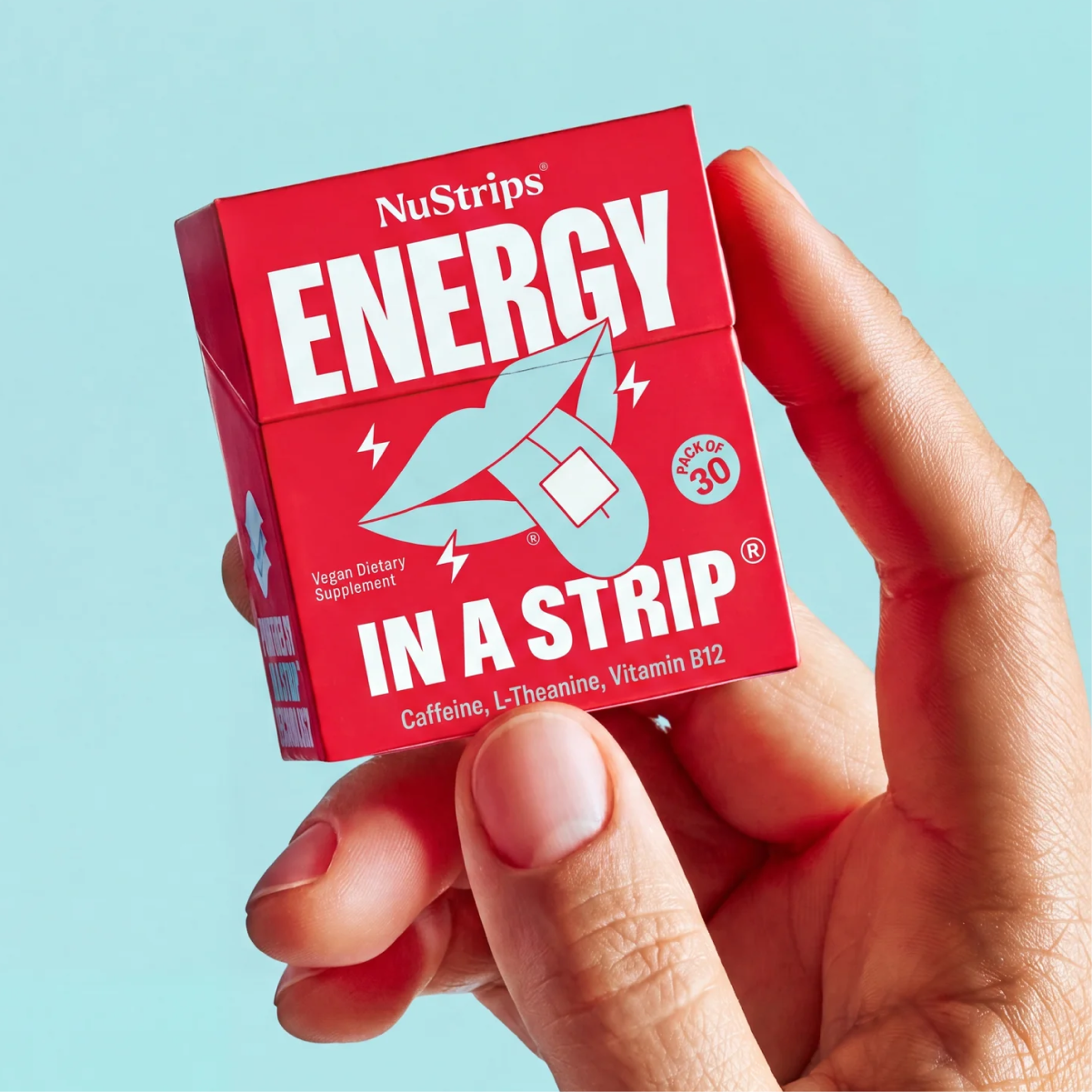
NuStrips created the oral strip supplement category — 20M+ strips sold since 2020. If you're new to the format, the first question is always the same: how fast do caffeine strips actually work? Below is the minute-by-minute timeline, the reason a strip has a head start on a brewed coffee or a gulped-down pill, how long the lift lasts, and what speeds it up or slows it down for your body specifically. Whether you're weighing a strip against your morning coffee, timing one before the gym, or just wondering why the last one didn't hit, this guide has the numbers. New to strips altogether? Start with what energy strips are, then come back here for the timing.
How fast do caffeine strips work?
A NuStrips Energy strip dissolves on your tongue in about 30 seconds. From there, most people notice the first lift in 5 to 15 minutes, and caffeine keeps climbing toward its peak in your bloodstream over the next 30 to 60 minutes. The strip feels quick for one reason: there's no cup to brew and no solid pill sitting in your stomach waiting to break down. Part of the dose crosses into your system through the tissues in your mouth the moment the strip melts, and the rest is absorbed as usual.
| Time after taking | What's happening | What you feel |
|---|---|---|
| 0:00 | Strip placed on your tongue | Berry-pomegranate flavor; no water needed |
| ~0:30 | Strip fully dissolved | Nothing yet — absorption is starting |
| 5–15 min | Caffeine crossing into your bloodstream | First clean lift; focus sharpens |
| 30–60 min | Caffeine nears peak levels | Full alertness, steadied by L-theanine† |
| ~5–6 hrs | About half the caffeine has cleared | Gentle taper, not a crash |
Those windows are typical, not a promise for every body — caffeine's measured time-to-peak ranges from about 15 to 120 minutes across individuals, mostly because of differences in metabolism and what's in your stomach. The strip's advantage isn't a magic number; it's that it removes the two slowest steps of a coffee or a pill: brewing and digestion.
It helps to separate two moments people often blur together. The first lift — that noticeable click of alertness — usually shows up in 5 to 15 minutes. The peak, when caffeine is at its highest level in your blood, comes later, around 30 to 60 minutes. You don't need to wait for the peak to get to work; the strip is doing its job well before then. That's exactly why timing a strip 15 to 30 minutes before a meeting, a drive, or a lift works so well.
The minute-by-minute timeline of a caffeine strip
Taking a strip is three simple steps, and each one maps to a stage of how the caffeine reaches you:



- 0:00 — Peel. Tear open the single-serve pouch and place one strip on your tongue. No water, no shaker, nothing to time.
- 0:30 — Dissolve. The strip melts in about 30 seconds. As it does, caffeine and L-theanine are already contacting the blood-vessel-rich tissues in your mouth.
- 5–15 min — Absorb. The first lift arrives. This is where a strip pulls ahead of a pill: caffeine has begun entering your bloodstream directly instead of waiting to be gulped down and digested.
- 30–60 min — Peak. Caffeine approaches its high point. With 50mg, that's a clear, workable alertness — not the wired, heart-racing feeling of a triple espresso or a big energy drink.
- A few hours — Taper. The lift fades gradually as caffeine clears, smoothed by L-theanine so there's no hard comedown.†
Why do strips work faster than coffee or a caffeine pill?
It comes down to where absorption starts. A caffeine capsule has to be gulped down with water, break apart in your stomach, and travel through digestion before the caffeine reaches your bloodstream — a process that typically takes 30 to 45 minutes to feel. A strip skips the line. It dissolves on your tongue, and a portion of the caffeine is absorbed straight through the tissues in your mouth, which are dense with blood vessels.
The tissues lining your mouth sit right on top of a network of small blood vessels, so a molecule that dissolves there can slip into circulation quickly rather than making the longer trip through your stomach and liver first. Caffeine is small and dissolves easily, which makes it well suited to starting its work this way.
This isn't marketing — it's how oral-tissue delivery behaves in the lab. In studies of caffeine delivered through the mouth (caffeinated chewing gum, the closest studied cousin to a strip), caffeine from gum reached its peak in roughly 45 to 80 minutes versus about 85 to 120 minutes from a gulped-down capsule — meaningfully sooner, at roughly 75 to 90% of the total dose. That "sooner" is the entire point of a strip.
The chart below plots how caffeine from a strip, a coffee, and an energy drink tends to climb and clear over time.
| Format | Caffeine | Prep | First felt | Nears peak |
|---|---|---|---|---|
| NuStrips Energy strip | 50mg | Dissolves ~30 sec, no water | ~5–15 min | ~30–60 min |
| Brewed coffee (8oz) | 80–100mg | Brew ~4–6 min | ~10–30 min | ~30–120 min |
| Caffeine pill/capsule | 100–200mg | Gulp with water | ~30–45 min | ~45–90 min |
| Energy drink (12–16oz) | 80–300mg | Chug | ~10–30 min | ~30–120 min |
Honest credit where it's due: brewed coffee isn't slow to be felt once it's in the cup, and it's cheap, warm, and a ritual people love. But you have to make it, it can be hard on an empty stomach, and a big afternoon cup carries enough caffeine to reach your bedtime. A strip trades the ritual for speed, portability, and precise dosing. There's a practical payoff, too: because a strip needs no water, no brewing, and no fridge, the fastest caffeine is also the one you'll actually reach for at your desk, in the car, mid-hike, or on a plane. For the full head-to-head, see our caffeine strips vs coffee breakdown.
How long does a caffeine strip last? The half-life and afternoon-crash math
Onset is only half the timing question — the other half is how long it stays. Caffeine's average half-life is about 5 to 6 hours, meaning roughly half the dose is still circulating that many hours after you take it. Run the math on a single 50mg strip taken at 3 p.m.: you're down to about 25mg by early evening and under 20mg near midnight — a small amount for most people.
Now compare a 16oz energy drink at around 160mg taken at the same 3 p.m. Half-life works the same way, so it still leaves roughly 80mg circulating at 8 p.m. — more than a full strip's worth of caffeine in your system at bedtime. That's the quiet reason big-caffeine afternoons wreck sleep: it's not just the amount, it's how long it lingers. (More on that trade-off in caffeine strips vs energy drinks.)
What you won't get from a well-dosed 50mg strip is the classic caffeine cliff — the jittery peak followed by a hard drop that sends you back for another cup. A smaller dose paired with L-theanine tends to rise and fall more gently, which is the whole design goal: usable focus that fades on its own instead of dropping you off a ledge.†
The research backs the timing. In a controlled trial, 400mg of caffeine taken even 6 hours before bed cut total sleep time by more than an hour (Drake et al., 2013). A strip is 50mg — one-eighth of that dose — so an afternoon strip is far gentler on sleep than a large coffee or an energy drink. Caffeine is still caffeine, though: if you're sensitive or want a solid night, finish your last strip about 6 hours before bedtime. And if the real problem is winding down at night, that's a job for melatonin, not more caffeine — see how fast melatonin strips work.
What affects how fast you feel a caffeine strip?
Two people can take the same strip and feel it differently. The main variables:
- Body weight. Caffeine spreads through your body water (about 0.5–0.75 L per kg), so the same 50mg reaches a higher concentration in a smaller person — they tend to feel it faster and stronger.
- Tolerance. Regular heavy caffeine use trains your brain to add adenosine receptors, so the same dose does less. A few lower-caffeine days brings the sensitivity back.
- Food in your stomach. A large meal slows how quickly the digested portion of any caffeine is absorbed. Because part of a strip absorbs through the tissues in your mouth, it's a little less at the mercy of a full stomach than a pill you gulp down.
- Smoking. Cigarette smoke revs up CYP1A2, the liver enzyme that breaks caffeine down, so smokers clear caffeine roughly 56% faster and feel it fade sooner.
- Genetics and medications. CYP1A2 gene variants make some people fast and others slow caffeine metabolizers — clearance can vary widely between individuals. Oral contraceptives, some antidepressants, and pregnancy slow caffeine breakdown and stretch the effect out. If any apply to you, talk to your doctor.
How L-theanine smooths the caffeine curve
Speed is one thing; how the energy feels is another. Each NuStrips Energy strip pairs its 50mg of caffeine with 30mg of L-theanine, an amino acid found in tea. On its own, caffeine can bring jitters and a hard comedown. L-theanine takes the edge off. In controlled trials, the caffeine-and-L-theanine pairing improved the speed and accuracy of attention-switching and reduced susceptibility to distraction more than caffeine alone (Owen et al., 2008; Giesbrecht et al., 2010).† L-theanine raises alpha brain-wave activity — the pattern linked with calm, focused alertness — so the lift comes in smoother and tapers gently instead of spiking and crashing. That's what "clean energy, no crash" actually means.† The strip pairs caffeine with L-theanine — the same combination those studies tested — and a touch of vitamin B12 (6mcg, 250% DV, as methylcobalamin) rounds it out to support normal energy metabolism.† That combination is why people reach for a strip for focused work, studying, long drives, and afternoon slumps rather than just raw wakefulness.
Why isn't my caffeine working?
If a strip — or your usual coffee — has stopped doing much, the cause is usually one of these:
- Tolerance. The most common reason. Heavy daily caffeine dulls the response; a few lower-caffeine days reset it.
- Timing. Caffeine prevents a slump better and faster than it reverses one you're already deep in. Take your strip before the wall — mid-morning or right after lunch — not at the bottom.
- Dehydration. Mild dehydration feels a lot like caffeine wearing off. Drink water first, then judge.
- Sleep debt. Caffeine masks tiredness; it doesn't repay it. If you're chronically short on sleep, no dose will feel like enough.
- Under-dosing for your body. A larger or higher-tolerance person may barely register 50mg. You can take a second strip — just keep your daily caffeine under about 400mg total (see the FAQ).
How to take a NuStrips Energy strip
Three steps: Peel the single-serve pouch, Dissolve the strip on your tongue (about 30 seconds, no water, no chewing), and Absorb — the caffeine and L-theanine pass through the tissues in your mouth for a fast, clean lift. For a workout or a focus block, take it 15 to 30 minutes ahead so the caffeine is climbing toward peak right when you need it. One strip is 50mg — about half a cup of coffee — so it's easy to dose to the moment instead of over-caffeinating. Curious how it ranks against other brands? See the best energy strips of 2026, and read the research behind each ingredient in the science behind NuStrips.
Press has taken notice of the format: Forbes called it "like something out of a science fiction novel," NBC "an incredibly easy way to take nutritional supplements," and CBS "a revolution in nutrition technology." Across the catalog, NuStrips holds 10,000+ verified reviews, and every order is backed by a 60-day money-back guarantee.
References
- Alsabri SG, et al. "Kinetic and Dynamic Description of Caffeine." Journal of Caffeine and Adenosine Research, 2018. journals.sagepub.com
- Kamimori GH, et al. "The rate of absorption and relative bioavailability of caffeine administered in chewing gum versus capsules to normal healthy volunteers." International Journal of Pharmaceutics, 2002. sciencedirect.com
- Wickham KA, Spriet LL. "Administration of Caffeine in Alternate Forms." Sports Medicine, 2018. pmc.ncbi.nlm.nih.gov
- Owen GN, et al. "The combined effects of L-theanine and caffeine on cognitive performance and mood." Nutritional Neuroscience, 2008. pubmed.ncbi.nlm.nih.gov
- Giesbrecht T, et al. "The combination of L-theanine and caffeine improves cognitive performance and increases subjective alertness." Nutritional Neuroscience, 2010. pubmed.ncbi.nlm.nih.gov
- "The role of adenosine receptors in the central action of caffeine." PMC, 2010. pmc.ncbi.nlm.nih.gov
- Drake C, et al. "Caffeine Effects on Sleep Taken 0, 3, or 6 Hours before Going to Bed." Journal of Clinical Sleep Medicine, 2013. jcsm.aasm.org
- U.S. Food & Drug Administration. "Spilling the Beans: How Much Caffeine is Too Much?" fda.gov
† These statements have not been evaluated by the Food and Drug Administration. This product is not intended to diagnose, treat, cure, or prevent any disease.