Caffeine Strips vs Energy Drinks: Clean 50mg, Zero Sugar (2026)
Last updated: 2026-07-02
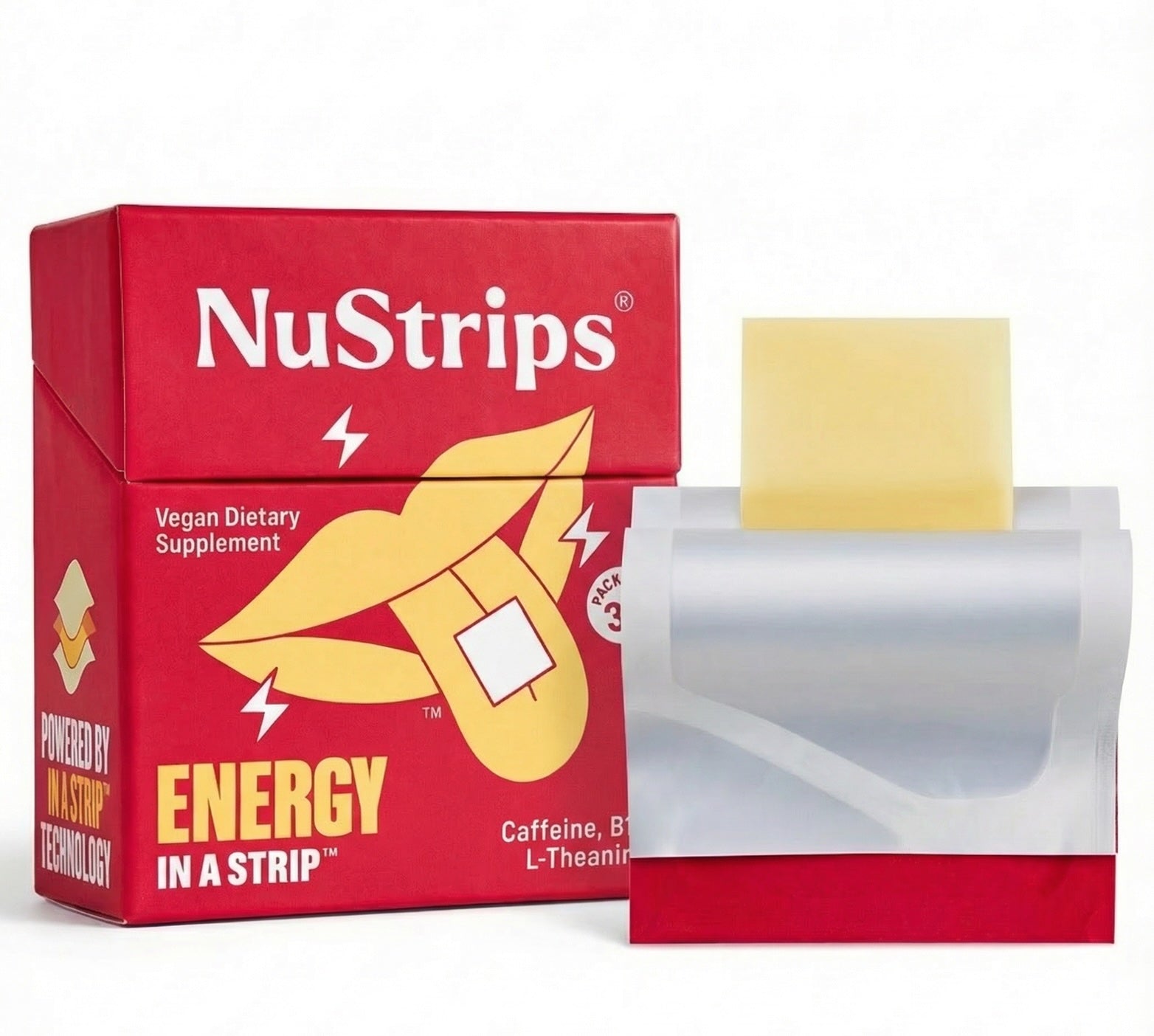
A NuStrips Energy strip and an energy drink both deliver caffeine, but that's where the overlap ends. One strip gives you 50mg of caffeine paired with 30mg of L-theanine and zero sugar — it dissolves on your tongue for a fast, clean lift, without the 27–54g of sugar, taurine, or over-caffeination packed into a can.
If you've ever felt wired and then wrecked an hour after a Monster, you already know the problem with energy drinks: they answer tiredness by throwing a huge dose of caffeine and a pile of sugar at it. This guide breaks down the real numbers — caffeine, sugar, calories, and additives — and explains why a 50mg strip built around a caffeine-and-L-theanine pairing gives you focus without the jitters or the crash. NuStrips Energy strips were built for exactly this. NuStrips created the oral strip supplement category — 20M+ strips sold since 2020, backed by 10,000+ verified reviews across the range.
Key takeaways
- One NuStrips Energy strip has 50mg of caffeine and 0g of sugar — versus 27g of sugar in a Red Bull and 54g in a 16oz Monster.
- Popular energy drinks range from 80mg (Red Bull) to 300mg (Bang) of caffeine per serving; a strip's 50mg is a modest, controllable dose — about half a cup of coffee.
- The sugar in a regular energy drink can spike your blood glucose and set up a rebound crash one to three hours later. A zero-sugar strip skips that cycle.
- Strips pair caffeine with L-theanine, an amino acid from tea that clinical trials show sharpens focus and blunts caffeine's jitters — most energy drinks contain none.
- Strips are solid, so they clear airport security freely; a full can of energy drink does not pass the TSA 3.4oz carry-on liquid limit.
How much caffeine and sugar are in an energy drink vs a caffeine strip?
Here is the side-by-side that most "energy drink comparison" pages skip. Caffeine is only half the story — sugar, calories, and additives are where a can and a clean strip really split apart. One NuStrips Energy strip delivers 50mg of caffeine and 0g of sugar; the drinks below carry between 80mg and 300mg of caffeine and, in the regular versions, a full day's worth of sugar or more.
| Product | Serving | Caffeine | Sugar | Calories | L-theanine | Notable additives |
|---|---|---|---|---|---|---|
| NuStrips Energy strip | 1 strip | 50mg | 0g | ~0 | 30mg | B12 (methylcobalamin); monk fruit + stevia; no taurine |
| Red Bull | 8.4 oz can | 80mg | 27g | 110 | none | Taurine, B-vitamins |
| Monster Energy | 16 oz can | 160mg | 54g | 210 | none | Taurine, guarana, B-vitamins |
| Celsius | 12 oz can | 200mg | 0g | 10 | none | Guarana, green tea extract, sucralose |
| Bang | 16 oz can | 300mg | 0g | 0 | none | Creatine, BCAAs, sucralose + acesulfame potassium |
Two things jump out. First, the caffeine spread: a strip's 50mg is roughly half a cup of coffee, while a single Bang carries 300mg — three-quarters of the FDA's 400mg-a-day ceiling for healthy adults, in one can. Second, the sugar: a regular 16oz Monster's 54g is more than a full day's added-sugar allowance under American Heart Association guidance, which caps added sugar at 36g for men and 25g for women. You can blow past your sugar limit for the day with one drink, before you have eaten a thing.
What does one caffeine strip feel like, and how fast does it kick in?
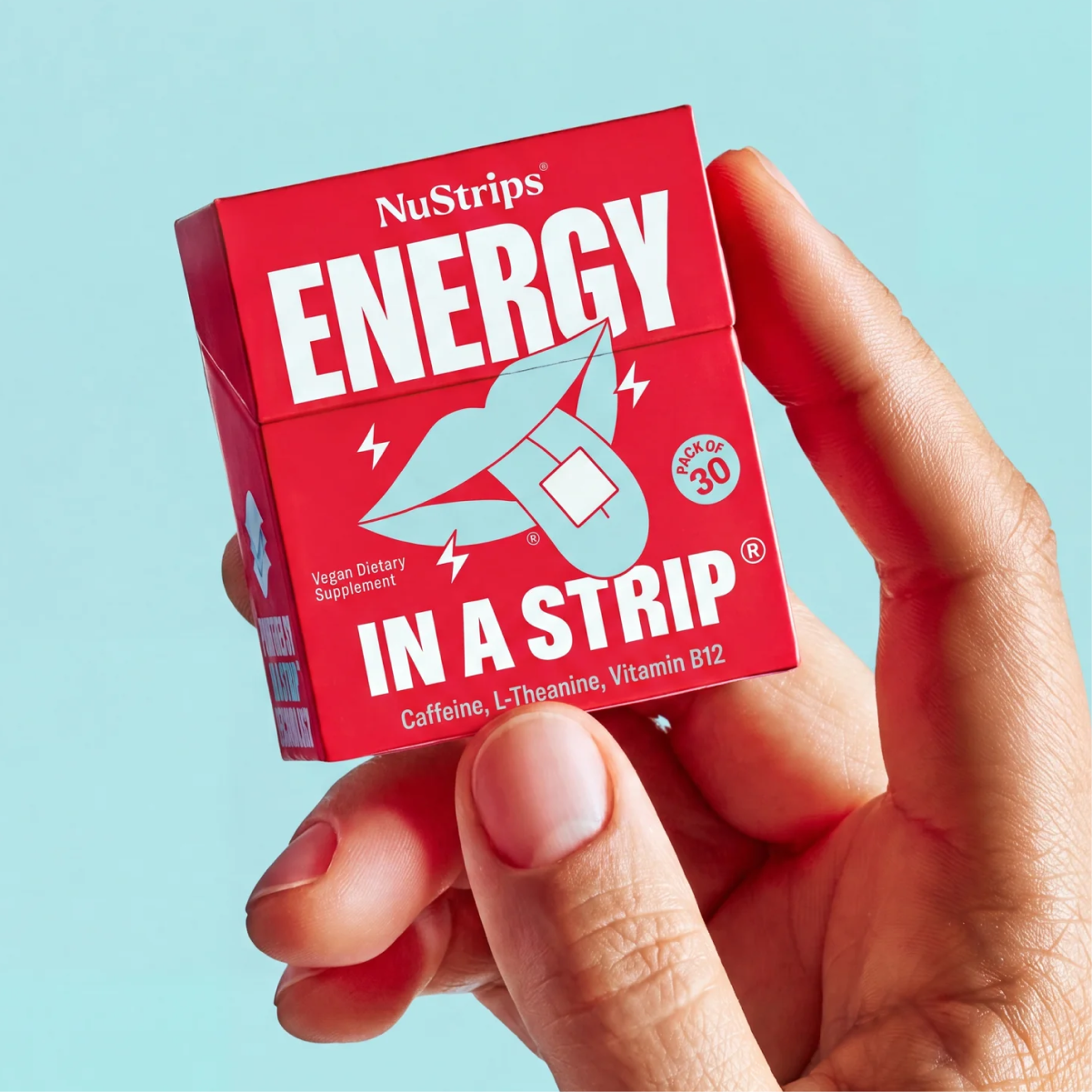
A strip is not a slow-release capsule you gulp down with water, and it is not a 16oz can you nurse for an hour. It is a fast, contained dose. The routine is three steps:
- Peel — tear open the single-serve pouch.
- Dissolve — place the strip on your tongue. It dissolves in about 30 seconds — no water, no chewing.
- Absorb — the caffeine and L-theanine pass through the tissues in your mouth into your bloodstream for a fast, clean lift.
Because part of the dose is taken up through the mouth instead of waiting on digestion, most people feel the lift within about 5–15 minutes, versus the roughly 30–45 minutes it takes a chugged drink or a gulped-down pill to work through the stomach. The feel is "focused," not "buzzing" — the L-theanine keeps the curve smooth. For the full minute-by-minute breakdown, see how fast caffeine strips work.
Why do energy drinks make you crash?
Two separate mechanisms stack up, and the sugary drinks trip both. Here is what the caffeine-absorption curve actually looks like across a strip, a coffee, and an energy drink.
The sugar crash
When you chug a sugary drink, 27–54g of fast sugar hits your bloodstream in minutes. Blood glucose spikes within roughly 15–30 minutes, your pancreas floods insulin to bring it back down, and that insulin response tends to overshoot — pulling blood sugar below your normal baseline. The result is reactive (rebound) hypoglycemia: the foggy, irritable, hungry, tired feeling that shows up one to three hours after the can. Then you crave more sugar, and the loop repeats. A zero-sugar strip never starts that cycle — there is no glucose spike to overshoot.
The caffeine cliff
Caffeine works by blocking adenosine, the brain chemical that signals drowsiness. The bigger the dose, the more adenosine is dammed up behind it — and caffeine's half-life is roughly five to six hours, so a 200–300mg hit lingers, then tapers hard as the adenosine floods back in. A modest 50mg dose creates a smaller, smoother curve with far less to come down from. Pair it with L-theanine and the edge softens further. That is the whole idea behind "clean energy, no crash."†
Dehydration piles on
Caffeine is a mild diuretic, so a very high dose can nudge you toward mild dehydration — which itself reads as fatigue and brain fog. Stack that on top of a sugar crash and a caffeine taper and you get the classic "why am I more tired than before I drank it" slump. A modest 50mg dose and a glass of water sidestep most of that.
The half-life math matters for sleep, too. Because caffeine can linger five to six hours, an afternoon energy drink at 200mg can still have meaningful caffeine in your system at bedtime. If it is already late and you want to wind down instead, that is a job for our sleep strips, not another stimulant.
Does caffeine paired with L-theanine really beat a straight caffeine hit?
Yes — and this is the single biggest difference between a strip and a can. L-theanine is an amino acid found naturally in green tea. On its own it promotes a calm, focused alertness. Paired with caffeine, it is one of the most-studied combinations in cognitive research, and the trials keep landing in the same place.
In a 2008 study in Nutritional Neuroscience, 50mg of caffeine with 100mg of L-theanine — almost exactly the strip's ballpark — improved the speed and accuracy of attention-switching and made participants less susceptible to distraction than caffeine alone (Owen et al.). A separate 2008 trial in Biological Psychology found the combination produced faster reaction times, fewer headaches, and higher alertness than either ingredient by itself (Haskell et al.). A 2010 study reported the pairing lifted subjective alertness and cut tiredness (Giesbrecht et al.). The through-line across all three: L-theanine keeps the focus while trimming the jitters — the exact edge that pure high-dose caffeine tends to bring.
Most energy drinks give you the caffeine and none of the L-theanine, which is why "more milligrams" often backfires: past a point, extra caffeine buys you jitters and a harder landing, not more focus. You can read the full breakdown of the science behind the caffeine-and-L-theanine pairing on our science hub.
Clean label vs taurine and synthetic blends
Energy drinks lean on taurine, guarana (which is really just more caffeine), and synthetic sweeteners like sucralose and acesulfame potassium. Sugar-free cans trade the sugar crash for a stack of artificial sweeteners; regular cans keep the sugar. A NuStrips Energy strip keeps its active list short: caffeine 50mg, L-theanine 30mg, and vitamin B12 6mcg (methylcobalamin, 250% DV), which supports normal energy metabolism.† It is sweetened with monk fruit and stevia and colored with red beet powder — no taurine, no sugar, no artificial colors.
Are sugar-free energy drinks like Celsius and Bang a better option?
Sugar-free cans fix one problem and lean into another. Dropping to 0g of sugar removes the reactive-hypoglycemia crash — a genuine improvement over a 54g Monster. But Celsius runs about 200mg of caffeine and Bang about 300mg in a single can, which is a large, fixed dose you cannot dial back once it is open. For context, 300mg is three-quarters of the FDA's 400mg daily ceiling for healthy adults, in one sitting.
They also swap sugar for synthetic sweeteners such as sucralose and acesulfame potassium, and add stimulant extras like guarana (more caffeine) or creatine and BCAAs. If you specifically want a heavy pre-workout hit, that can be the point. But if you are trying to stay sharp through a normal workday, a 200–300mg can is easy to overdo — and it is still a liquid you cannot carry through airport security. A 50mg strip gives you the zero-sugar benefit and the dose control, without committing you to a triple-shot of caffeine.
Can you control your caffeine dose better with a strip than an energy drink?
Yes — dose control is the quiet advantage, and it is the one people notice within a week. A can is an all-or-nothing unit: once you crack a 200mg Celsius or a 300mg Bang, you have committed to the whole dose, and it is easy to reach for a second. A strip is 50mg, full stop.
Need a small lift before a meeting? One strip. Long drive or a brutal 3 p.m.? Take a second, deliberately, and you are still at 100mg — a third of a single Bang. You titrate to the task instead of over-caffeinating by default. The FDA's guidance of up to 400mg a day for healthy adults leaves most people plenty of room; the point is that strips let you decide exactly where you land instead of a beverage company deciding for you. If you would rather compare against your morning cup, see how caffeine strips vs coffee stack up.
Can you take caffeine strips through airport security?
This is where strips quietly win travel, and almost nobody points it out. Energy drinks are liquids, so they fall under the TSA's 3-1-1 rule: nothing over 3.4oz (100ml) in your carry-on. A full 8.4oz Red Bull or a 16oz Monster will not clear the checkpoint — you either chug it before security or buy an overpriced can at the gate.
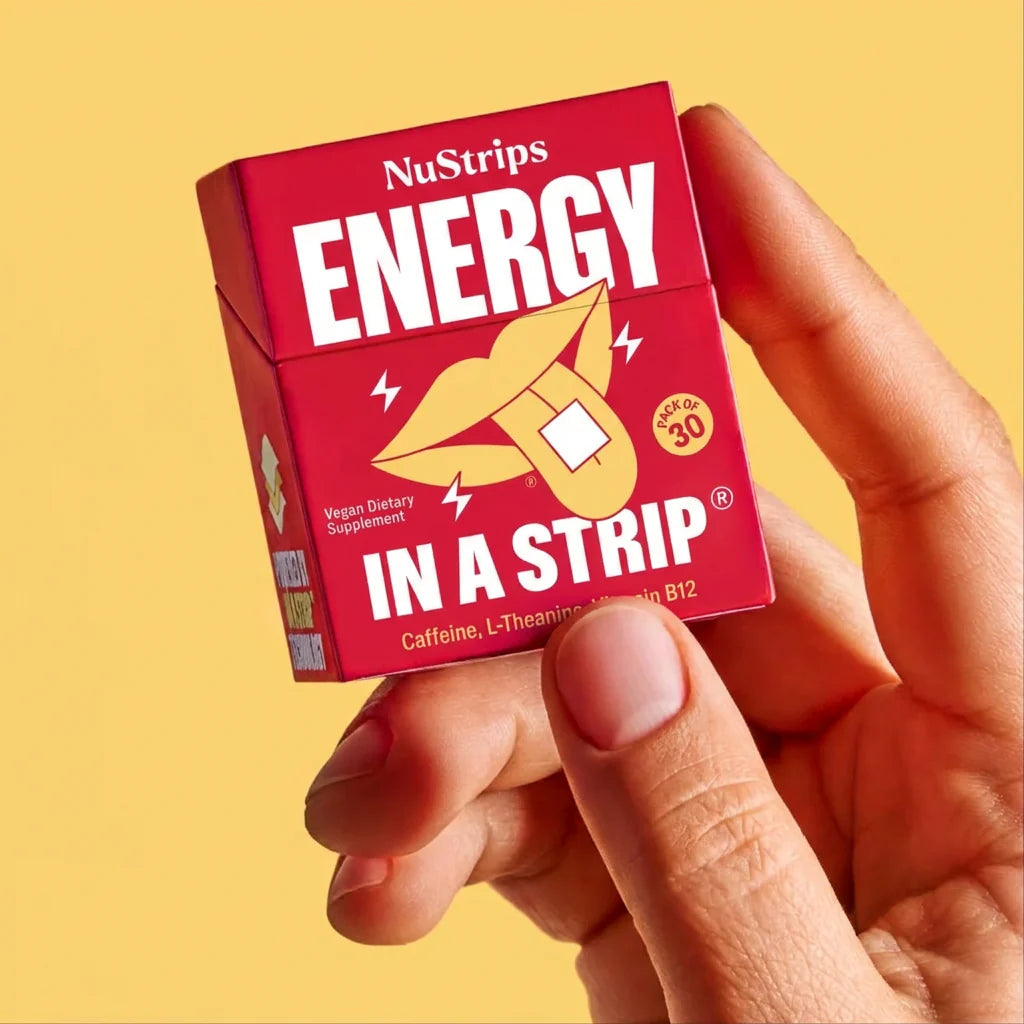
Strips are solid. A 30-strip pack is the size of a card, drops into any pocket or bag, and passes security with zero liquid restrictions. The same logic applies to a commute, a hike, a festival, or a desk drawer: no can, no spill, no refrigeration, no melting ice. For anyone who moves during the day, that portability is a real, everyday edge over a beverage — and it is exactly the kind of thing that made people ask what energy strips are in the first place.
How do I switch from energy drinks to caffeine strips?
If you are used to a 200mg can, jumping to a single 50mg strip can feel light on day one — that is tolerance talking, not the strip underperforming. Ease down instead of white-knuckling it:
- Morning: one strip in place of your first can. Add a coffee if you genuinely need more, and let your tolerance reset over a week or two.
- Afternoon slump: one strip around 1–3 p.m. instead of a second can — 50mg is enough to clear the fog without wrecking your sleep.
- Pre-workout or a long drive: one strip 10–15 minutes before, since it kicks in fast and there is no liquid to weigh you down.
- Travel: keep a pack in your bag for flights and time-zone resets, where a can is either stopped at security or nowhere to be found.
Keep your daily total within the FDA's 400mg guidance for healthy adults, skip caffeine within about six hours of bedtime, and you will feel steadier energy across the day rather than a string of peaks and crashes.
Should you choose a caffeine strip or an energy drink?
Honest version — each has a lane, and energy drinks deserve credit where it is due.
Choose a caffeine strip if you want:
- A clean, controllable 50mg dose with zero sugar and no crash cycle
- Focus over raw stimulation — the caffeine-and-L-theanine pairing
- Something pocketable for travel, the office, a workout, or the car
- A short, clean label: no taurine, no sugar, no artificial colors
An energy drink may suit you if you want:
- A cold, flavored drink you sip over time — it is a beverage as much as a stimulant
- A very high caffeine load in one serving (though 200–300mg is not for everyone)
- Something already stocked on every gas-station and vending shelf right now
Energy drinks genuinely win on taste, cold refreshment, and sheer availability. But if what you are really after is clean focus without the sugar, without over-caffeinating, and without the mid-afternoon collapse, the strip is the better tool. For a full head-to-head of the category, see our ranking of the best energy strips of 2026.
Sources
- U.S. Food & Drug Administration. "Spilling the Beans: How Much Caffeine is Too Much?" — up to 400mg/day is generally safe for healthy adults; 200mg/day in pregnancy. fda.gov
- American Heart Association. "How Much Sugar Is Too Much?" — added-sugar limits of 36g/day for men and 25g/day for women. heart.org
- Red Bull (official). Energy Drink ingredients — 80mg caffeine and 27g sugar per 8.4 fl oz can. redbull.com
- Owen GN, Parnell H, De Bruin EA, Rycroft JA. "The combined effects of L-theanine and caffeine on cognitive performance and mood." Nutritional Neuroscience. 2008;11(4):193–198. PubMed
- Haskell CF, Kennedy DO, Milne AL, Wesnes KA, Scholey AB. "The effects of L-theanine, caffeine and their combination on cognition and mood." Biological Psychology. 2008;77(2):113–122. ScienceDirect
- Giesbrecht T, Rycroft JA, Rowson MJ, De Bruin EA. "The combination of L-theanine and caffeine improves cognitive performance and increases subjective alertness." Nutritional Neuroscience. 2010;13(6):283–290. PubMed
- Transportation Security Administration. "Liquids, Aerosols, and Gels (3-1-1) Rule" — 3.4oz/100ml carry-on limit for liquids. tsa.gov
- Seifert SM, Schaechter JL, Hershorin ER, Lipshultz SE. "Health Effects of Energy Drinks on Children, Adolescents, and Young Adults." Pediatrics (American Academy of Pediatrics). 2011;127(3):511–528. AAP
- Healthline. "Rebound Hypoglycemia: Understanding Reactive Low Blood Sugar" — insulin overshoot after rapid sugar intake. healthline.com
- Mayo Clinic. "Caffeine: How much is too much?" — caffeine half-life and the 400mg-a-day guideline. mayoclinic.org
† These statements have not been evaluated by the Food and Drug Administration. This product is not intended to diagnose, treat, cure, or prevent any disease.