Caffeine Strips vs Coffee: Faster, Cleaner Energy (2026)
Last updated: 2026-07-02
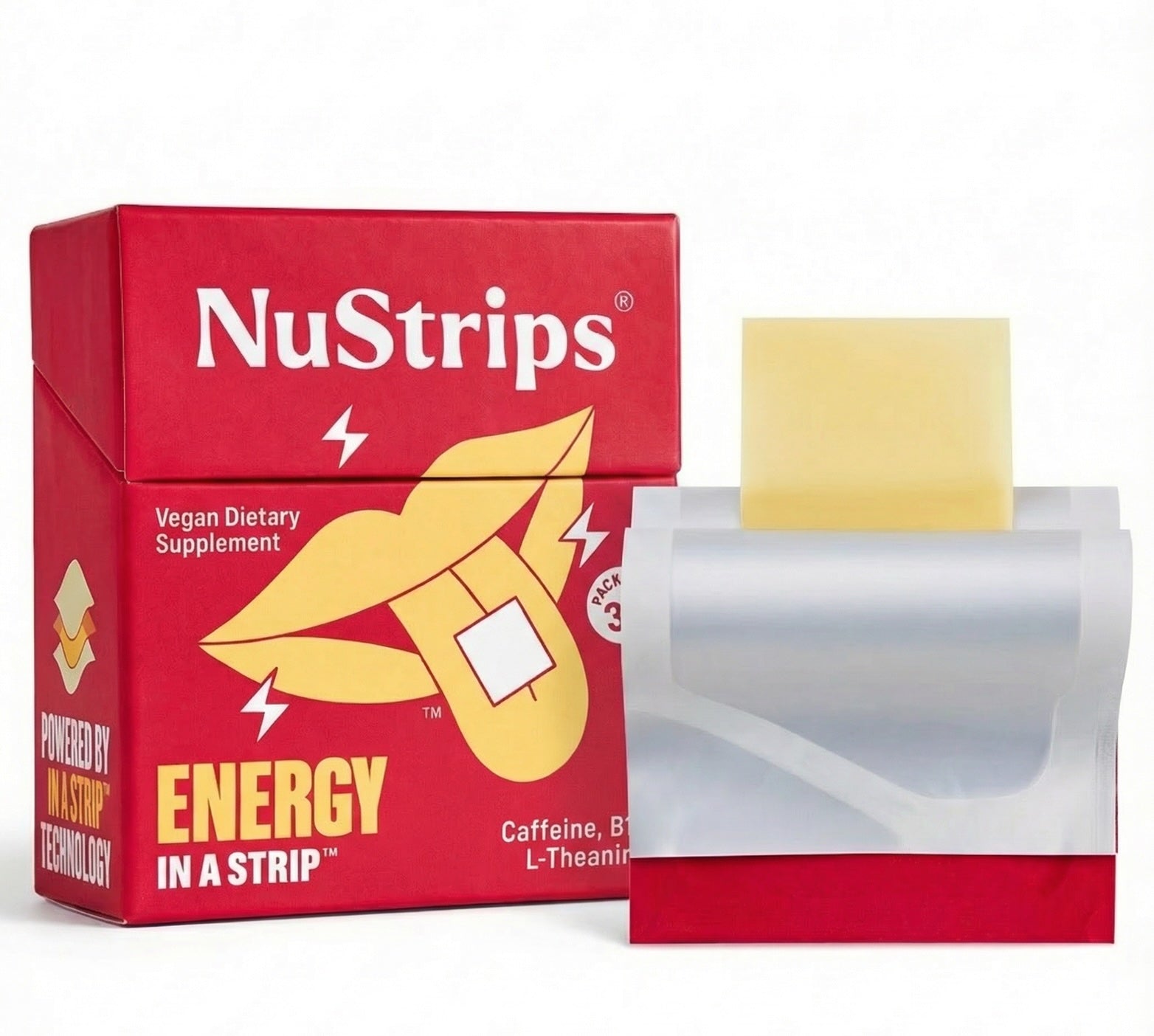
A NuStrips Energy caffeine strip and coffee both run on caffeine — but they behave differently. One strip carries 50mg of caffeine (about half a cup of coffee) plus 30mg of L-theanine, dissolves on your tongue in about 30 seconds, and gives a clean, jitter-free lift most people feel within 5 to 15 minutes.
Coffee is a ritual, and a good one. But the ritual comes bundled with things you didn't order: acid on an empty stomach, tannins that stain your teeth, a caffeine load that swings from 60mg to 200mg+ depending on who poured it, and a half-life long enough that a 3 p.m. cup can still be circulating at bedtime. A caffeine strip strips all of that back to the part you actually want — a fixed, modest dose of caffeine paired with L-theanine, the amino acid coffee doesn't have. This guide breaks down the caffeine numbers, the onset math, and exactly when each one wins.
Key takeaways
- One NuStrips Energy strip delivers 50mg of caffeine — roughly half an 8-oz cup of coffee — plus 30mg of L-theanine to keep the lift smooth.
- A strip dissolves on your tongue in about 30 seconds and most people feel it in 5 to 15 minutes, versus roughly 30 to 45 minutes for coffee, which has to be digested first.
- L-theanine is coffee's missing ingredient — the tea amino acid clinically shown to pair with caffeine for focus without the jitters.†
- Strips skip coffee's stomach acid, tannin stains, and bathroom urgency, and they carry zero sugar (sweetened with monk fruit, stevia, xylitol, and erythritol).
- Caffeine's roughly 5-hour half-life means an afternoon coffee can linger past bedtime; a smaller, fixed 50mg strip is far easier to time.
What's the difference between a caffeine strip and coffee?
Coffee is brewed water that pulls caffeine, acids, oils, and tannins out of roasted beans. A caffeine strip is a thin, dissolvable film — about the size of a breath strip — pre-loaded with an exact dose of caffeine and a few supporting ingredients, and nothing else. You place it on your tongue, it melts in about 30 seconds, and the actives pass through the tissues in your mouth into your bloodstream. No mug, no machine, no water, no wait for a pot to brew.
NuStrips created the oral strip supplement category — 20M+ strips sold since 2020. Each NuStrips Energy strip is built on three actives: 50mg of caffeine for alertness, 30mg of L-theanine to smooth caffeine's edge, and 6mcg of vitamin B12 (methylcobalamin, 250% of the Daily Value) to support normal energy metabolism.† Coffee, by contrast, delivers caffeine plus whatever the roast, grind, and pour happen to produce that morning — but no L-theanine and no fixed dose. You can read more about the format on our science of oral strips hub, or start with the basics in what energy strips are.
The mechanism underneath both is the same: caffeine blocks adenosine, the brain chemical that builds up through the day and makes you feel drowsy. Block the drowsiness signal and alertness rises. Where the strip pulls ahead is what rides alongside the caffeine — and how fast it gets in.
How much caffeine is in a strip vs a cup of coffee?
This is where most people are surprised. A cup of coffee is not a fixed dose — it's a range, and a wide one. Mayo Clinic lists an 8-ounce cup of brewed coffee at roughly 96mg of caffeine, and a single 1-ounce espresso shot at about 64mg. But an 8-ounce pour can climb to 165mg, a large diner mug or a coffee-shop "grande" can run 150 to 200mg, and a big cold brew — steeped 12 to 24 hours at a high coffee-to-water ratio — regularly tops 200mg. A NuStrips Energy strip is a flat, predictable 50mg every time.
| Metric | NuStrips Energy strip | Brewed coffee (8 oz) | Espresso (1 shot) | Cold brew (large) |
|---|---|---|---|---|
| Caffeine | 50 mg (fixed) | ~95 mg (80–165) | ~64 mg | ~200 mg+ |
| L-theanine (anti-jitter) | 30 mg | none | none | none |
| Added sugar | 0 g | 0 g (black) | 0 g | 0 g (black) |
| Onset (time to feel it) | ~5–15 min | ~30–45 min | ~30–45 min | ~30–45 min |
| Water / brewing needed | none | yes | machine | 12–24 hr steep |
| Stomach acid load | none | acidic | acidic | acidic |
| Stains teeth (tannins) | no | yes | yes | yes |
| Dose control | fixed 50 mg | varies by pour | varies | easy to over-pour |
| Pocketable / travel | yes | no | no | no |
The takeaway isn't that coffee has "too much" caffeine — 95mg is a fine morning dose for most people. It's that coffee doesn't tell you what you're getting, and the number moves every time. If you're stacking a morning cup, a mid-morning refill, and an afternoon pick-me-up, the math adds up quietly. A strip's fixed 50mg makes it easy to know exactly where you stand — especially useful if you want a small top-up without committing to another full mug. For a side-by-side on the sugary end of the spectrum, see caffeine strips vs energy drinks.
Which works faster — a caffeine strip or coffee?
When you drink coffee, the caffeine has to travel down to your stomach and small intestine and absorb from there. Peak caffeine levels in the blood typically land 30 to 60 minutes after you drink it, and the effect you actually notice usually shows up somewhere around 30 to 45 minutes in — later if you drank it with a big breakfast, since food slows things down.
A strip takes a shorter route. Because it dissolves on your tongue and the caffeine and L-theanine move through the thin, blood-vessel-rich tissues in your mouth, a meaningful share reaches your bloodstream without waiting on digestion. Most people feel a NuStrips Energy strip within about 5 to 15 minutes — fast enough to catch a slump before it flattens you, instead of gulping down a pill with water or brewing a pot and hoping it lands before your meeting. If speed is your main question, we go deeper in how fast caffeine strips work.

Why does coffee give you jitters and a crash — and a strip doesn't?
Two reasons: dose and what's missing. Jitters are largely a dose problem — a 200mg cold brew on an empty stomach hits far harder than a 50mg strip. But the bigger difference is L-theanine, the amino acid found naturally in tea and absent from coffee.
The caffeine-and-L-theanine pairing is one of the better-studied combinations in the nootropic literature. In a placebo-controlled crossover study, Owen and colleagues (Nutritional Neuroscience, 2008) found that 50mg of caffeine with 100mg of L-theanine improved both the speed and accuracy of an attention-switching task and reduced susceptibility to distraction — improvements that plain caffeine didn't match. Haskell and colleagues (Biological Psychology, 2008) reported the same pattern: the combination improved reaction time, working memory, and self-rated alertness beyond what either ingredient did alone. The consistent finding is that L-theanine keeps the alertness while taking the edge off — focus without the jitters.† That's why NuStrips builds L-theanine into every Energy strip at 30mg, a ratio of roughly 1.7:1 caffeine-to-theanine that sits inside the range studied in the research above.
The "crash" is the other half. As caffeine wears off, the adenosine it was blocking floods back and drowsiness can rebound — and a bigger dose means a bigger swing. A modest 50mg strip produces a gentler curve than a jumbo coffee, so there's less of a cliff on the way down. That's the whole idea behind clean energy, no crash.
What does coffee do to your body that a caffeine strip doesn't?
Coffee is more than caffeine, and the extras aren't always welcome:
- Stomach acid. Coffee both stimulates gastric acid and relaxes the lower esophageal sphincter — the valve that keeps stomach contents down. A classic New England Journal of Medicine study documented both effects, which is why coffee can trigger heartburn or an unsettled stomach, especially first thing in the morning. A strip contains no coffee oils or acids to irritate your gut.
- Teeth staining. Coffee's tannins bind to the proteins in tooth enamel, and its acidity temporarily softens enamel so pigments stick — the mechanism dentists point to for that gradual yellow tint. A clear, sugar-free strip leaves nothing behind to stain.
- Bathroom urgency. Coffee is a well-known stimulant of the digestive tract and a mild diuretic. Great at home; less great mid-commute or mid-flight. A 50mg strip doesn't come with the same "find a restroom" clock.
- Dose creep and jitters. Because a cup's caffeine varies so much, it's easy to over-caffeinate without realizing it. A fixed 50mg strip removes the guesswork.
None of this makes coffee bad — for a lot of people it's part of a healthy routine. It just means coffee carries baggage that a single-purpose caffeine strip doesn't.
Will an afternoon coffee wreck your sleep?
Often, yes — and the culprit is caffeine's half-life. In healthy adults, caffeine's half-life averages around 5 hours (studies put the range at roughly 4 to 6 hours, longer for some people). "Half-life" means half the dose is still in your system after that window. So a 150mg afternoon coffee at 3 p.m. leaves roughly 75mg circulating at 8 p.m. and about 37mg near midnight.
That residue matters more than people think. In a controlled study, Drake and colleagues (Journal of Clinical Sleep Medicine, 2013) gave 400mg of caffeine at 0, 3, and even 6 hours before bed — and found that even the 6-hours-before dose measurably cut total sleep time by more than an hour. The practical rule: keep meaningful caffeine at least 6 hours away from bedtime. A smaller 50mg strip is simply easier to fit inside that window than a 150 to 200mg afternoon cup — and if the goal is protecting your sleep, that's a real advantage. When it's actually time to wind down, that's a job for a different tool entirely; see how fast melatonin strips work.
Should you choose a caffeine strip or coffee?
Honestly, it isn't always either/or. Here's the clean decision:
Choose a caffeine strip if…
- You want a fast, fixed, jitter-free lift and dislike the coffee shakes.
- Coffee bothers your stomach, stains your teeth, or sends you to the bathroom at bad times.
- You're commuting, flying, at the gym, or somewhere with no kettle — a strip lives in your pocket and a large mug doesn't clear airport security.
- You need a controlled afternoon top-up without a full cup wrecking your sleep.
- You want zero sugar and near-zero calories with your caffeine.
Choose coffee if…
- The ritual is the point — the warmth, the smell, the ten quiet minutes with a mug.
- You genuinely love the taste and look forward to it.
- You want the highest caffeine hit in one go, and your stomach and sleep can handle it.
- Cost-per-cup at home is hard to beat.
Plenty of people keep their morning coffee and reach for a strip at 2 p.m. instead of a second cup — you get the ritual in the morning and a clean, sleep-friendly top-up later. If you want to see how NuStrips stacks up against every other strip on the market, we ranked them in the best energy strips of 2026.
How to swap in a strip
It takes about 30 seconds and no water:
- Peel — tear open the single-serve pouch.
- Dissolve — place the strip on your tongue. It melts in about 30 seconds — no water, no chewing.
- Absorb — the caffeine and L-theanine pass through the tissues in your mouth into your bloodstream for a fast, clean lift.
Every order is backed by a 60-day money-back guarantee, ships within 24 hours, and includes free US shipping over $40 — so trading one afternoon cup for a strip is a low-stakes test. Curious what actual customers say? Browse our 10,000+ verified customer reviews.
Frequently asked questions
Is a caffeine strip stronger than coffee?
No — a single strip is intentionally lighter. It delivers 50mg of caffeine, versus roughly 95mg in an 8-oz cup of brewed coffee and 150 to 200mg+ in a large or cold brew. What a strip does better is get in faster and pair the caffeine with L-theanine for a smoother, more focused lift, rather than simply hitting harder.
How many cups of coffee does one strip equal?
Roughly half an 8-oz cup of brewed coffee, or a little under one espresso shot. At 50mg, one strip is a modest, controlled dose — closer to a half-cup than a full mug.
Can I use a caffeine strip before a workout?
Many people do, precisely because of the speed and dose control — a strip can be timed in the 5-to-15-minute window before you train without a stomach full of liquid sloshing around, and 50mg is an easy dose to stack toward your personal pre-workout target. Everyone's caffeine tolerance is different, so start low and see how you respond. If you have a heart condition or take medication, talk to your doctor first.
Will caffeine strips stain my teeth?
No. Coffee stains teeth because its tannins bind to enamel and its acidity makes enamel more porous. NuStrips Energy strips are clear, sugar-free, and contain no tannins or coffee pigments, so there's nothing to leave a stain behind.
Can I take a caffeine strip and coffee together?
You can, but count your total caffeine. A strip (50mg) plus an 8-oz coffee (~95mg) is about 145mg — well within the FDA's 400mg-per-day guidance for healthy adults, but worth tracking if you're sensitive or add more cups later in the day. Many people use the strip specifically to replace a second or third coffee rather than add to it.
Do caffeine strips cause a crash like coffee?
They're designed to avoid it. The crash comes from a big caffeine dose wearing off and adenosine rebounding. A modest 50mg dose paired with L-theanine — the amino acid clinically shown to smooth caffeine's effects — produces a gentler curve and a softer landing than a jumbo coffee.†
Will a caffeine strip upset my stomach the way coffee can?
It shouldn't. Coffee can irritate the stomach because it stimulates gastric acid and relaxes the valve at the top of the stomach. A strip contains no coffee oils or acids and isn't taken with a large volume of liquid, so it's a gentler option for people whose stomachs don't love coffee — especially first thing in the morning.
Can I use a caffeine strip instead of my morning coffee?
Yes. A strip gives you a fast, clean 50mg lift with no brewing and no acid. If you're used to a stronger morning cup, note that 50mg is lighter than a typical coffee, so you may prefer a strip as an afternoon replacement and keep coffee for that first hit — or use a strip and simply expect a smoother, more moderate start.
How many caffeine strips are safe in a day?
At 50mg each, you'd need eight strips to reach the FDA's 400mg-per-day general guidance for healthy adults — so a strip or two is a modest dose. Keep your total caffeine from all sources (coffee, tea, soda, chocolate) in mind, and avoid caffeine within about 6 hours of bedtime. If you're pregnant, nursing, under 18, sensitive to caffeine, or on medication, talk to your doctor about the right amount for you.
Are caffeine strips better than coffee if I get anxious or jittery?
For jitter-prone people, a strip is often the friendlier choice: the dose is smaller and fixed, and the L-theanine is there specifically to take the edge off caffeine while preserving the alertness.† If caffeine reliably makes you anxious regardless of dose, less is more — and talking to your doctor is the right move.
References
- U.S. Food & Drug Administration. "Spilling the Beans: How Much Caffeine is Too Much?" — 400 mg/day not generally associated with negative effects in healthy adults. fda.gov
- Temple JL, et al. "The Safety of Ingested Caffeine: A Comprehensive Review." Frontiers in Psychiatry (2017) — 400 mg/day not associated with adverse effects; half-life review. PMC5445139
- Mayo Clinic. "Caffeine content for coffee, tea, soda and more" — brewed coffee ~96 mg/8 oz; espresso ~64 mg/shot. mayoclinic.org
- GoodRx Health. "How Much Caffeine Is in a Cup of Coffee?" — brewed, espresso, and cold brew ranges. goodrx.com
- Owen GN, et al. "The combined effects of L-theanine and caffeine on cognitive performance and mood." Nutritional Neuroscience (2008). PubMed 18681988
- Haskell CF, et al. "The effects of L-theanine, caffeine and their combination on cognition and mood." Biological Psychology (2008). ScienceDirect
- Cohen S, Booth GH. "Gastric Acid Secretion and Lower-Esophageal-Sphincter Pressure in Response to Coffee and Caffeine." New England Journal of Medicine (1975). nejm.org
- "The role of tea and coffee in the development of gastroesophageal reflux disease." PMC (2019). PMC6559035
- Institute of Medicine. "Pharmacology of Caffeine" — peak plasma 15–120 min after ingestion; half-life. NCBI Bookshelf. NBK223808
- Drake C, et al. "Caffeine Effects on Sleep Taken 0, 3, or 6 Hours before Going to Bed." Journal of Clinical Sleep Medicine (2013). jcsm.aasm.org
† These statements have not been evaluated by the Food and Drug Administration. This product is not intended to diagnose, treat, cure, or prevent any disease.