Energy Strips vs Energy Drinks vs Coffee: 2026 Caffeine Showdown
Last updated: 2026-08-10
If you want caffeine without the sugar, the crash, or the 200mg jolt, you have three real choices in 2026: a dissolvable energy strip, an energy drink, or a cup of coffee. NuStrips Energy delivers 50mg of caffeine — about half a cup of coffee — paired with 30mg of L-theanine, with 0g sugar and 0 calories. A 12oz Celsius or Alani Nu carries 200mg. A 16oz Monster carries 160mg and 54g of sugar. This page puts all of them side by side, cited to each brand's own label, so you can pick the one that fits your day.
Key takeaways
- Sugar bombs vs zero sugar: Red Bull carries 27g of sugar (110 cal) and Monster carries 54g (230 cal). NuStrips Energy, Celsius, Alani Nu, and 5-Hour Energy are all 0g sugar — the crash you feel from the sugary cans is largely the blood-sugar drop, not the caffeine wearing off.
- The dose spread is huge: caffeine per serving runs from 45mg (Everyday Dose) up to 200mg (Celsius, Alani Nu, 5-Hour Energy). NuStrips Energy sits low on purpose at 50mg.
- Only two products here add L-theanine: NuStrips Energy (30mg) and Everyday Dose (150mg). L-theanine is the amino acid from tea that smooths caffeine's edge and helps cut jitters.
- Format decides the job: cans and coffee are a ritual you sit with; a strip is an instant, pocketable, no-liquid lift you can take anywhere — including through airport security.
- Price per serving: NuStrips Energy runs $0.89–$1.33 a strip versus roughly $2–$4 for a single can at retail.
Energy strips vs energy drinks vs coffee: what's the actual difference?
All three deliver caffeine. Where they split is dose, sugar, format, and how fast the lift arrives. Coffee is the baseline most people already know — a standard 8oz cup of brewed coffee runs about 95mg of caffeine, a single espresso shot about 64mg. Energy drinks stack caffeine higher (80mg to 200mg per serving) and often add sugar, taurine, and B-vitamins in a carbonated can. Energy strips take a different route entirely: a thin strip that dissolves on your tongue in about 30 seconds, no water, no can, no calories.
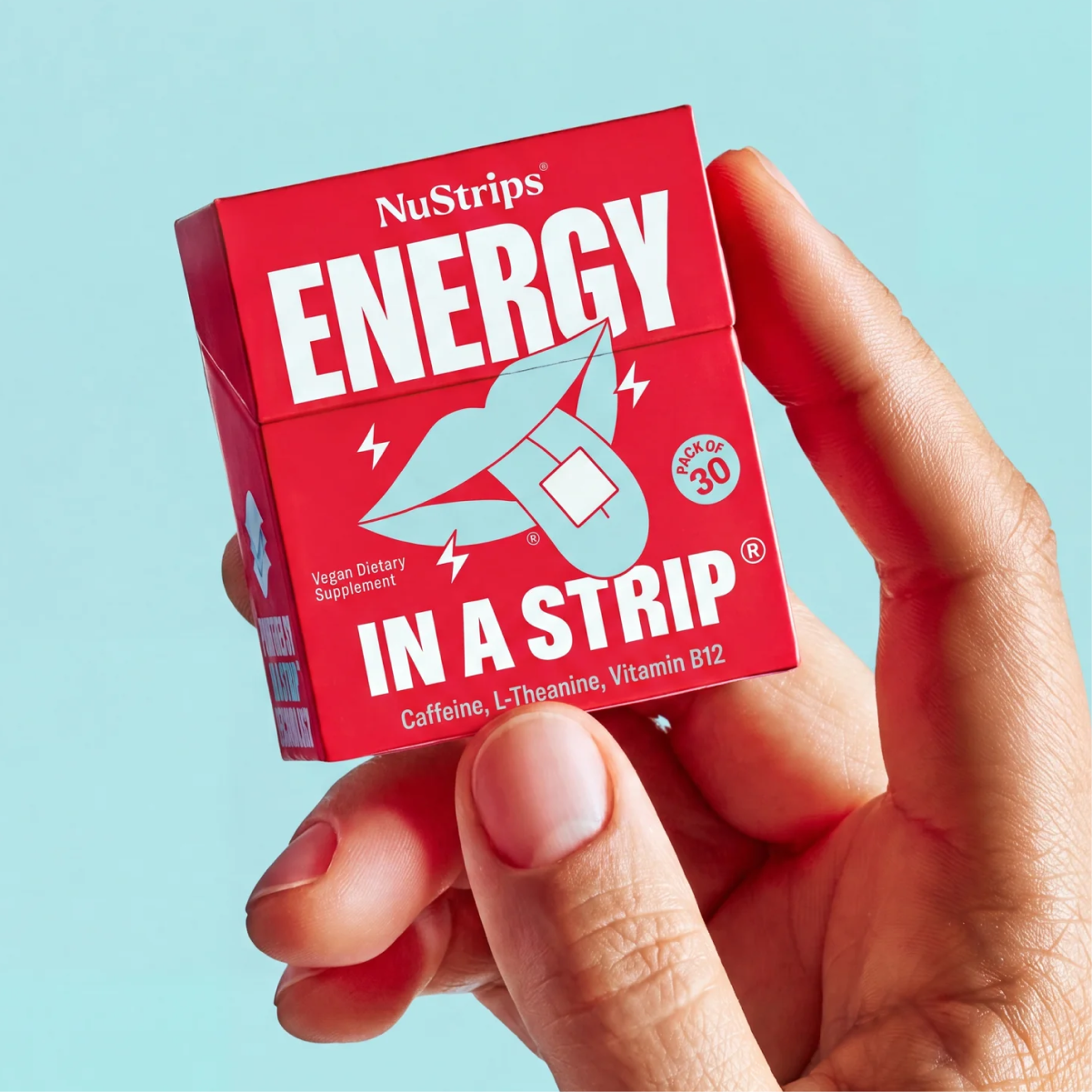
NuStrips created the oral strip supplement category — 20M+ strips sold since 2020. The idea is simple. Instead of gulping a pill with water or chugging a can, you place a strip on your tongue and the active ingredients pass through the tissues in your mouth into your bloodstream. NuStrips Energy pairs 50mg of caffeine with 30mg of L-theanine and 6mcg of B12 (methylcobalamin, 250% DV), sweetened with monk fruit, stevia, and erythritol — 0g sugar, 0 calories, no taurine, no artificial color (the red is beet powder).†
Think of the three formats as answers to three different questions. Coffee answers "what's my morning ritual?" Energy drinks answer "what do I grab from the cooler when I want something cold, flavored, and strong?" Strips answer "how do I get a clean, exact dose of caffeine right now, anywhere, without sugar or a container?" Once you frame it that way, most of the comparison stops being about which is best in the abstract and starts being about which fits the moment in front of you. The rest of this page gives you the numbers to make that call.
How does the caffeine and sugar compare across every option?
Here is the master table, with each competitor spec cited to the brand's own label or a primary listing in the references below. We omit any cell we could not verify to a primary source — no guessed numbers.
| Product (serving) | Caffeine | L-theanine | Sugar | Calories | Format | Onset | Price / serving |
|---|---|---|---|---|---|---|---|
| NuStrips Energy (1 strip) | 50mg | 30mg | 0g | 0 | Dissolvable strip | Fast (oral) | $0.89–$1.33 |
| Brewed coffee (8oz) | ~95mg | — | 0g* | ~2* | Hot brew | ~30–45 min | Varies |
| Celsius (12oz) | 200mg | — | 0g | ~10 | Carbonated can | ~30–45 min | ~$2 |
| Red Bull (8.4oz) | 80mg | — | 27g | 110 | Can | ~30–45 min | ~$3–4 |
| 5-Hour Energy (1.93oz, Reg) | 200mg | — | 0g | ~4 | Liquid shot | ~30 min | ~$3–4 |
| Everyday Dose Coffee+ (1 serving) | 45mg | 150mg | 0g added | ~25 | Mushroom coffee (brew/mix) | ~30–45 min | ~$1.20 |
| Alani Nu (12oz) | 200mg | — | 0g | ~10 | Can | ~30–45 min | ~$2 |
| Monster (16oz, Green) | 160mg | — | 54g | 230 | Can | ~30–45 min | ~$3 |
*Black coffee only; sugar and calories rise with any milk, cream, or sweetener added. Celsius and Alani Nu sugar/calorie figures are from current retail listings citing the nutrition panel. All figures reflect the standard serving noted; flavors and formats vary.
Why do sugary energy drinks cause a crash?
The mid-afternoon slump people blame on caffeine is often the sugar. A 16oz Monster carries 54g of sugar — roughly 13 teaspoons — and a standard Red Bull carries 27g. A large dose of sugar spikes blood glucose quickly, insulin rises to clear it, and blood sugar can dip below where it started, leaving you tired and reaching for the next can. Zero-sugar options sidestep that curve entirely.
This is the first fork in the road. If your energy source is a sugar bomb — Red Bull at 27g, Monster at 54g — a big part of the "crash" is metabolic, not caffeine-related. NuStrips Energy, Celsius, Alani Nu, and 5-Hour Energy are all sugar-free, so the story shifts from sugar to dose.
It's worth being precise about what "the crash" is, because the word gets used loosely. There are really two separate dips people lump together. The first is the sugar dip described above — fast up, fast down, driven by insulin clearing a big glucose load. The second is the caffeine dip: as caffeine clears and adenosine floods back in, the drowsiness it was masking returns, sometimes with a rebound. A sugary can can hand you both at once. Cutting the sugar removes half the problem for free, and pairing a modest caffeine dose with L-theanine softens the other half. That's the mechanical reason a 50mg strip tends not to leave people flattened the way a big sweet can does.
Is 200mg of caffeine too much?
Not for everyone. The FDA notes that up to 400mg of caffeine per day is generally safe for healthy adults, and both the FDA and Mayo Clinic use that as the ceiling. A single 200mg Celsius or Alani Nu is half your day's budget in one can. For some people that's fine. For others — anyone who feels jittery, anxious, or heart-racy on a full can — 200mg in one hit is simply more than they want.
That's the second fork. The caffeine bombs (Celsius, Alani Nu, 5-Hour Energy at ~200mg) are built for high tolerance and a big jolt. NuStrips Energy goes the other way on purpose: 50mg is a modest dose, about half a cup of coffee, paired with L-theanine so the lift stays smooth. You cannot easily over-caffeinate on a strip the way you can drain a can before you notice. Nobody in this category owns the honest low-dose lane — that's the one NuStrips built.
Absolutely love my Nustrips. I don't need energy drinks anymore. I'm saving a ton and getting so much more than steady, clean energy without a huge crash. I rarely need more than 1 strip a day.— Melissa, verified NuStrips customer
What does L-theanine actually do?
Caffeine works by blocking adenosine, the chemical that builds up through the day and signals drowsiness. Block it and you feel more alert. L-theanine is an amino acid found in tea leaves, and it takes the edge off caffeine's sharper side. In a placebo-controlled study published in Nutritional Neuroscience in 2010, the combination of L-theanine and caffeine improved accuracy during demanding task-switching and increased self-reported alertness while reducing tiredness — better focus with a calmer feel than caffeine alone.
This is why the L-theanine column matters in the master table. Of everything here, only NuStrips Energy (30mg) and Everyday Dose (150mg) add it. Straight coffee and the big cans give you caffeine without the smoothing partner. That pairing is the difference between "wired" and "focused," and it's the reason the low-dose strip can feel like it punches above its 50mg.†

What's actually in these besides caffeine?
The ingredient panel is where the "clean label" argument gets real, and it cuts in different directions for different products. Most of the big cans add taurine, glucuronolactone, guarana, and a stack of synthetic B-vitamins on top of caffeine. Red Bull and Monster add sugar. 5-Hour Energy uses sucralose as its sweetener and packs 30mg of niacin (vitamin B3) — enough that some people experience the niacin "flush," a temporary warm, red, tingling sensation. None of that is dangerous at label doses, but it's more moving parts than some people want, and it's worth knowing what you're actually taking in.
NuStrips Energy keeps the list short: caffeine, L-theanine, B12 as methylcobalamin, and a monk fruit, stevia, and erythritol sweetener system — no taurine, no added sugar, and no artificial color (the red comes from beet powder). Everyday Dose goes a different route, layering in adaptogenic mushrooms and collagen because it's built as a coffee replacement, not a stimulant hit. The point isn't that one panel is universally "better" — it's that they're built for different jobs, and reading the label tells you which job each product is for.
Which one wins for travel and on-the-go?
This is where format stops being a footnote. A can is liquid, so it can't go through airport security in your carry-on above 3.4oz, it needs to stay cold to taste right, and it's bulky in a bag or a car cup holder. Coffee is a place you have to be — a café, a kitchen, a machine. A strip is none of that. It's a flat pouch you can keep in a wallet, a gym bag, a jacket pocket, or a glovebox, it doesn't leak or spill, it needs no water, and because there's no liquid it clears TSA without a second look. For a traveler, a nurse on shift, a parent with hands full, or anyone who needs to be sharp somewhere with no kitchen nearby, the strip is the only one of the three that goes wherever you go.
How do I choose between a strip, a can, and coffee?
Match the tool to the moment. Here's the honest decision guide:
- You want a ritual to sit with. Coffee and mushroom coffee like Everyday Dose win here. There's warmth, taste, and a few minutes to yourself. Everyday Dose adds adaptogens (lion's mane, chaga), collagen, and 150mg of L-theanine — it's a considered coffee replacement, not an on-the-go hit. Credit where it's due: it does a job a strip doesn't.
- You want the biggest legal jolt and love the flavor. Celsius, Alani Nu, and Monster have huge flavor ranges, brand culture, and 160–200mg per serving. If you tolerate that dose and enjoy the drink, they deliver.
- You want a fast, clean, portable lift with no sugar and no crash. This is the strip's lane. 50mg + 30mg L-theanine, 0g sugar, 0 calories, dissolves in ~30 seconds, fits in a pocket, and passes airport security because there's no liquid. No can to carry, chill, or recycle.
- You over-caffeinate easily. Skip the 200mg cans. A 50mg strip gives you a controlled dose you can add to, not a can you finish before you feel it.
How fast does each one work?
Caffeine from a drink you gulp typically takes about 30–45 minutes to peak, because it has to travel through your stomach and gut first. A strip that dissolves on your tongue starts absorption through the tissues in your mouth, so the lift tends to arrive sooner — useful when you need to be sharp in minutes, not half an hour. Caffeine's half-life is roughly 5–6 hours regardless of format, which is why it's smart to skip caffeine about 6 hours before bed no matter what you're taking.
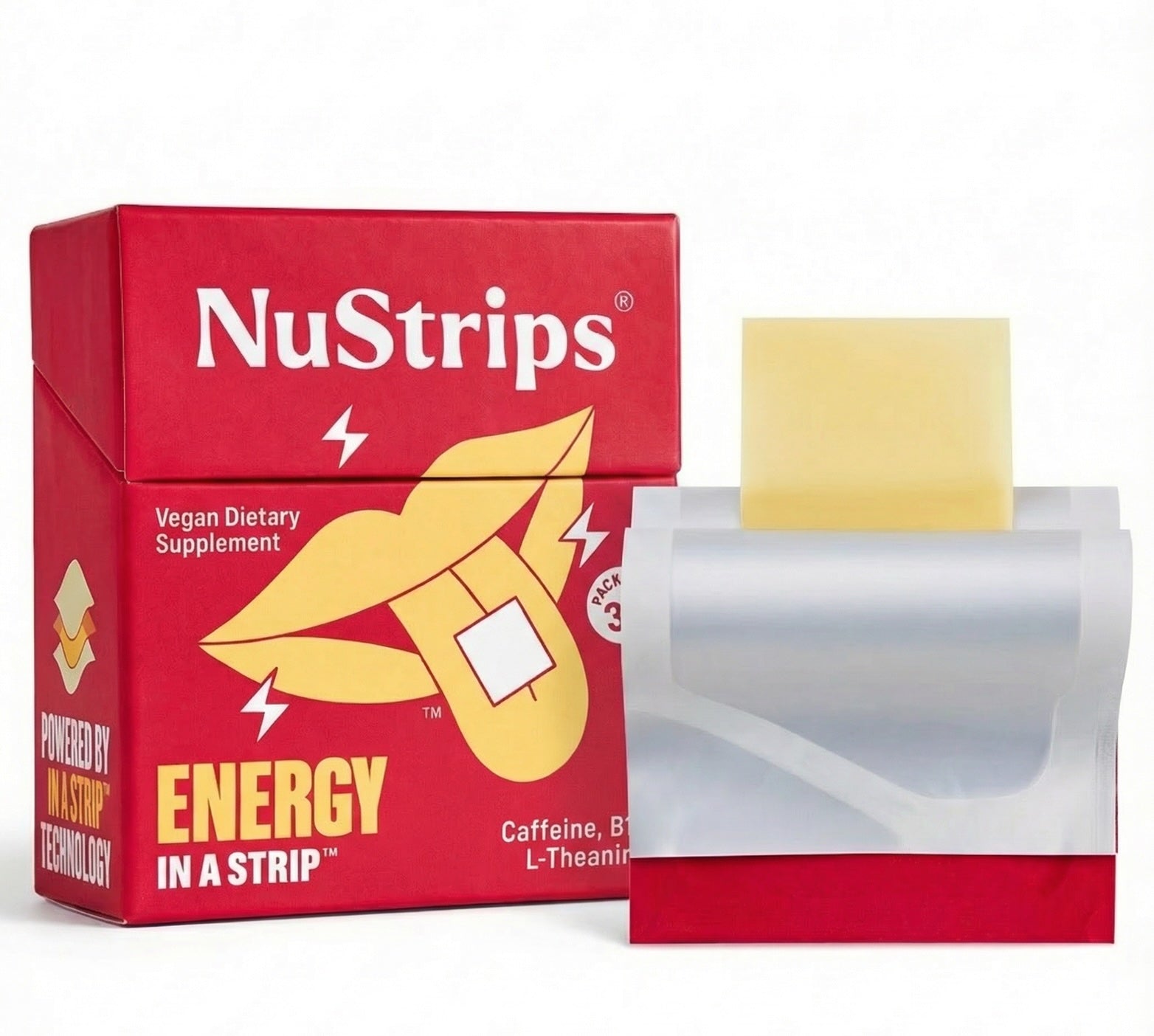
The three-step version of using a strip:
- Peel — tear open the single-serve pouch.
- Dissolve — place the strip on your tongue. It dissolves in about 30 seconds — no water, no chewing.
- Absorb — the caffeine and L-theanine pass through the tissues in your mouth into your bloodstream for a fast, clean lift.
Which is the healthiest energy source?
"Healthiest" depends on what you're optimizing for, and honesty matters more than a sales pitch here. On sugar and calories, the zero-sugar options — NuStrips Energy, Celsius, Alani Nu, 5-Hour Energy, and black coffee — clearly beat the 27g Red Bull and 54g Monster. On caffeine dose, lower is gentler on people sensitive to stimulants, which favors the 45–50mg options (Everyday Dose, NuStrips Energy) and a modest cup of coffee over the 200mg cans. On added functional ingredients, Everyday Dose brings adaptogens and collagen that the others don't.
Coffee has real merits: it's inexpensive, widely available, and carries antioxidants. Its downsides are the caffeine dose creep of a big café cup and whatever sugar and cream get added. Energy drinks win on taste, availability, and the social ritual of a cold can. Strips win on a clean, precise, sugar-free, portable dose with L-theanine built in. None of these is a substitute for sleep, and if you're pregnant, under 18, or managing a heart or anxiety condition, keep caffeine conservative and talk to your doctor.
I quit coffee, espresso and energy drinks after using my first nu strip. I would 100% recommend these!— Suzanne, verified NuStrips customer
NuStrips Energy vs each brand: the head-to-head pages
Every rival in the table above gets its own detailed, cited breakdown. Pick the one you actually drink and see the full comparison:
- NuStrips Energy vs Celsius — 50mg vs 200mg caffeine, for people Celsius over-stimulates.
- NuStrips Energy vs Red Bull — 0g sugar vs 27g, and where the crash really comes from.
- NuStrips Energy vs 5-Hour Energy — the portable caffeine test: strip vs shot, no niacin flush, no sucralose.
- NuStrips Energy vs Everyday Dose — instant strip vs mushroom coffee you brew.
- NuStrips Energy vs Alani Nu — 50mg vs 200mg, both sugar-free, strip vs can and powder stick.
- NuStrips Energy vs Monster — 0g sugar vs 54g, the biggest sugar bomb in the category.
Want the fundamentals first? Read what energy strips are, see the best energy strips, compare caffeine strips vs coffee, or check how fast caffeine strips work. The receipts live on our science page and our customer reviews — 9,450+ verified reviews and counting.
What does NuStrips Energy cost compared to a daily can?
NuStrips Energy is $39.99 for 30 strips ($1.33 each), $59.99 for 60 ($1.00 each), or $79.99 for 90 ($0.89 each). A single energy drink at retail typically runs $2–$4. If you're a one-can-a-day person, the strip is usually cheaper per serving and a lot cheaper by the case — and it takes up no fridge space. Every order ships within 24 hours, US shipping is free over $40, and there's a 60-day money-back guarantee, so trying it costs you nothing if it isn't your thing.
References
- NuStrips Energy label and pricing — nustrips.com product page, accessed 2026-08.
- Celsius caffeine (200mg), 0g sugar, ~10 calories — celsius.com essential facts and retail nutrition listing, accessed 2026-08.
- Red Bull 8.4oz: 80mg caffeine, 27g sugar, 110 calories — redbull.com product nutrition and Walmart product listing, accessed 2026-08.
- 5-Hour Energy Regular Strength: 200mg caffeine, 0g sugar, ~4 calories, 30mg niacin, sucralose — 5hourenergy.com nutrition & ingredients, accessed 2026-08.
- Everyday Dose Coffee+: 45mg caffeine, 150mg L-theanine, lion's mane/chaga, 4g collagen, no added sugar — everydaydose.com ingredients, accessed 2026-08.
- Alani Nu 12oz: 200mg caffeine, 0g sugar, ~10 calories — Alani Nu retail nutrition listing (Amazon/Walmart), accessed 2026-08.
- Monster Energy 16oz Green: 160mg caffeine, 54g sugar, 230 calories — monsterenergy.com and retail nutrition label, accessed 2026-08.
- Brewed coffee (~95mg/8oz) and espresso (~64mg) reference doses; FDA 400mg/day guidance — Mayo Clinic, accessed 2026-08.
- L-theanine + caffeine cognitive study — Owen et al., Nutritional Neuroscience 2010;13(6):283–290.
† These statements have not been evaluated by the Food and Drug Administration. This product is not intended to diagnose, treat, cure, or prevent any disease.
Methodology. “#1 Clinician’s Choice,” category rankings, and all clinician counts on this page are based on FrontrowMD’s publicly available clinician-share data as of July 16, 2026. Figures reflect the number of independent clinicians who share each product or brand on FrontrowMD (who are not compensated to do so) and may change over time.