On purpose.
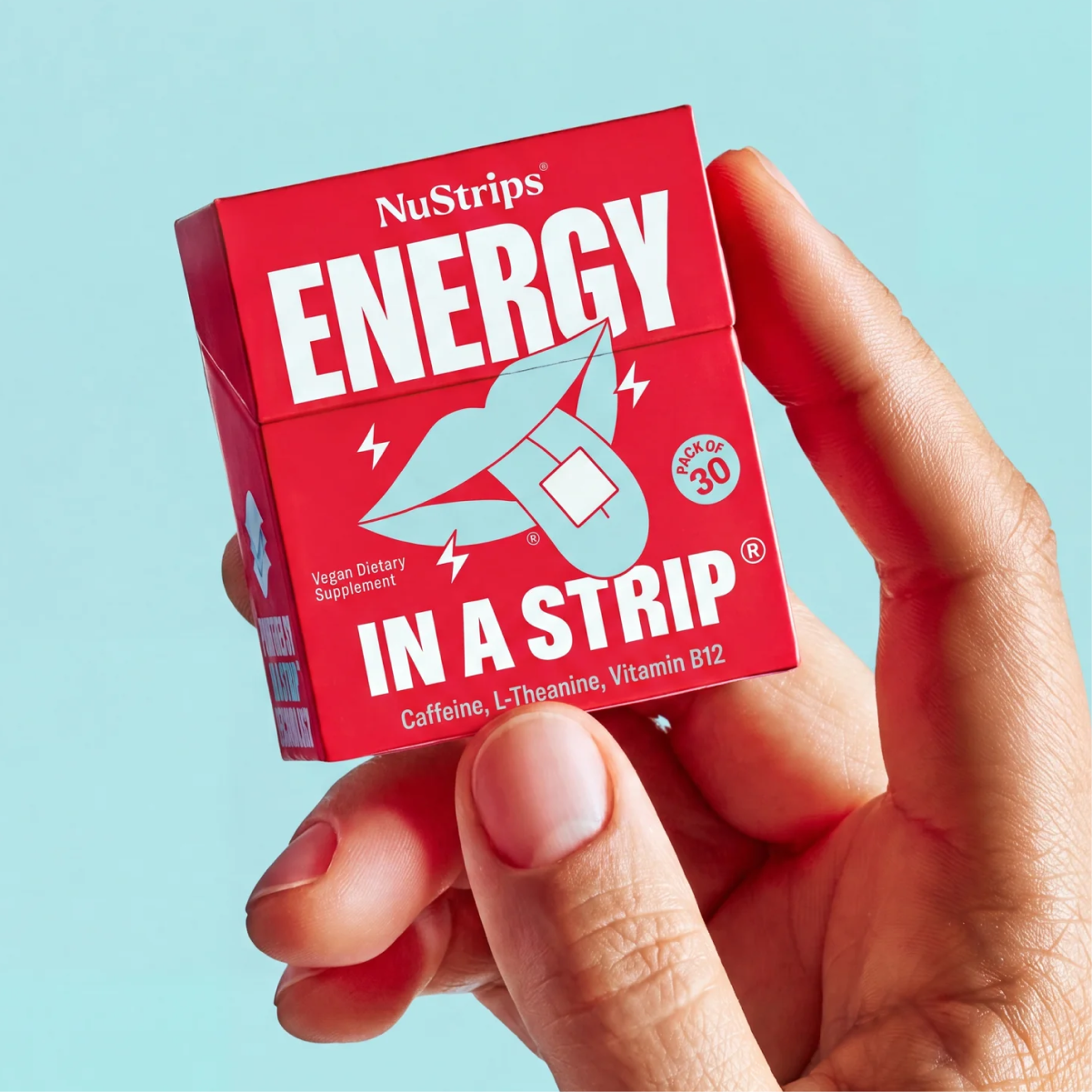
Celsius packs 200 mg of caffeine a can. NuStrips Energy is a strip — 50 mg clean caffeine + 30 mg L-theanine for calm, focused energy without the overstimulated, heart-racing jitters. 0 g sugar, pockets over cans.
NuStrips Energy vs Celsius: 50mg vs 200mg Caffeine (2026)
Last updated: 2026-08-10
NuStrips Energy is a dissolvable caffeine strip with 50mg of caffeine and 30mg of L-theanine that you place on your tongue — about a quarter of the 200mg of caffeine in a 12oz can of Celsius. If Celsius leaves you wired, jittery, or feeling your heart race, a strip gives you a smaller, deliberate dose of clean energy with no can, no carbonation, and no 200mg spike.
Key takeaways
- A 12oz Celsius has 200mg of caffeine; one NuStrips Energy strip has 50mg — roughly a quarter of the dose.
- Both are sugar-free: Celsius is 0g sugar and about 10 calories; NuStrips Energy is 0g sugar and 0 calories.
- NuStrips pairs its 50mg of caffeine with 30mg of L-theanine, an amino acid from tea shown in research to smooth caffeine's edge for calm, focused energy.
- A strip dissolves on your tongue in about 30 seconds — no can to crack, no liquid to carry through TSA, no need to finish a whole drink to control your dose.
- NuStrips Energy runs $0.89–$1.33 per strip; Celsius typically runs about $1.19–$2.08 per can at retail.
Is a Celsius alternative with less caffeine actually worth it?
If you searched for a Celsius alternative, you probably already like the idea of a sugar-free energy hit — you just don't love how 200mg of caffeine makes you feel. That is a reasonable place to land. Celsius delivers a big, sustained caffeine load in a carbonated 12oz can, and for a lot of people that is more stimulation than they want on a normal Tuesday.
NuStrips Energy takes the opposite approach on purpose. Instead of a large dose you drink over 20 minutes, it gives you 50mg of caffeine — about half a cup of coffee — paired with 30mg of L-theanine to keep the lift smooth. You place one strip on your tongue, it dissolves in about 30 seconds, and the caffeine and L-theanine pass through the tissues in your mouth into your bloodstream. No water, no chewing, no can.
NuStrips created the oral strip supplement category — 20M+ strips sold since 2020. The pitch here is not "we have more." It is honest low-dose: a labeled, repeatable 50mg that is hard to overshoot, for the times when a full Celsius is simply too much.
Good clean energy without the buzz! Helped me kick my Celsius habit which was overstimulating the heck out of me!! I was worried that I wouldn't get enough of a lift but they're surprisingly perfect. Not to mention the fact that they're so easy to take on the run!— Jeannine, verified NuStrips customer
How much caffeine is in Celsius vs NuStrips Energy?
This is the whole comparison in one number. A 12oz Celsius contains 200mg of caffeine — the caffeine content of roughly two cups of brewed coffee, all in one can. One NuStrips Energy strip contains 50mg. That is a four-to-one difference, and it is the reason the two products feel completely different in your body.
Here is the head-to-head, spec for spec.
| Spec | NuStrips Energy (1 strip) | Celsius (12oz can) |
|---|---|---|
| Caffeine | 50mg | 200mg |
| L-theanine | 30mg | None listed |
| Sugar | 0g | 0g |
| Calories | 0 | ~10 |
| Format | Dissolvable strip on your tongue | Carbonated 12oz can |
| Onset | Fast oral absorption (no waiting to finish a drink) | Sipped over minutes; caffeine peaks later |
| Price / serving | $0.89–$1.33 / strip | ~$1.19–$2.08 / can |
Both products are sugar-free, so this is not a sugar-crash story the way Red Bull or Monster is. With Celsius the variable is dose. 200mg is a real, legitimate amount of caffeine that some people handle well and enjoy. For others it is simply too much, too fast — and that is who a 50mg strip is built for.

Why does Celsius make me jittery or anxious?
The most common reason is straightforward: the dose. Caffeine works by blocking adenosine, the brain chemical that builds up through the day and signals drowsiness. Block enough of it and you feel alert. Block a lot of it, quickly, and that same mechanism can tip into a racing heart, restlessness, and that wired, anxious edge — especially if you are caffeine-sensitive, drinking it on an empty stomach, or already had coffee earlier.
At 200mg, a single Celsius delivers a big block of caffeine in one sitting. If you are the kind of person who feels every milligram, that is often the source of the jitters. It is not that Celsius is doing anything wrong — it is doing exactly what a 200mg energy drink is designed to do. It just may be more caffeine than your system wants.
NuStrips Energy addresses that in two ways. First, the dose is smaller: 50mg is a modest amount of caffeine, so there is far less to block all at once. Second, each strip includes 30mg of L-theanine. L-theanine is an amino acid found in tea, and the caffeine-and-L-theanine pairing has been studied specifically for this problem. In a 2010 study published in Nutritional Neuroscience, the combination improved accuracy on attention-switching tasks and self-reported alertness while helping people stay focused and less distracted during demanding work. The practical translation people describe is calm, focused energy without the jitters.†
Is 200mg of caffeine too much?
Not for everyone — and it is worth being precise here rather than alarmist. The FDA notes that up to about 400mg of caffeine per day is generally not associated with negative effects for healthy adults. A single 200mg Celsius fits inside that ceiling with room to spare.
The catch is that 400mg is a daily total, and 200mg in one can uses half of it in a single sitting. Stack a Celsius on top of morning coffee and an afternoon pick-me-up and you can reach the ceiling fast — which is where the racing heart and difficulty winding down at night tend to show up. Caffeine has a half-life of roughly 5–6 hours, so a mid-afternoon 200mg can still be working in your system near bedtime. A common guideline is to skip caffeine within about 6 hours of sleep.
A 50mg strip makes that math easier. You can take one when you actually need a lift, know exactly how much you took, and not blow through your daily budget on a single serving. If you are pregnant, breastfeeding, managing a heart condition, or taking medication, talk to your doctor about your caffeine intake — that advice applies to any caffeine source, strip or can.
How fast does a caffeine strip work compared to Celsius?
Speed is one of the quiet advantages of the format. When you drink caffeine, it has to travel down, get processed through your stomach and gut, and then enter your bloodstream — which is why a coffee or an energy drink usually takes something like 30 to 45 minutes to fully hit. With a Celsius, you are also pacing yourself across a 12oz can, so the caffeine arrives gradually as you sip.
A strip skips part of that trip. Because it dissolves on your tongue, a portion of the caffeine and L-theanine is absorbed through the tissues in your mouth rather than waiting on digestion. You also take the full dose in one motion — there is no can to nurse. The practical result is a lift that comes on quickly and predictably, which is exactly what you want when you are about to start a task, a workout, or a long drive and don't have 40 minutes to wait for a drink to kick in.
It also means you are never in the position of having finished a whole Celsius, felt nothing yet, and reached for a second one — the exact move that turns 200mg into 400mg by accident. One strip, one clean onset, one known dose.
Can't I just drink half a Celsius?
You can, and if that works for you, great. But in practice a half-finished carbonated can is awkward — it goes flat, it is easy to absent-mindedly finish, and "half a can" is a rough estimate, not a labeled dose. The whole appeal of a strip is precision. One strip is one dose. You never have to decide how much of a 200mg can counts as "enough," and you cannot accidentally over-caffeinate yourself by finishing the drink.
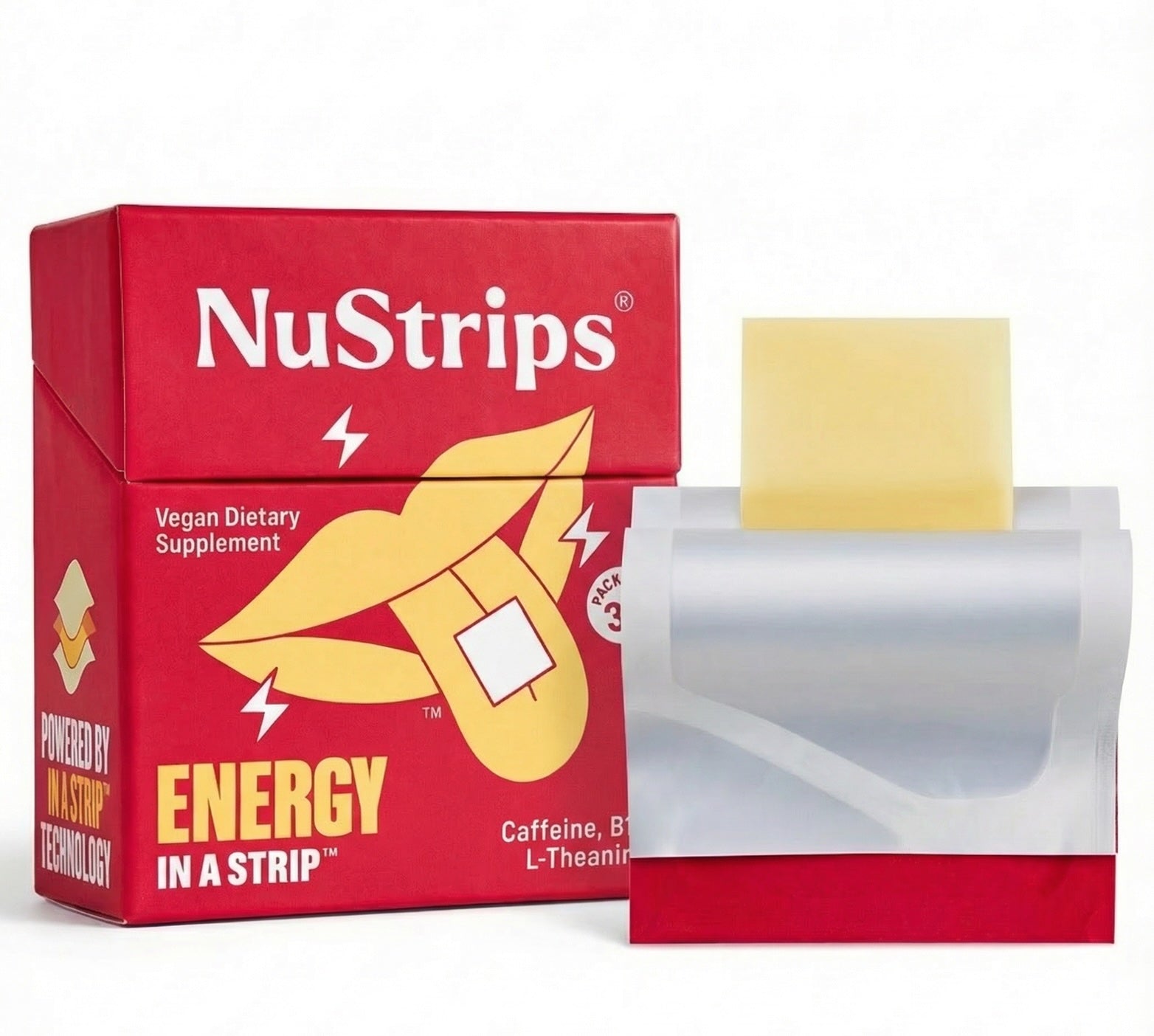
This is where format quietly matters. A Celsius is a 12oz liquid you have to carry, keep cold-ish, crack open, and drink. A NuStrips Energy strip is a single-serve pouch the size of a stick of gum. It lives in a pocket, a bag, a car console, or a gym bag, and it works the same whether you are at your desk or halfway up a trail. There is no liquid, which also means it clears airport security without the 3.4oz liquid limit that stops a can at the checkpoint.
Is NuStrips Energy cheaper than Celsius?
On a per-serving basis, usually yes — and the gap widens if you compare against grocery-store Celsius rather than a deep online deal. NuStrips Energy is $39.99 for 30 strips ($1.33 each), $59.99 for 60 ($1.00 each), or $79.99 for 90 ($0.89 each). Celsius runs roughly $1.19 to $2.08 per can depending on where you buy it; the cheapest subscribe-and-save online prices land near the bottom of that range, while a single can from a cooler at a gas station is often at the top.
Put it on a monthly basis. If you drink one Celsius a day, that is 30 cans a month — call it somewhere between $36 and $62 at typical retail. Thirty NuStrips Energy strips at the 90-pack price is about $27, and even the smaller packs stay at or below the middle of the Celsius range. You are paying for a quarter of the caffeine, which is the point, but you are also generally paying less per day for it — and you are not carrying a case of cans home.
None of this makes Celsius overpriced; energy drinks cost what they cost. It just means switching to a strip does not ask you to pay a premium for the smaller dose and cleaner label.
Good clean energy without the buzz! Helped me kick my Celsius habit which was overstimulating the heck out of me!!— Jeannine, verified NuStrips customer
Do NuStrips Energy strips travel better than a can?
By a wide margin, and this is where a lot of former can-carriers convert. TSA's 3.4oz liquid rule stops a 12oz Celsius at the security checkpoint — you either finish it, dump it, or buy an overpriced one past the gate. A NuStrips Energy strip is not a liquid, so it goes through security in your pocket and works the same at 35,000 feet as it does on the ground.
The same logic applies to anywhere a can is inconvenient: a backpacking trip where weight matters, a car with no cupholder to spare, a gym bag you don't want leaking, a meeting where cracking a fizzy can is awkward. A strip is single-serve, spill-proof, shelf-stable, and silent. For people whose energy needs are mobile — travel, shift work, parenting, the trail — the format alone is often the reason they switch, before caffeine dose even enters the conversation.
What does Celsius do better?
Plenty, and it is worth saying honestly. Celsius has a genuinely broad range of flavors and a satisfying carbonated, cold-drink experience that a strip does not try to replicate — if what you love is the ritual of sipping a cold, fizzy energy drink, Celsius delivers that and a strip does not. It is stocked in nearly every gas station, gym, and grocery store, so it is easy to grab on impulse. And its thermogenic, functional-energy marketing has built a large, loyal following for a reason: a lot of people feel great on it.
If a 200mg carbonated can is the experience you want and your body handles it well, Celsius is a solid product and you should keep enjoying it. NuStrips Energy is for the specific person for whom that 200mg is the problem — who wants the clean, sugar-free lift without the volume of caffeine, the carbonation, or the can.
How do NuStrips Energy strips work?
Three steps, about 30 seconds:
- Peel — tear open the single-serve pouch.
- Dissolve — place the strip on your tongue. It dissolves in about 30 seconds — no water, no chewing.
- Absorb — the caffeine and L-theanine pass through the tissues in your mouth into your bloodstream for a fast, clean lift.
Each strip also carries 6mcg of vitamin B12 (methylcobalamin, 250% of the Daily Value), which supports normal energy metabolism.† The Berry Smoothie flavor is sweetened with monk fruit, stevia, and erythritol — zero sugar, zero calories, no taurine, and no artificial color (the red comes from beet powder). It is a clean, short label, and every number on it is printed on the pack.
Does a strip really give enough energy to replace Celsius?
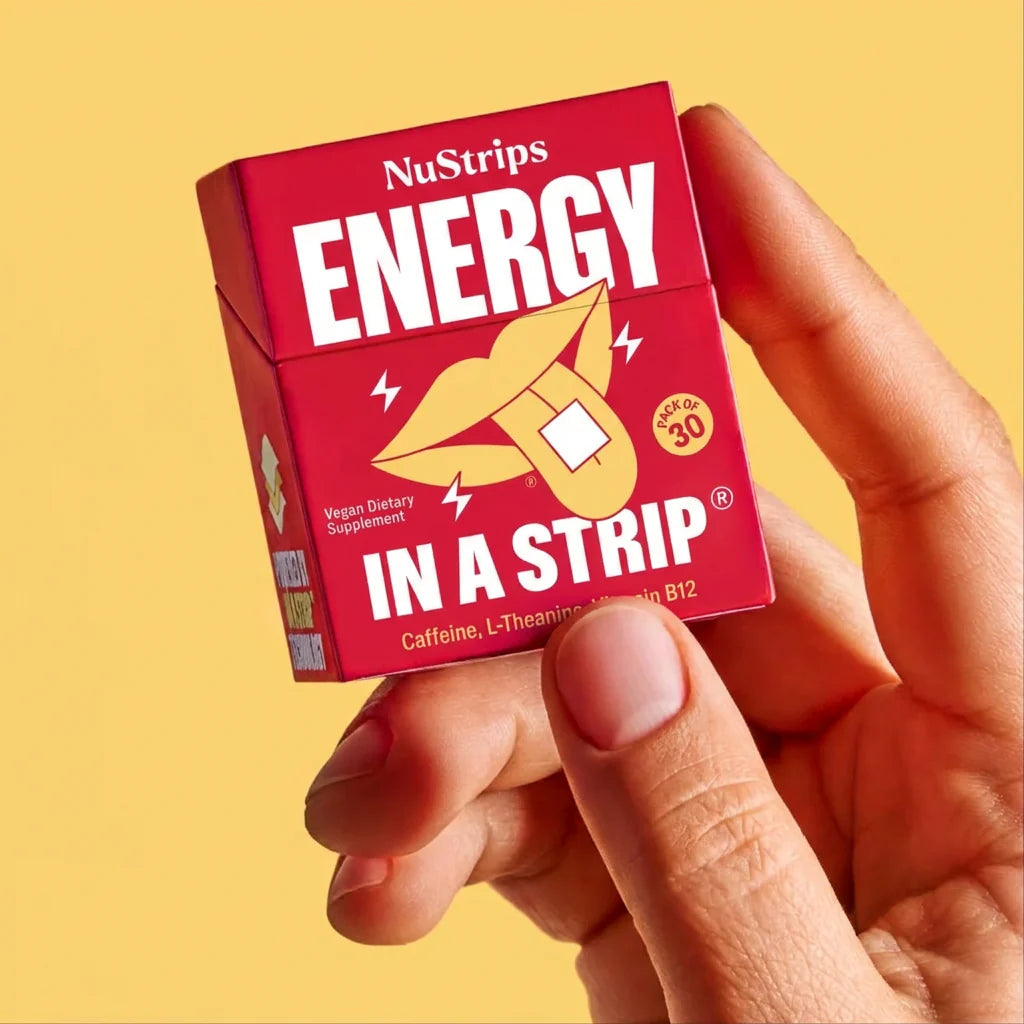
This is the honest worry, and it is the one Jeannine named above: 50mg sounds small next to 200mg, so will it actually do anything? For most people the answer is yes — because the goal is not the biggest possible jolt, it is a clean, usable lift you can feel without the downside. 50mg is about half a cup of coffee, which is plenty for real focus, and the L-theanine keeps that focus smooth instead of spiky.
The people most likely to be happy switching are exactly the ones Celsius over-stimulates: if you have been drinking Celsius but feeling wired, anxious, or crashing later, a smaller deliberate dose often feels better, not weaker. And if you occasionally want more, you know precisely what "more" means — a second labeled 50mg strip, not an unmeasured extra can. NuStrips Energy comes with a 60-day money-back guarantee, ships within 24 hours, and ships free in the US over $40, so trying the switch is low-risk.
Should you switch from Celsius to NuStrips Energy?
A quick way to decide. You are a good candidate for the switch if:
- Celsius leaves you jittery, anxious, or with a racing heart — the 50mg dose plus L-theanine is built for exactly this.
- You want caffeine you can dose precisely, not by the can, and you don't want to risk stacking to 400mg.
- You travel, commute, or work on the move and a liquid can is a hassle at security or in a bag.
- You like Celsius's sugar-free profile but want zero calories and a short, clean label with no taurine or artificial color.
You should probably stick with Celsius if the carbonated, cold, sip-it-slowly experience is the part you love, if you genuinely feel great on 200mg, or if grabbing a can at any store on impulse matters more to you than dose control. Both can be true at once, too — plenty of people keep Celsius for the ritual moments and use strips for focus, travel, and afternoons when 200mg would be too much.
Where can I compare this to other energy drinks?
Celsius is one of several 200mg caffeine drinks, and the same low-dose logic applies across the category. If you want the full landscape — drinks, shots, coffee, and strips side by side — start with our pillar comparison, Energy Strips vs Energy Drinks vs Coffee. For a close cousin to Celsius on the caffeine-content front, see NuStrips Energy vs Alani Nu, another 200mg sugar-free line. If your issue is sugar rather than caffeine, NuStrips Energy vs Red Bull breaks down the 27g-sugar contrast. You can also read up on the category basics in What Are Energy Strips and Best Energy Strips, dig into the research on our science page, or read verified customer reviews.
References
- Celsius caffeine (200mg), sugar (0g), and calories (~10) per 12oz can — Caffeine Informer, accessed August 2026: caffeineinformer.com/caffeine-content/celsius-energy-drink.
- Celsius retail price per can (~$1.19–$2.08) — current retailer listings (Amazon, Target, Acme), accessed August 2026: target.com Celsius 12-pack.
- NuStrips Energy specifications (50mg caffeine, 30mg L-theanine, 6mcg B12, 0g sugar, 0 calories) and pricing — NuStrips product label and store: nustrips.com/products/energy-in-a-strip.
- Caffeine + L-theanine on attention and alertness — Giesbrecht T, Rycroft JA, Rowson MJ, De Bruin EA. "The combination of L-theanine and caffeine improves cognitive performance and increases subjective alertness." Nutritional Neuroscience 2010;13(6):283–290: pubmed.ncbi.nlm.nih.gov/21040626.
- Caffeine safety context (up to 400mg/day generally safe for healthy adults) — U.S. Food & Drug Administration: fda.gov — Spilling the Beans: How Much Caffeine is Too Much.
† These statements have not been evaluated by the Food and Drug Administration. This product is not intended to diagnose, treat, cure, or prevent any disease.
Methodology. “#1 Clinician’s Choice,” category rankings, and all clinician counts on this page are based on FrontrowMD’s publicly available clinician-share data as of July 16, 2026. Figures reflect the number of independent clinicians who share each product or brand on FrontrowMD (who are not compensated to do so) and may change over time.