By the NuStrips Team · Reviewed against peer-reviewed research · Published July 1, 2026
Last updated: 2026-07-27
To stop doomscrolling in bed, don't just remove the phone — replace the trigger. Give your hands and mouth one small job instead: a melatonin + L-theanine strip that dissolves on your tongue in about 30 seconds. A ritual you can do beats a rule you have to obey.
Trade the scroll for a 30-second ritual.
Key takeaways
You don't beat a scroll habit with willpower — you swap it for a competing 30-second ritual your hands can actually do.
A melatonin strip dissolves on your tongue in seconds — no water, no glass on the nightstand, no reason to grab the phone.
Sleep gummies carry a hidden sugar problem (OLLY Sleep adds 2g sugar per serving), and the melatonin-gummy category has documented dose inconsistency (JAMA).†
Oral melatonin in pills is largely lost to first-pass liver metabolism (roughly 3–15% bioavailable) — dissolving on your tongue is a faster route.†
NuStrips Sleep: melatonin 5mg, L-theanine 10mg, valerian 15mg, vitamin B6 5mg. One strip. No sugar. Precise dose.†
It's 11:07pm. You are in bed. The lights are off. And you are holding a small rectangle of glass that is, by design, engineered to keep you awake. You know this. You have known this for years. And yet the thumb keeps moving, because the thumb has somewhere to be and your brain has decided that "one more video" is a reasonable thing to want at 11:07pm on a Tuesday.
Here's the part nobody tells you: you are not weak. You are up against a product that was built by very smart people to be exactly this hard to put down. Telling yourself to "just stop" is like telling yourself to just stop being hungry. The urge is real. The willpower approach loses. So let's stop pretending willpower is the answer and talk about what actually works — substitution.
You don't quit a ritual. You replace it. Give the hands and the mouth one small, calmer job at 11pm, and the scroll loses its slot.
We make oral strips, so yes — we're biased. We think the answer to a bad bedtime ritual is a better bedtime ritual, and we happen to sell one. But the mechanism here isn't a marketing trick; it's behavior science that predates us by decades. When you're trying to break a cue-routine-reward loop, the reliable move isn't to delete the routine. It's to keep the cue and the reward, and swap the routine in the middle. Your cue is "I'm in bed, wound down but not asleep." Your reward is "something to occupy me until sleep comes." The scroll is just the routine you happened to grab. So grab a different one.
How do I stop doomscrolling in bed?
Start by accepting the thing that makes this hard: the reason you reach for the phone in bed is that your hands and your attention have nothing else to do, and the phone is right there, glowing, promising novelty. Remove it and you create a vacuum. Vacuums don't hold. Within four nights the phone is back on the nightstand and the ritual reasserts itself.
So don't just subtract. Add something first, then subtract. The sequence that works:
Give your hands a competing job that ends. The doomscroll has no natural stopping point — that's the trap. A ritual with a defined end (peel, place, dissolve, done) hands your brain a finish line the feed never will.
Move the phone across the room to charge. Not on the nightstand. Across the room. The friction of getting up is the whole point.
Do your wind-down thing where the phone isn't. Tea. A page of a paper book. The strip on your tongue. Lights low.
Let the ritual be small. Big routines (ten steps, a whole regimen) collapse under fatigue. A 30-second ritual survives the night you're exhausted, which is exactly the night that matters.
The strip does a specific job in this sequence. It occupies the same 30-second window the first scroll would have owned — the transition from "lights off" to "asleep." It gives your mouth and hands a task. And because it dissolves on your tongue with no water, there's no trip to the kitchen, no glass to fill, no reason to reach for the phone "just to check the time" on the way. The friction that usually reintroduces the screen is gone.
30 sec
for one strip to dissolve on your tongue
0 g
added sugar per NuStrips Sleep strip
5 mg
melatonin, one precise dose, every strip
What should I do instead of scrolling before sleep?
The best replacement is boring in the best way: predictable, low-effort, and finite. The scroll is exciting and infinite. You beat it by being the opposite. A short, repeatable ritual you can run half-asleep in the dark.
Here's the 30-second version, because if it takes longer than that you won't do it on the nights you most need to:
Step one: peel one strip. No water, no measuring.Peel one strip. One pack lives in the nightstand drawer where the phone used to live. Pull one out.
Step two: place it on your tongue.Place it on your tongue. Not under it — on it. It starts dissolving on contact.
Step three: let it dissolve. Lights off. Done.Let it dissolve, lights off. Roughly 30 seconds. Blueberry flavor. Then your hands are empty, the room is dark, and there's genuinely nothing left to do but sleep.
That's the whole thing. The point is that it ends. A scroll doesn't end — the feed is built to never end, which is why you keep going until your eyes physically give out. A three-step ritual with a hard stop retrains the window. You're not white-knuckling your way past the phone; you're occupying its slot with something calmer that finishes on its own. Once the ritual owns 11pm, the scroll has nowhere to live.
If you want the full wind-down, pair the strip with the analog basics: dim the lights an hour out, keep the room cool, put a paper book (not a lit screen) within reach. But the non-negotiable, do-it-even-when-you're-wrecked piece is the strip. It's the anchor because it's the smallest.
What's the fastest natural way to wind down?
Two things NuStrips Sleep uses to support winding down, and why the format matters as much as the formula.†
Melatonin (5mg). Melatonin is the signal your body already uses to say "it's night." The catch with the pill-and-gummy version is delivery. When you take oral melatonin as a capsule, a large share is lost to first-pass metabolism in the liver — one review put oral bioavailability at roughly 3–15% (DeMuro et al., 2000).† A strip that dissolves on your tongue takes a faster route into circulation, which is the entire reason the format exists. Same molecule, better door.
L-theanine (10mg). An amino acid found in tea, studied for supporting a calm, settled state without sedation.† It's the reason a cup of green tea feels focused-calm rather than jittery, and it's in the strip alongside the melatonin to support that "settled, not knocked out" feeling.† We also add valerian (15mg), long used as a traditional wind-down botanical, and B6 (5mg) which supports the body's own melatonin-related pathways.†
The molecule was never the problem. Getting it past a habit that fights it — and past a liver that discards most of the pill version — that's the problem the strip solves.
None of this "cures" anything. If you're dealing with a diagnosed sleep disorder, that's a conversation with your doctor, not a supplement label. What a fast, low-sugar, precise-dose melatonin strip does is support falling asleep and give you a real ritual to replace the one that's been sabotaging you.† Those are the honest claims, and they're the ones that matter at 11:07pm.
"The patients who sleep better aren't the ones with more willpower. They're the ones who built a cue their brain could actually follow — small, same every night, phone nowhere near it."
Do melatonin strips beat a phone-free bedroom alone?
A phone-free bedroom is genuinely good advice. It's also advice most people can't sustain, because it's pure subtraction — it takes the phone away and offers nothing in its place. The nights you're most likely to break it are the nights you're most tired, most anxious, most in need of the wind-down. That's the whole failure mode of willpower-based fixes: they work great right up until you actually need them.
A strip isn't a replacement for a phone-free bedroom. It's what makes a phone-free bedroom stick. The ritual gives you a reason to reach for the drawer instead of the screen. It's the something that fills the vacuum. Subtraction plus substitution beats subtraction alone, every time.
And here's the honest comparison people actually want — strip versus the two things you'd otherwise grab for melatonin. Gummies and pills both have real trade-offs the sleep-tip articles rarely put in one table.
Format
Onset
Added sugar
Dose accuracy
Portability / water
NuStrips Sleep strip
Dissolves on tongue ~30 sec; fast route, no first-pass loss†
0 g
Precise printed dose (5mg) per strip
Flat pack, pocketable; no water
Melatonin gummy
Must chew & digest first
Typically ~2 g/serving (OLLY Sleep: 2g added sugar)
Category shows documented variance vs. label (JAMA, gummy category)†
Jar; no water, but bulky & melts
Melatonin pill
Taken as a tablet, digested; ~3–15% oral bioavailability (first-pass loss)†
0 g
Accurate dose, but most is metabolized before use†
Bottle; usually needs water to take
Two things worth being precise about, because they're often overstated. First, the gummy issue: a 2023 JAMA analysis of melatonin gummy products as a category found the labeled melatonin content was frequently off — some products well over or under label. That's a category-level finding about gummies, not an accusation against any single honest brand. Second, the sugar: OLLY Sleep, a popular gummy, lists 2g of added sugar per serving. Two grams isn't a health crisis — but it's two grams of sugar you're eating right before bed, every night, to fall asleep. A strip skips it entirely.
On pills: they're not "bad." A melatonin tablet is accurate and cheap. But most of that accurate dose is discarded by your liver before it ever does anything (the 3–15% bioavailability figure), and a pill wants a glass of water — which means getting up, which means the kitchen, which means the phone. The strip removes both problems: better delivery, and a ritual with zero friction to reintroduce the screen.
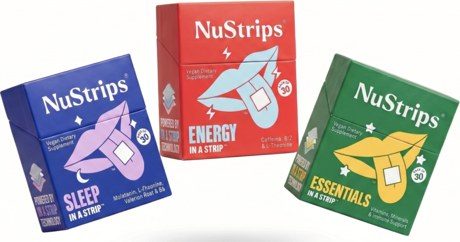
3 strips. One stack. For better sleep, all-day energy, and a calm mind & body.
NuStrips ★
Sleep · Energy · Essentials strips
📱
No Supplements
coffee · Red Bull · all-nighters
Basic
OLLY · Nature Made · Nature’s Bounty
Premium
AG1 · IM8 · Ritual · Grüns
Luxe
Full Premium set + Trackers (Whoop, Oura) + Healthy Meals 3×/day
Absorption & speed
Full & Fastoral absorption
N/A
Slowlost to digestion
Slowlost to digestion
Slowlost to digestion
Closes gaps in nutrition
✓20 actives
✗
✓
✓
✓expensive meals
Fixes sleep
✓
✗
✓often unreliable
Maybe2nd product for +$70
✓
Gives you energy
✓no jitters
✓jitters and crash
✗
Maybe$40 mushroom coffee
✓
Calms stress
✓ashwagandha
✗raises cortisol
Maybewith a 2nd product
Maybe4th product
✓
Tastes good
✓all 3 strips
Maybeacquired taste
Maybegummies, not pills
✗tastes like dirt
✓healthy meals
Travels with you
✓pocket-size, no water
N/A
✗bulky bottles
✗tub, shaker & water
✗a suitcase of gear
Price
$69.42/mo~$2/day
~$110/moin coffee
$60–90/mo
$79–280/mo3–4 products
$650–1,500+
Anything you take by pill, gummy, or greens powder is digested first and can lose much of its active dose along the way; NuStrips strips dissolve on your tongue in seconds. Over-the-counter sleep aids are frequently unreliable, and independent testing (JAMA, 2023) found most melatonin gummies varied widely from their labeled dose. “Luxe” assumes the full premium stack plus devices and prepped meals — the same coverage NuStrips gives, at 10×+ the price. Prices current as of July 2026 and may change.
How long does a melatonin strip take to work?
The strip itself is gone in about 30 seconds — that's the dissolve time on your tongue, no water needed. What you're really asking is how fast it starts supporting sleep, and the honest answer is: individual, but the format is built for speed. Because a strip dissolves on your tongue rather than passing through the stomach and first-pass liver metabolism, the melatonin has a faster, more direct route than a pill.† You can read more on the exact mechanics of onset in our breakdown of how fast melatonin strips work, and how the strip format compares head-to-head in melatonin strips vs gummies.
Practically, the play is simple: do the strip as the last thing before lights-out, not 90 minutes early. It's the closing move of the ritual. Peel, place, dissolve, done — and by the time the taste of blueberry is gone, your hands are empty and the room is dark. That's the design. The strip is fast on purpose, so the ritual is short on purpose, so you'll actually do it on the night you're most wrecked.
Why does the ritual hold when the willpower fixes don't?
Because it survives the worst night. That's the only test that matters. Every sleep-hygiene checklist you've ever read is technically correct and practically useless the night you're truly exhausted, because a tired brain doesn't run a ten-step protocol. It runs the one path of least resistance it already knows — and right now that path is the phone. The way you win isn't by adding discipline to a depleted brain. It's by making the calmer path the easier one.
Think about what actually happens on a hard night. You get in bed already frayed. The phone is eighteen inches away, charged, glowing, offering the one thing your worn-out brain wants most: something to happen so you don't have to sit with the quiet. Discipline is nowhere to be found — it clocked out hours ago. So the question is never "will I have the willpower tonight?" The question is "what is the closest, lowest-effort thing my hand can reach for?" Change that answer and you change the night, no willpower required.
The strip wins that reach because it's engineered to be the smallest possible move: one item, in the drawer where the phone used to sit, done in half a minute with nothing to fill, measure, or clean up. There's no protocol to remember and nothing to get up for. It asks less of you than the scroll does — and on the night you have nothing left to give, "asks less" is the only spec that counts. That's why a peel-place-dissolve ritual outlasts a phone ban: the ban demands effort at the exact moment you have none, and the strip demands almost nothing at all.
If your sleep problem is partly a next-day problem — you're wrecked because you're papering over dead mornings with an energy-drink habit — that's a different loop, and we wrote about it separately in why your phone is the drug you're most addicted to. The nighttime scroll and the daytime crash feed each other. But start here, at night, with the smallest possible change: one strip, one drawer, phone across the room.
NuStrips created the oral strip supplement category back in 2020, and we've sold more than 20 million strips since — including a Sleep strip that carries a 4.36-star rating across 5,034 verified reviews, part of 9,450+ verified reviews across the brand. Clinicians on FrontrowMD independently recommend our stack and aren't compensated to. We tell you all that not because a review count helps you sleep, but because you should know the ritual you're about to build has been run by a lot of people at 11pm, and it holds.
Stop scrolling. Start stripping. The scroll never had a finish line. This does.
The full stack is Sleep + Energy + Essentials — calm at night, clean focus by day, daily nutrition underneath it all — three strips, about $2 a day. But if you take one thing from this page, take the smallest thing: tonight, put the phone across the room, and put one melatonin sleep strip in the drawer where it used to sit. Replace the trigger. That's the whole move.
† These statements have not been evaluated by the Food and Drug Administration. This product is not intended to diagnose, treat, cure, or prevent any disease.
Methodology. “#1 Clinician’s Choice,” category rankings, and all clinician counts on this page are based on FrontrowMD’s publicly available clinician-share data as of July 16, 2026. Figures reflect the number of independent clinicians who share each product or brand on FrontrowMD (who are not compensated to do so) and may change over time.