The #1 Clinician-Recommended Sleep Aid on FrontrowMD: Why NuStrips Sleep Wins
Last updated: July 16, 2026
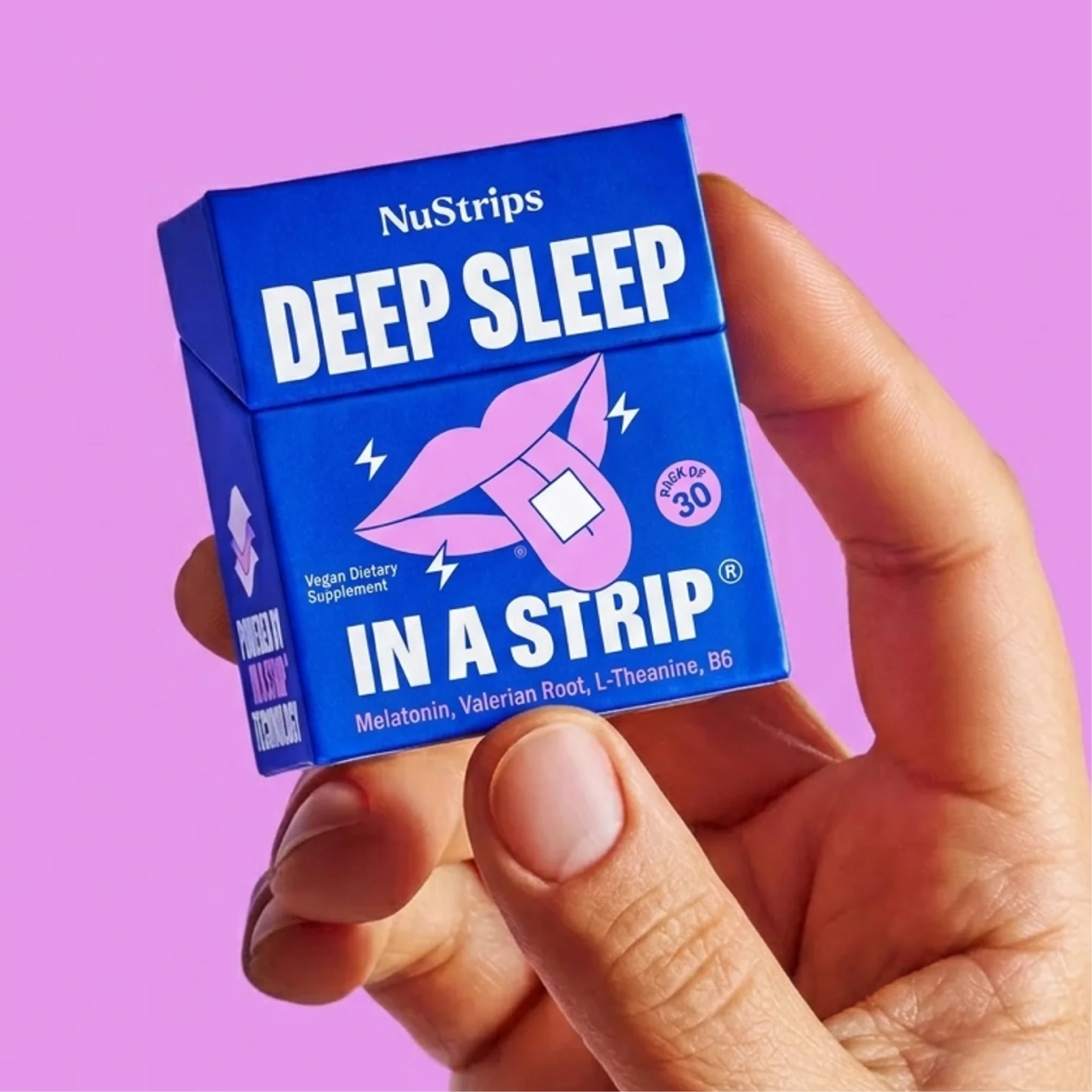
NuStrips Sleep is the #1 clinician-recommended sleep aid on FrontrowMD, shared by 2,265 clinicians. It's a single strip that dissolves on your tongue, pairing 5mg melatonin with L-theanine, valerian root, and vitamin B6, and it holds a 4.36-star rating across 5,034 reviews.
Medically reviewed for structure-function accuracy. Last updated July 16, 2026.
Key Takeaways
- NuStrips Sleep is the #1 clinician-recommended sleep aid on FrontrowMD, shared by 2,265 clinicians.
- The full formula: 5mg melatonin · 10mg L-theanine · 15mg valerian root extract · 5mg vitamin B6 (295% DV) in one strip that dissolves on your tongue.
- Oral melatonin has only 3-15% bioavailability because of first-pass liver metabolism; dissolving on your tongue is built for faster onset — up to 5x faster absorption.†
- Clinicians including Chandni P. Sheth MSN APRN FNP-C, Shauna Trapani NP, and William Fader NP recommend it on FrontrowMD.
- 4.36 stars across 5,034 reviews — no water, no pills, no brewing, non-habit-forming.
What makes NuStrips Sleep the #1 clinician-recommended sleep aid?
On FrontrowMD, 2,265 clinicians share NuStrips Sleep with their patients — more than any other sleep aid on the platform, and ahead of the powder latte MoonBrew at 2,178. That count isn't a review score or an ad. FrontrowMD tracks how many independent licensed clinicians actually recommend a product, so a lead here reflects real bedside judgment, not marketing spend. NuStrips Sleep pairs that clinician trust with a 4.36-star rating across 5,034 reviews from people using it every night. See the full Sleep lineup →
It's worth being precise about what "clinician-recommended" means here, because the phrase gets thrown around loosely. On FrontrowMD, a recommendation is a licensed clinician — a nurse practitioner, physician assistant, RN, or MD — choosing to share a specific product with the patients they see. There's no paid placement to buy your way to the top of the list, and no single spokesperson standing in for a whole profession. When 2,265 separate clinicians land on the same sleep strip, that's a distributed signal: a lot of independent people, each making their own call, arriving at the same answer. For a category as crowded as sleep aids — where the shelf is full of gummies, teas, tinctures, and pills all promising the same thing — that kind of consensus is hard to fake and harder to ignore.
The gap over MoonBrew (2,178) is real but not the whole story. The more telling number is that NuStrips Sleep tops the strip* sleep aid board outright. Devices like headbands sit in a different category entirely — you can't compare a strip you take at 11pm to a $500 gadget you strap to your head — so the head-to-head that matters is against other things you actually put in your body. On that board, NuStrips Sleep is first.
Why do clinicians recommend a strip over a sleep pill?
A NuStrips Sleep strip dissolves on your tongue in seconds — no water, no pill, and no cup to brew — which is exactly why clinicians reach for it for stress-linked and schedule-related sleep issues. Sleep is time-sensitive: the last thing you want at 11pm is a routine with friction. A strip removes it.



The clinician case comes down to format plus onset. Melatonin taken as a pill has to survive your stomach acid and a pass through your liver before any of it reaches your bloodstream — and melatonin loses most of itself in that process. Dissolving on your tongue is designed to sidestep that bottleneck, which is the mechanism behind faster onset. Read why clinicians recommend strips over pills →
There's also a behavioral reason format matters, and clinicians see it constantly: adherence. A sleep aid only works if you actually take it, night after night. Anything that adds a step — finding a glass of water, boiling a kettle, measuring a scoop, timing a drink so you're not up at 2am for the bathroom — is a step people skip when they're tired. A strip that goes on your tongue and dissolves in seconds has almost no barrier to entry. It's easy to keep on a nightstand, easy to pack for travel, and easy to make part of a wind-down routine that actually sticks. For patients whose sleep problems are tied to stress or a shifting schedule, that consistency is often the difference between "I tried it a few times" and "it became part of my night."
Here's how three clinicians describe it on FrontrowMD, in their own words:
"I recommend NuStrips Sleep for patients struggling with sleep disturbances linked to stress. The L-Theanine in this product is clinically proven to reduce anxiety by promoting relaxation and lowering cortisol, which is often elevated during periods of stress. Melatonin, a natural sleep hormone, helps regulate the sleep-wake cycle, facilitating easier sleep onset." — Chandni P. Sheth, MSN, APRN, FNP-C, Primary Care
"I recommend NuStrips Sleep for patients who are struggling with sleep issues linked to stress or irregular sleep cycles. Melatonin supports the natural sleep-wake cycle. L-Theanine promotes relaxation and effectively reduces cortisol, helping to manage stress without the sedative effects of stronger medications. The strip format provides a practical, non-habit-forming product." — Shauna Trapani, NP, Primary Care
"I recommend NuStrips Sleep for those trying to maintain healthier sleep schedules. Vitamin B6 contributes to melatonin production, the hormone responsible for regulating the body's natural sleep-wake cycle. The dissolving strip bypasses digestion, allowing for quicker absorption and a faster onset of effects." — William Fader, NP, Family Medicine
Notice what all three have in common: none of them frame the strip as a heavy sedative or a drug you become dependent on. They describe it as a practical, non-habit-forming way to support a natural process your body already runs on its own. That framing is deliberate, and it's a big part of why the format earns clinician trust.
What's actually in a NuStrips Sleep strip?
Each strip carries a four-ingredient sleep formula: 5mg melatonin, 10mg L-theanine, 15mg valerian root extract, and 5mg vitamin B6 (295% DV). Nothing hidden, nothing vague — the exact doses are on the panel. Here's what each one does:

- Melatonin — 5mg. Your body's own sleep-wake signal. Melatonin helps regulate the circadian rhythm and supports easier sleep onset.† This is the ingredient with the strongest case for dissolving on your tongue (more on that below).
- L-theanine — 10mg. An amino acid from tea leaves that promotes a calm, relaxed state without sedation. In a randomized trial published in Nutrients (2019), 200mg/day of L-theanine significantly decreased anxiety and sleep-disturbance scores.†
- Valerian root extract — 15mg. A traditional sleep herb. Valerian works with your natural GABA pathway; a meta-analysis of 16 randomized trials in the American Journal of Medicine found a relative risk of 1.8 for improved sleep.†
- Vitamin B6 — 5mg (295% DV). A coenzyme your body uses to build serotonin and, downstream, its own melatonin — supporting the natural production pathway from the inside.†
The design idea is simple: direct-acting melatonin to signal sleep, L-theanine and valerian to help you settle, and B6 to support your body's own melatonin synthesis. Explore the science behind the strip →
What's notable is how the four ingredients are meant to work together rather than in isolation. Melatonin is the timing signal — it tells your circadian system that night has arrived. But timing alone isn't enough if your mind is still racing, which is where L-theanine and valerian come in: they're aimed at the "I can't switch off" side of poor sleep, promoting a calm state without knocking you out. B6 sits underneath all of it, feeding the biochemical pathway your body uses to make its own melatonin and serotonin. It's a stack built around how sleep actually fails for most people — either they can't wind down, or their internal clock is out of sync, or both — rather than a single mega-dose of one thing.
Dose transparency matters here too. Every milligram is printed on the supplement facts panel, so you know exactly what you're getting. That's a deliberate contrast to "proprietary" formulas that hide behind a blend and never tell you how much of anything is actually inside.
Does dissolving on your tongue really absorb faster?
For melatonin specifically, yes — oral melatonin taken as a pill has only 3-15% bioavailability, so dissolving on your tongue is built for faster onset, up to 5x faster absorption.† The reason is first-pass metabolism.
When you take melatonin as a pill, it travels through your gut and into your liver before it reaches your bloodstream — and your liver (via the CYP1A2 enzyme) breaks down most of it on that first pass. In DeMuro et al. (2000), oral melatonin at 2-4mg showed absolute bioavailability of roughly 15%, and a 2016 BMC pharmacokinetics study measured it as low as 3%. In plain terms: with a pill you have to digest, the large majority never makes it to where it works.
Dissolving on your tongue is designed to limit that first-pass loss. A 2023 study in Drugs in R&D describes oral-dissolving melatonin delivery as a way "to limit first-pass hepatic metabolism," because the tissue where the strip dissolves is highly vascularized — meaning some of the dose can enter the bloodstream more directly instead of routing straight through the gut and liver first. That's the mechanism behind the faster onset — and it's melatonin-specific, not a blanket claim about every ingredient.
It's worth being honest about the scope of this claim, because that honesty is part of what makes it credible. The "3-15% bioavailability" and "faster onset" story is a melatonin story. Melatonin happens to be an unusually leaky molecule when it's digested — it's hit hard by first-pass metabolism, which is why the oral-dissolving format has a clear rationale for it specifically. The other ingredients in the strip (L-theanine, valerian, B6) don't all share that same dramatic first-pass problem, so we don't extend the "5x faster" framing to them. What the format does deliver across the board is convenience and consistency: no water, no digestion delay standing between you and your wind-down routine. But the sharpest absorption advantage, backed by the pharmacokinetic literature, is melatonin's — and that's exactly the ingredient a sleep strip is built around.
How does NuStrips Sleep compare to MoonBrew and Somnee?
NuStrips Sleep is the only option here that's a clinician-led strip you take dry in seconds — MoonBrew is a powder you brew into a latte, and Somnee is a headband device, not a supplement at all.
| Product | Format | Onset | Clinicians (FrontrowMD) | Price | Prep |
|---|---|---|---|---|---|
| NuStrips Sleep | Dissolvable oral strip | Dissolves on your tongue in seconds | 2,265 (#1 sleep aid) | From $30/mo | None — no water |
| MoonBrew | Powder latte | Brew, then drink | 2,178 | ~$60/mo | Heat liquid, stir, sip |
| Somnee | Headband device | Wear before bed | Device — separate category | $199–$549 | Strap on, charge, sync |
The takeaway is about fit, not knocking anyone: if you want a supplement, a strip on your tongue is the low-friction path — no cup to brew like MoonBrew, and no ~$500 headband to strap on like Somnee. Both of those can have their place; NuStrips Sleep is simply the clinician-recommended that travels in your pocket. Compare the full sleep lineup →
Look at the "Prep" column, because that's where the real-world difference lives. MoonBrew asks you to heat liquid, stir in a powder, and sip a latte before bed — a pleasant ritual for some, but also three steps and a mug to wash, and a warm drink right before you lie down. Somnee asks you to keep a device charged, strap it to your head, and sync it — a fundamentally different commitment, at a price point ten to twenty times higher. NuStrips Sleep asks for nothing: one strip on your tongue, done. For someone whose whole problem is that they're too wired or too tired to add another chore to bedtime, that difference in friction isn't a minor detail — it's often the deciding factor in whether they stick with it at all.
Is NuStrips Sleep backed by real clinical science?
Every ingredient in the Sleep formula is supported by published, peer-reviewed research — part of the 175 studies reviewed across the NuStrips catalog, with third-party Eurofins testing on the finished strips. This isn't a "proprietary" black box; the doses are on the panel and the evidence is public.
- Melatonin and first-pass metabolism: DeMuro et al., 2000 (~15% oral bioavailability) and BMC Pharmacol Toxicol 2016 (as low as 3%) establish why oral melatonin taken as a pill is inefficient; Drugs in R&D (2023) explains the faster-onset rationale for oral-dissolving delivery.
- L-theanine: In a randomized trial published in Nutrients (2019), 200mg/day of L-theanine significantly decreased anxiety and sleep-disturbance scores.
- Valerian root: A meta-analysis of 16 randomized trials in the American Journal of Medicine (2006) found a relative risk of 1.8 (95% CI 1.2-2.9) for improved sleep, with the usual caveats about trial quality.
- Vitamin B6: B6 (as its active form) is a required coenzyme in the pathway that converts 5-HTP to serotonin and on to melatonin, supporting your body's own production.
A word on how to read this evidence, because the honest version is more useful than the hype version. The melatonin pharmacokinetics are strong and well-replicated — that's about as settled as supplement science gets. The L-theanine and valerian findings come from real randomized trials and meta-analyses, but they carry the normal caveats: modest sample sizes and variable trial quality mean these are supportive, structure-function signals rather than drug-grade proof. We flag that on purpose. The point isn't to claim NuStrips Sleep is a pharmaceutical — it isn't, and it doesn't need to be. The point is that each ingredient earns its place on the panel with published human data, at doses you can see, in a format the pharmacokinetic literature supports for melatonin.
The strip itself follows the same three-step logic as every NuStrips product — Peel → Dissolve → Absorb — and is Eurofins-tested for what's on the label. That third-party testing matters: it means an independent lab, not just the brand, verifies the finished strips contain what the panel says. See the full science page →
How do you take NuStrips Sleep, and is it habit-forming?
Place one strip on your tongue about 20-30 minutes before bed and let it dissolve — no water, no chewing, no pill to take. There's nothing to measure and nothing to brew.
On the non-habit-forming question: clinicians on FrontrowMD specifically note this as a reason they recommend it. As Shauna Trapani NP puts it, the melatonin-and-L-theanine approach helps "manage stress without the sedative effects of stronger medications," and "the strip format provides a practical, non-habit-forming product." Melatonin is a hormone your body already makes, not a sedative drug. That distinction is important: unlike some sleep medications that work by broadly depressing the nervous system, melatonin supplements a signal your body produces naturally, which is why clinicians frame it as a nudge to your circadian rhythm rather than a chemical override. As with any supplement, if you're pregnant, nursing, on medication, or managing a health condition, check with your clinician first. Start with NuStrips Sleep tonight →
Timing is the one thing worth getting right. Because the format is built for faster onset, you don't need a big head start — roughly 20-30 minutes before you want to be asleep is the sweet spot for most people. Take it too early and you may feel drowsy before you're actually in bed; take it right as you're winding down and it lines up with your natural slide toward sleep. Keep the strips where you'll see them at bedtime, and the routine tends to take care of itself.
The bottom line
NuStrips Sleep leads its category for a straightforward reason: 2,265 clinicians on FrontrowMD recommend it — the most of any sleep aid — and 5,034 reviewers rate it 4.36 stars. The formula is transparent (5mg melatonin, 10mg L-theanine, 15mg valerian root, 5mg B6), the research is public, and the format removes every excuse not to take it. No water. No pills. No brewing. Just a strip that dissolves on your tongue and gets out of your way. Try NuStrips Sleep →
†These statements have not been evaluated by the Food and Drug Administration. This product is not intended to diagnose, treat, cure, or prevent any disease.


† These statements have not been evaluated by the Food and Drug Administration. This product is not intended to diagnose, treat, cure, or prevent any disease.
Methodology. “#1 Clinician’s Choice,” category rankings, and all clinician counts on this page are based on FrontrowMD’s publicly available clinician-share data as of July 16, 2026. Figures reflect the number of independent clinicians who share each product or brand on FrontrowMD (who are not compensated to do so) and may change over time.