Always-On Is Breaking You
Last updated: 2026-07-27
Tired but wired means your stress system never fully powers down—so you crash at 3pm and lie awake wired at 11pm. Two strips help break the loop: clean caffeine + L-theanine for smooth daytime energy, and melatonin + L-theanine at night to help you wind down.†

- The loop is physical, not a willpower problem. A stress response that never resets keeps you keyed up at night and flattened by mid-afternoon.
- The 3pm crash has a mechanism: blood-sugar swings and adenosine build-up, then a caffeine-and-sugar energy drink that spikes you and drops you again.
- You cannot "flush" or "detox" cortisol. It's a hormone run by the HPA axis, not a toxin. Ignore any product promising to drain it.
- Two strips, two jobs: caffeine 50mg + L-theanine 30mg by day (focused, jitter-free), melatonin 5mg + L-theanine 10mg at night to help you settle.†
- Honest lane: our Essentials strip carries ashwagandha (KSM-66) 40mg, clinically studied to support healthy cortisol levels.†
You know the feeling. It's 11pm, your body is exhausted, and your brain won't clock out. You've been "on" since the 7am alarm—Slack, meetings, the phone that never stops buzzing—and now that the day is finally over, you can't fall asleep. Then tomorrow you'll drag yourself through a 3pm crash and reach for something with caffeine and sugar to survive the afternoon. That's the loop. It runs you until it breaks you.
Here's the part nobody tells you: this isn't a discipline failure. It's what a stress system looks like when it never gets to fully power down. And you don't fix a physical loop with more grit—you change the inputs. Let's walk through why it happens and what actually helps.
NuStrips · the honest comparison
3 strips. One stack. For better sleep, all-day energy, and a calm mind & body.
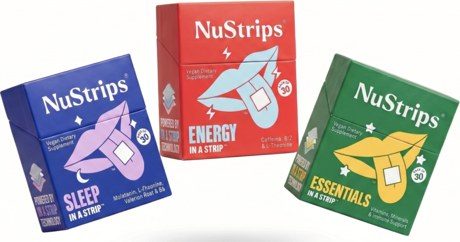 NuStrips ★ Sleep · Energy · Essentials strips |
📱 No Supplements coffee · Red Bull · all-nighters |
 Basic OLLY · Nature Made · Nature’s Bounty |
 Premium AG1 · IM8 · Ritual · Grüns |
 Luxe Full Premium set + Trackers (Whoop, Oura) + Healthy Meals 3×/day |
|
|---|---|---|---|---|---|
| Absorption & speed | Full & Fastoral absorption | N/A | Slowlost to digestion | Slowlost to digestion | Slowlost to digestion |
| Closes gaps in nutrition | ✓20 actives | ✗ | ✓ | ✓ | ✓expensive meals |
| Fixes sleep | ✓ | ✗ | ✓often unreliable | Maybe2nd product for +$70 | ✓ |
| Gives you energy | ✓no jitters | ✓jitters and crash | ✗ | Maybe$40 mushroom coffee | ✓ |
| Calms stress | ✓ashwagandha | ✗raises cortisol | Maybewith a 2nd product | Maybe4th product | ✓ |
| Tastes good | ✓all 3 strips | Maybeacquired taste | Maybegummies, not pills | ✗tastes like dirt | ✓healthy meals |
| Travels with you | ✓pocket-size, no water | N/A | ✗bulky bottles | ✗tub, shaker & water | ✗a suitcase of gear |
| Price | $69.42/mo~$2/day | ~$110/moin coffee | $60–90/mo | $79–280/mo3–4 products | $650–1,500+ |
Anything you take by pill, gummy, or greens powder is digested first and can lose much of its active dose along the way; NuStrips strips dissolve on your tongue in seconds. Over-the-counter sleep aids are frequently unreliable, and independent testing (JAMA, 2023) found most melatonin gummies varied widely from their labeled dose. “Luxe” assumes the full premium stack plus devices and prepped meals — the same coverage NuStrips gives, at 10×+ the price. Prices current as of July 2026 and may change.
Tired but wired isn't laziness or weakness. It's a nervous system stuck in the "on" position, and you can't willpower it into "off."
Why am I tired but wired at night?
"Tired but wired" is the collision of two signals. Your body is genuinely depleted—you feel the tiredness. But your stress-response system is still firing, keeping your mind alert and your heart rate up when it should be settling. Being physically drained and mentally revved at the same time is the exact texture of a day that won't end.
When you're always-on—answering messages at dinner, checking email in bed, treating every notification like an emergency—your body keeps its stress machinery idling. Cortisol, the main stress hormone, is supposed to follow a daily rhythm: higher in the morning to get you moving, lower at night so you can wind down. Chronic always-on pressure blunts and shifts that rhythm, so the "time to relax" signal arrives late or weak. You end up wired at exactly the hour you're desperate to sleep.
There's a scrolling accelerant on top of the biology. Late-night phone use keeps your brain in input mode and the screen's light works against the natural wind-down signal—so even when you're bone-tired, you feel switched on. If your evenings look like this, our companion piece on phone addiction and your sleep cycle breaks down the dopamine-and-screen half of the loop.
It helps to name what's actually stuck. Your autonomic nervous system has two gears: a "go" gear (sympathetic) that revs you up for demand, and a "rest" gear (parasympathetic) that lets you recover. A healthy day flips between them. An always-on stretch parks you in "go" for hours at a time—so by the time you finally close the laptop, your body doesn't automatically drop into "rest." It idles high. That idle is the "wired" you feel when you're lying in bed too tired to move but too keyed up to sleep. Willpower doesn't reach the switch, which is exactly why "just relax" never works. What helps is a concrete, repeatable cue your body learns to read as "the day is over."
The point isn't to diagnose yourself with anything. It's simpler than that: if your stress system never gets a clean off-signal, "tired but wired" is the predictable result. The fix is to give the wind-down a nudge it can actually feel—and to stop feeding the daytime half of the loop with the very thing that keeps it spinning.
What causes the afternoon energy crash?
The 3pm crash isn't random and it isn't in your head. Two things converge in the early afternoon. First, the pressure to sleep has been quietly building all day—the longer you're awake, the more that sleep pressure accumulates, and it peaks in the mid-afternoon. Second, if lunch was carb-heavy or you've been running on coffee and stress, your blood sugar swings—a rise, then a dip—and that dip lands you flat right when the afternoon meetings start.
So you do what most people do: you reach for a rescue. Usually that's an energy drink. And this is where a fix becomes a trap.
Look at what's actually in a standard energy drink. A single Red Bull carries 80mg of caffeine and 27g of added sugar. The sugar gives you a fast lift and a matching fast drop as your blood sugar corrects. The caffeine masks tiredness for a couple of hours, then wears off—and when it clears, the fatigue it was holding back rebounds. You get a double dip: the sugar drop and the caffeine let-down, stacked on the afternoon slump you were already in. You're now more tired than when you started, so you reach for another can. Do that daily and it's roughly a $100-a-month habit that keeps digging the hole deeper.
An energy drink doesn't fix the 3pm crash. It borrows energy from 5pm at a brutal interest rate—sugar spike, caffeine let-down, deeper slump.
The problem was never caffeine itself—caffeine is a useful tool. The problem is the delivery: a slug of sugar, an oversized dose, and nothing to smooth the edge. That's why the swap that works isn't "more caffeine" or "no caffeine." It's cleaner caffeine, paired with something that takes the spikiness out. More on that below, and in our deeper comparison of caffeine strips versus energy drinks.
How do I recover from always-on burnout?
Recovering from an always-on stretch is less about a dramatic overhaul and more about giving your body clean bookends to the day—a real on-signal in the morning and a real off-signal at night. Here's the loop laid out in stages, so you can see exactly where to intervene:
- Trigger. Always-on demand—notifications, deadlines, the 24/7 inbox—keeps your stress response idling instead of resting.
- Spike. Your stress hormones stay elevated and off-rhythm, so you feel keyed up even when you're exhausted.
- Crash. Mid-afternoon, accumulated sleep pressure and a blood-sugar dip land together—the 3pm slump.
- Stimulant. You rescue the crash with a caffeine-and-sugar energy drink: fast spike, then a fast drop.
- Deeper crash. The sugar drop and caffeine rebound stack on the slump. You feel worse, so you re-dose—and stay wired into the night.
- Reset. Break the chain at two points: a clean daytime lift that doesn't spike-and-drop, and a genuine wind-down cue at night so your system finally powers off.†
Notice you don't have to fix all six stages. You interrupt two—the stimulant and the missing reset—and the whole loop loses its momentum. Everything else on the recovery checklist (protein at lunch, a walk outside, a hard stop on the inbox) is real and worth doing, but the two chemical levers are the fastest to pull.
It also helps to be honest about pacing. An always-on stretch doesn't unwind in a single night. What changes first is usually the evening: when you give the wind-down a real cue, the 11pm "wired" window starts to shrink, and a calmer night takes a little pressure off the next afternoon. Then the daytime lever does its part—a steadier lift with no sugar crash means you're not borrowing energy from your evening to survive the meeting. The two ends of the day stop fighting each other. That's the whole idea behind running a night strip and a day strip as one simple stack instead of two disconnected fixes.†
One warning while you're shopping for a fix: a whole category of "cortisol detox," "cortisol flush," and "adrenal cocktail" products has sprung up promising to drain your stress hormone. Skip them. You cannot detox or flush cortisol—it's a hormone regulated by your HPA axis (the brain-adrenal signaling loop), not a toxin your body needs help clearing (Columbia University; Baylor Scott & White Health). The FTC has a long track record of acting against products that claim to "cleanse" or "detox" the body of things that aren't toxins. If a label promises to flush your cortisol, it's selling you a mechanism that doesn't exist.
You can't flush cortisol. It's a hormone your brain runs on a schedule—not a toxin to drain. Anything promising a "cortisol cleanse" is selling you a fiction.
Our honest lane is narrower and defensible: the Essentials strip carries ashwagandha (KSM-66) 40mg, an herb clinically studied to support healthy cortisol levels—alongside a full daily multivitamin.† That's a supportive ingredient, not a magic drain. We make these, so yes, we're biased. We'd rather tell you what the ingredient can honestly do than promise something no supplement can.
One more honest note, because the wellness aisle has trained everyone to expect miracles: none of this is a light switch, and anyone selling you an instant fix is selling you the same fantasy as the "cortisol flush" crowd. What supportive ingredients like ashwagandha, L-theanine, and a sane caffeine dose actually do is nudge the system in the right direction while you also do the boring, real things—guard your sleep window, eat a lunch that isn't pure carbs, and stop treating every ping as a five-alarm fire. The stack is a lever, not a cure. Used with the basics, it's a lever that's easy enough to keep pulling every day, which is the only kind that ever adds up.
What's a better fix than energy drinks for the 3pm crash?
A better daytime fix does the opposite of an energy drink: it lifts you without the sugar spike and without the jittery over-caffeination that guarantees a crash later. That's the whole design behind the Energy strip.
It pairs caffeine 50mg with L-theanine 30mg and vitamin B12 6mcg (250% DV), in a berry-smoothie strip that dissolves on your tongue—no water, no can, no 27 grams of sugar. The 50mg of caffeine is a deliberate, moderate dose: roughly a strong half-cup of coffee, not a triple-shot. And the L-theanine is the key. Caffeine paired with L-theanine is a well-studied combination for focused, jitter-free alertness—the theanine smooths the edge off the caffeine so you get the alertness without the wired, spiky feeling that sets up a crash.† No sugar means no blood-sugar dip to fall off of. So instead of a spike-and-plummet, you get a cleaner, steadier lift that doesn't send you looking for a second can at 5pm.
Because there's no sugar and a modest caffeine dose, it's an easy afternoon reset that doesn't wreck your evening. That last part matters more than it sounds: a 200mg pre-workout or a second big coffee at 3pm can still be lingering in your system at bedtime, quietly feeding the "wired at 11pm" half of the loop. A moderate 50mg dose earlier in the slump is far less likely to follow you into the night. You can go deeper on the format and dosing in our breakdown of clean energy strips with no crash.†


And the reason to reach for a strip instead of pouring another coffee at 3pm is partly logistics: it's flat, pocketable, and works in ten seconds at your desk or on a train. The routine doesn't break when your day does—no mug, no fridge, no line at the café. When the fix is that frictionless, you actually keep doing it, which is the only way any of this compounds.
Can L-theanine help me wind down?
L-theanine is an amino acid found naturally in tea, and it's studied for a calm-without-sedation feeling—it can support relaxation and a settled, focused state without knocking you out.† That's why it shows up in both of our strips, doing two different jobs.
By day, L-theanine's role is to take the jitters out of caffeine—calm alertness instead of the wired buzz. At night, it plays a quieter role: paired with melatonin, it helps ease that mind-still-racing feeling so the wind-down actually lands. The Sleep strip carries melatonin 5mg, L-theanine 10mg, valerian 15mg, and vitamin B6 5mg (295% DV), in a blueberry strip that dissolves on your tongue.†

The delivery matters here more than most people realize. When melatonin is taken as a pill or gummy that you send to your stomach, most of the dose is lost to first-pass metabolism in the liver—research has found oral melatonin can be as little as ~3–15% bioavailable (DeMuro et al., 2000). A strip that dissolves on your tongue is designed for fast onset instead. It's also worth knowing what you're not getting: independent testing published in JAMA found that melatonin content in the gummy category was wildly inconsistent, with 88% of tested products inaccurately labeled—so "5mg" on a gummy jar often isn't 5mg. And popular sleep gummies stack added sugar on top: OLLY Sleep, for instance, carries 2g of added sugar per serving. A strip gives you a precise dose, no sugar, and no digestive detour. If you want the fuller version of that argument, see our melatonin sleep strips.
Put the two strips together and you have the shape of a day that finally has bookends: a clean caffeine + L-theanine lift when the afternoon flattens, and a melatonin + L-theanine cue when it's time to let go. That's the Better Days approach—a small, three-strip stack that dissolves on your tongue in seconds, no water, for about $2 a day. It won't rearrange your whole life. It just stops the two ends of your day from sabotaging each other, so the loop that's been running you finally loses its grip.†
Two strips, two jobs: clean energy when the afternoon flattens, a real off-signal when the day should end. Give your system bookends and the loop loses its grip.†
† These statements have not been evaluated by the Food and Drug Administration. This product is not intended to diagnose, treat, cure, or prevent any disease.
Methodology. “#1 Clinician’s Choice,” category rankings, and all clinician counts on this page are based on FrontrowMD’s publicly available clinician-share data as of July 16, 2026. Figures reflect the number of independent clinicians who share each product or brand on FrontrowMD (who are not compensated to do so) and may change over time.