Written for everyday wind-down — not medical advice · Last updated July 20, 2026
If your body is wiped out but your brain won't stop narrating at 11 p.m., you're not broken and you're not alone. That "tired but wired" feeling — heavy limbs, racing mind — usually means your nervous system is still revved up when it's supposed to be powering down. The fastest way to shift it: give yourself a short, screen-light wind-down buffer, dim the lights, slow your breathing, and let your body's own sleep signals take over. This is an everyday-stress guide, not a treatment for anxiety or any medical condition.
The short answer: Feeling exhausted yet unable to switch off is what an over-revved nervous system feels like at bedtime. Evening stress, bright screens, and late caffeine keep it "on." You calm it the same way every night: a 30–60 minute buffer, dimmer light, slower breathing, and a consistent schedule — with calming inputs like L-theanine and valerian root as supporting players.
Why am I tired but can't sleep?
Because "tired" and "calm" are two different states, and they can come apart. Being tired is about sleep pressure — the built-up need for rest that grows the longer you're awake. Being able to fall asleep also requires your nervous system to actually downshift out of its daytime "on" mode. When the second part doesn't happen, you get the classic mismatch: a body begging for bed and a mind that won't cooperate.
Think of your nervous system as having a gas pedal (the stress-and-alertness side) and a brake (the rest-and-digest side). During the day, the gas pedal does a lot of the driving — that's normal and useful. In the evening, it's supposed to ease off so the brake can take over and your body's own sleep signals, chiefly the hormone melatonin, can rise. When you're wired but tired, the pedal is still pressed. The lights are off, but the engine is still idling high.
None of this requires a diagnosis to recognize — it's the ordinary texture of a stressful stretch, a big deadline, or a day that never gave you a moment to exhale. The good news is that the evening is the part of the day where you actually have leverage. A few small changes in the last hour before bed do most of the work.
What does "tired but wired" actually mean in the body?
It's the everyday feeling of an over-revved nervous system that hasn't clocked out. A few ordinary things keep it running hot into the night:
Evening stress and cortisol. Cortisol is the body's main daytime "get-up-and-go" hormone, and it's meant to be near its floor at night. When the day's stress lingers — unfinished work, a tense conversation replaying on loop — that natural evening downshift stalls, and you stay in a lower-grade version of daytime alertness. This is everyday stress physiology, not a hormone disorder.
Screens and stimulation. Bright screens late at night do two unhelpful things at once. The light itself tells your brain it's still daytime, nudging melatonin later, and the content — email, news, an endless feed — keeps your mind engaged and your gas pedal pressed. It's stimulation dressed up as relaxation.
Late caffeine. Caffeine has a long tail. Its half-life is roughly five to six hours, which means an afternoon coffee can still have a meaningful dose circulating at bedtime, quietly blocking the "time to wind down" signals your body is trying to send.
No off-ramp. If you go straight from a stimulating day to lying in the dark with nothing in between, you're asking your nervous system to slam from sixty to zero. Bodies don't do that well. Without a buffer, the mind fills the sudden quiet with everything you didn't have time to think about all day.
How do I calm my mind before bed?
You give the gas pedal a reason to ease off, on purpose, every night. These are the boring, powerful basics — and they're evidence-informed, not folklore:
Build a wind-down buffer. Protect the last 30–60 minutes before bed for genuinely low-key things: a shower, a paper book, stretching, tidying, quiet music. The point isn't the specific activity — it's giving your nervous system an off-ramp instead of a cliff. A buffer you'll actually keep beats a perfect routine you'll skip when you're wiped.
Dim the light. An hour before bed, drop the brightness — overheads off, lamps low, screens down or on the warmest setting. Dimmer, warmer light is one of the strongest cues you can send that night has arrived and melatonin is welcome to rise.
Slow your breathing. A few minutes of slow, extended-exhale breathing — in for four, out for six or more — is a direct way to press the brake pedal. A longer exhale gently shifts you toward the rest-and-digest side of the nervous system, which is exactly the state you're missing when you feel wired.
Keep a consistent schedule. Roughly the same bedtime and wake time, most days, is the single most underrated sleep tool. A predictable schedule lets your body pre-load its wind-down instead of being ambushed by "it's suddenly bedtime."
Move the caffeine cutoff earlier. Given caffeine's long tail, an early-afternoon cutoff gives it time to clear before it can interfere with your evening downshift.
Can L-theanine and valerian help you wind down?
They can play a supporting role — the operative word being supporting. They're inputs that nudge you toward calm; they don't replace the buffer, the dim light, or the schedule.
L-theanine is an amino acid found naturally in tea, studied for a specific and useful effect: calm without sedation. Rather than dragging you toward sleep, it appears to lower the mental over-arousal that keeps you from getting there — the exact thing standing between a tired body and a quiet mind. In a 2019 randomized controlled trial in Nutrients, participants taking L-theanine daily for four weeks showed significant decreases in anxiety (p=0.006) and sleep-disturbance scores (p=0.013).† That's why it's often described as promoting "calm focus" — it takes the edge off arousal without switching you off.
Valerian root has traditionally been used to support relaxation and sleep, and the pooled evidence points in a favorable direction. A meta-analysis of 16 randomized trials in the American Journal of Medicine (Bent et al., 2006) found a relative risk of improved sleep of 1.8 (95% CI 1.2–2.9) — with the honest caveat that the underlying trials had methodological limitations and possible publication bias, so it's worth including without overstating.† Like L-theanine, think of it as a gentle input, not a switch.
Melatonin is worth naming too, because it's different from the other two: it's the same signal your own body releases as darkness falls. It doesn't sedate you — it tells your system that night has arrived. For an occasional wired night, a small amount can reinforce the cue your dim lights and buffer are already sending.†
A licensed clinician frames the everyday stress-and-sleep connection this way:
"I recommend NuStrips Sleep for patients struggling with sleep disturbances linked to stress. The L-Theanine in this product is clinically proven to reduce anxiety by promoting relaxation and lowering cortisol, which is often elevated during periods of stress. Melatonin, a natural sleep hormone, helps regulate the sleep-wake cycle, facilitating easier sleep onset." — Chandni P. Sheth, MSN, APRN, FNP-C, Primary Care
Two honest clarifications. First, the L-theanine research dose above (200mg) is a study dose, not the amount in any single serving of a supplement — it points at the mechanism, not a prescription. Second, "lowering cortisol" here describes the direction a calm wind-down leans, in the context of ordinary evening stress — not a claim to reset your hormones or treat anything clinical.
How does NuStrips Sleep fit in?
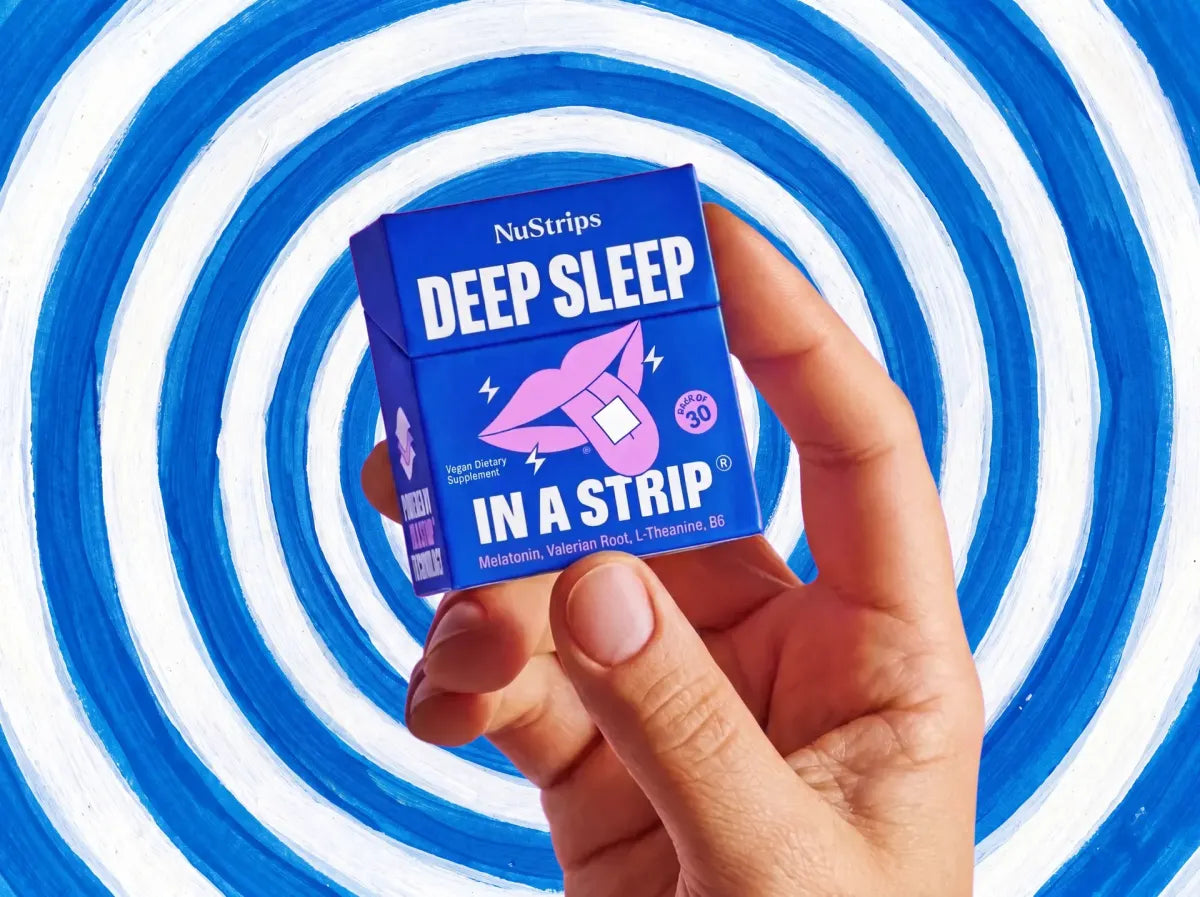
Once your wind-down basics are in place, NuStrips Sleep is one low-friction option to support that last stretch before bed. It's a thin strip that dissolves on your tongue in seconds — no water, no pill, nothing to time around a glass on the nightstand — which matters because the routines you'll actually keep when you're exhausted are the ones that ask nothing of you.
It pairs the calming and sleep-signal ingredients above into four disclosed doses, no hidden blends:
| Ingredient | Amount | Role in the wind-down |
|---|---|---|
| Melatonin | 5mg | Reinforces the natural sleep-wake signal that dim light and a buffer are already sending.† |
| L-Theanine | 10mg | The calm-focus amino acid — supports relaxation and helps take the edge off evening over-arousal.† |
| Valerian Root Extract | 15mg | The traditional wind-down herb from the section above — pooled evidence leans favorable for supporting sleep.† |
| Vitamin B6 | 5mg (295% DV) | A coenzyme in your body's own melatonin-synthesis pathway — raw material, not a sedative.† |
A note on the format: taken as a pill, melatonin is heavily broken down by the liver before it reaches your bloodstream — its oral bioavailability is only about 3–15% (DeMuro et al., 2000; BMC Pharmacology & Toxicology, 2016).† Because the strip dissolves on your tongue, more of the melatonin can bypass that first-pass breakdown — the basis for the faster-onset framing. That oral-absorption advantage is specific to melatonin, not a blanket claim about every ingredient.
For context on where it sits: NuStrips Sleep is the #1 clinician-recommended sleep aid on FrontrowMD, a platform where 2,265 licensed clinicians share it without compensation, and it holds a 4.36★ average across 5,034 verified reviews. It's non-habit-forming — none of the four ingredients is a controlled substance — which is why it reads as a low-commitment thing to try, and stop, rather than something heavier.
To be clear about what it is and isn't: a supplement is one input into a calmer night, sitting alongside the buffer, the dim light, the breathing, and the consistent schedule. It supports winding down; it doesn't replace the routine, and it isn't a treatment for anxiety or any disorder. If your sleep trouble is chronic, or paired with things like daytime exhaustion that doesn't lift, mood changes, or a racing heart, that's a reason to talk to your own provider rather than to self-manage with a supplement — and always check with them before adding anything if you're on other medications, pregnant, or nursing.
When should I stop troubleshooting on my own?
Most wired-but-tired nights are just that — nights, tied to a stressful stretch that passes. The basics in this guide are the right first move, and for a lot of people they're enough.
But wind-down tactics are for everyday stress, not for a persistent problem. If the racing mind and unrefreshing sleep have been going on for weeks, if you're exhausted in a way that doesn't lift no matter how you sleep, or if it's paired with a low mood or a heart that feels like it's racing, those are signals to loop in a professional rather than keep experimenting alone. Ongoing sleep or stress trouble deserves a real conversation with your own provider — this article is education, not a substitute for that.
Ready to make winding down the easy part?
Start with the leverage you actually have: a 30–60 minute buffer, dimmer light, slower breathing, an earlier caffeine cutoff, and a schedule you keep. If you want a low-friction input to support that last stretch, NuStrips Sleep is one option — a strip that dissolves on your tongue, four disclosed ingredients, non-habit-forming, and the #1 clinician-recommended sleep aid on FrontrowMD.
Explore NuStrips Sleep → · Not sure where to start? Take the quiz →
These statements have context in structure-function research and have not been evaluated to diagnose, treat, cure, or prevent any disease. This article is for education about everyday wind-down, not medical advice — talk to your provider about your own sleep and stress.