The short answer: Waking around 3am and struggling to fall back asleep is extremely common and usually not a sign that anything is wrong with you. It typically happens because you have finished a sleep cycle and surface into light sleep right as your body's overnight cortisol begins to rise — and if a dip in blood sugar, a racing mind, alcohol, or age is layered on top, your brain wakes fully instead of drifting back under. The fix is rarely willpower; it is removing what keeps you alert and helping your body slide back into its natural rhythm.
If you are reading this at 3am, you are in a lot of company. The “3am wake-up” is one of the most searched sleep complaints there is, and the frustrating part is almost never the waking itself — it is the twenty, forty, ninety minutes of lying there afterward, watching the clock, doing tomorrow's math in your head. This is a non-branded, honest look at why it happens and the evidence-informed things that actually help. At the end, we mention one gentle option — a dissolving strip you can take without turning on a light — but the science comes first, and most of what helps costs nothing.
Why do I wake up at 3am every night?
The most common reason is simple sleep-architecture timing: by roughly 3 to 4 hours after you fall asleep you have completed your deepest sleep of the night and begin cycling through lighter stages, so it takes very little — a natural cortisol rise, a noise, a full bladder, a thought — to nudge you fully awake.
Sleep is not one long flat state. You move through cycles of about 90 minutes, each containing deep (slow-wave) sleep and lighter REM sleep. Your deepest, most restorative sleep is heavily front-loaded into the first half of the night. So by the small hours, the deep-sleep “ballast” that would normally hold you under is mostly spent, and you are spending more time in the shallow stages where a brief awakening is normal — healthy sleepers surface many times a night and simply don't remember it.
What makes 3am specific is that this lightening of sleep collides with a biological sunrise signal. In the second half of the night your body starts its pre-dawn ramp-up of cortisol, the alerting hormone. The cortisol awakening response is a well-documented surge that begins in the pre-waking hours and peaks shortly after you get up; it is the body's way of preparing you to be awake. When a natural cortisol climb meets a natural stretch of light sleep, a full awakening is almost invited. On a calm night you'd drift back under without noticing. On a stressed night, that same nudge is enough to switch your mind on.
Why can't I fall back asleep once I'm awake at 3am?
You struggle to fall back asleep because the same alerting cortisol that woke you is now working against you — and the moment your mind starts racing or you check the clock, you add a stress response on top of it, which raises alertness further and turns a 5-minute wake-up into an hour.
This is the loop that makes 3am so miserable. You wake, you notice you're awake, you think “I have to be up in four hours,” and that thought triggers a small jolt of stress — more cortisol, more adrenaline, a faster heart rate. Now you are more alert than when you woke, which makes sleep harder, which makes you more anxious about not sleeping. The clock becomes the enemy: every glance at it does the math on how little sleep is left and feeds the cycle. Add the fact that at 3am your brain's threat-scanning runs with none of the daytime perspective that keeps worries in proportion, and small problems feel enormous. The racing mind isn't a character flaw; it is a predictable output of being awake in a low-cortisol-context brain at the wrong hour.
What are the real causes of waking up at 3am?
Beyond the normal cycle-plus-cortisol mechanism, several everyday factors make the 3am wake-up more likely or harder to recover from. Most people have two or three of these stacked at once.
| Cause | What's happening | Tell-tale sign |
|---|---|---|
| Sleep-cycle timing | Deep sleep is front-loaded; by ~3am you're in lighter stages where waking is easy. | You wake at almost the same time nightly. |
| Natural cortisol rise | Your pre-dawn alerting hormone starts climbing in the second half of the night. | You feel wired, not groggy, when you wake. |
| Blood-sugar dip | An overnight drop in glucose can trigger a small cortisol/adrenaline release to correct it, waking you. | Worse after alcohol or a low-carb, early dinner; may feel slightly hungry or shaky. |
| Stress & racing mind | Elevated baseline stress lowers the threshold for waking and floods you with thoughts once awake. | You wake straight into a worry loop. |
| Alcohol | A nightcap helps you fall asleep but fragments the second half of the night as it's metabolized (rebound wakefulness). | 3am wake-ups on nights you drank. |
| Age | Sleep naturally gets lighter and more fragmented with age; deep sleep declines. | Wake-ups became more frequent over the years. |
A quick word on blood sugar, because it surprises people: if glucose drops too low overnight, the body can release cortisol and adrenaline to push it back up — and those are exactly the hormones that wake you. This is one reason a heavy drinking night or a very early, low-carbohydrate dinner can reliably produce a 3am wake-up. And a word on alcohol: it is sedating going down, which is why a nightcap feels like it helps, but as your body clears it over the next few hours it produces a rebound in alertness that shreds the back half of the night. The 3am wake-up after wine is not a coincidence.
How do I fall back asleep at 3am?
The fastest way back to sleep is to lower your alertness instead of chasing sleep: keep the lights off and screens away, don't look at the clock, get out of bed if you're wired, and give your nervous system something boring and slow to do — slow breathing, a cool room, and a consistent morning wake time do more than any amount of trying. Here is what the evidence actually supports:
- Keep it dark — no screens. Light, especially the blue-rich light of a phone, suppresses melatonin and tells your brain it's morning. If you must check the time, don't; and if you get up, use the dimmest light you can.
- Don't look at the clock. Clock-watching converts a neutral wake-up into a stopwatch on your remaining sleep, which drives the anxiety loop. Turn it away from you.
- Make it boring — and leave the bed if needed. If you're still awake after ~20 minutes and feel wired, get up and do something dull and low-light (read a few pages of something unengaging) until you feel sleepy. This keeps your brain associating the bed with sleep, not with lying awake.
- Slow your breathing. Extending your exhale — for example inhaling for 4 counts and exhaling for 6 to 8 — nudges your nervous system out of fight-or-flight and lowers the alertness that's keeping you up. It gives a racing mind a single, physical thing to track.
- Cool the room. A slightly cool bedroom supports the drop in core body temperature that sleep depends on; being too warm is a common, hidden cause of light, broken sleep.
- Anchor a consistent wake time. The single most powerful long-term lever is getting up at the same time every day (yes, weekends). A stable wake time steadies your circadian rhythm and your cortisol timing, which over weeks makes the 3am wake-ups shallower and easier to sleep through.
Notice the theme: none of these is “try harder to sleep.” Trying to force sleep raises arousal and backfires. Every effective tactic works by reducing alertness and letting your body's own machinery take back over.
When should I worry about waking up at 3am?
An occasional 3am wake-up is normal and not a health problem. It's worth talking to a doctor if it becomes chronic — several nights a week for weeks — leaves you exhausted during the day, or comes with symptoms like loud snoring and gasping, low mood, or a persistent racing heart.
Most 3am waking is benign biology, not a disorder, and the tactics above resolve it for most people. But persistent early-morning waking can also accompany things worth ruling out with a professional — ongoing insomnia, a mood condition, sleep-disordered breathing, or a thyroid or blood-sugar issue. If the pattern is entrenched and wrecking your days, that's a conversation to have with a clinician, not a puzzle to white-knuckle alone. Nothing on this page is medical advice, and a dietary supplement doesn't diagnose, treat, cure, or prevent any condition.†
Can a supplement help you fall back into restful sleep at 3am?
This is the one honest, non-pushy place a product belongs on this page. If your 3am wake-ups are tied to a mind that won't settle and a body that's slow to wind back down, a gentle, non-habit-forming sleep-support formula is one reasonable option to consider — alongside, not instead of, the free tactics above. Here is what the ingredients in NuStrips Sleep do and what the research actually says.
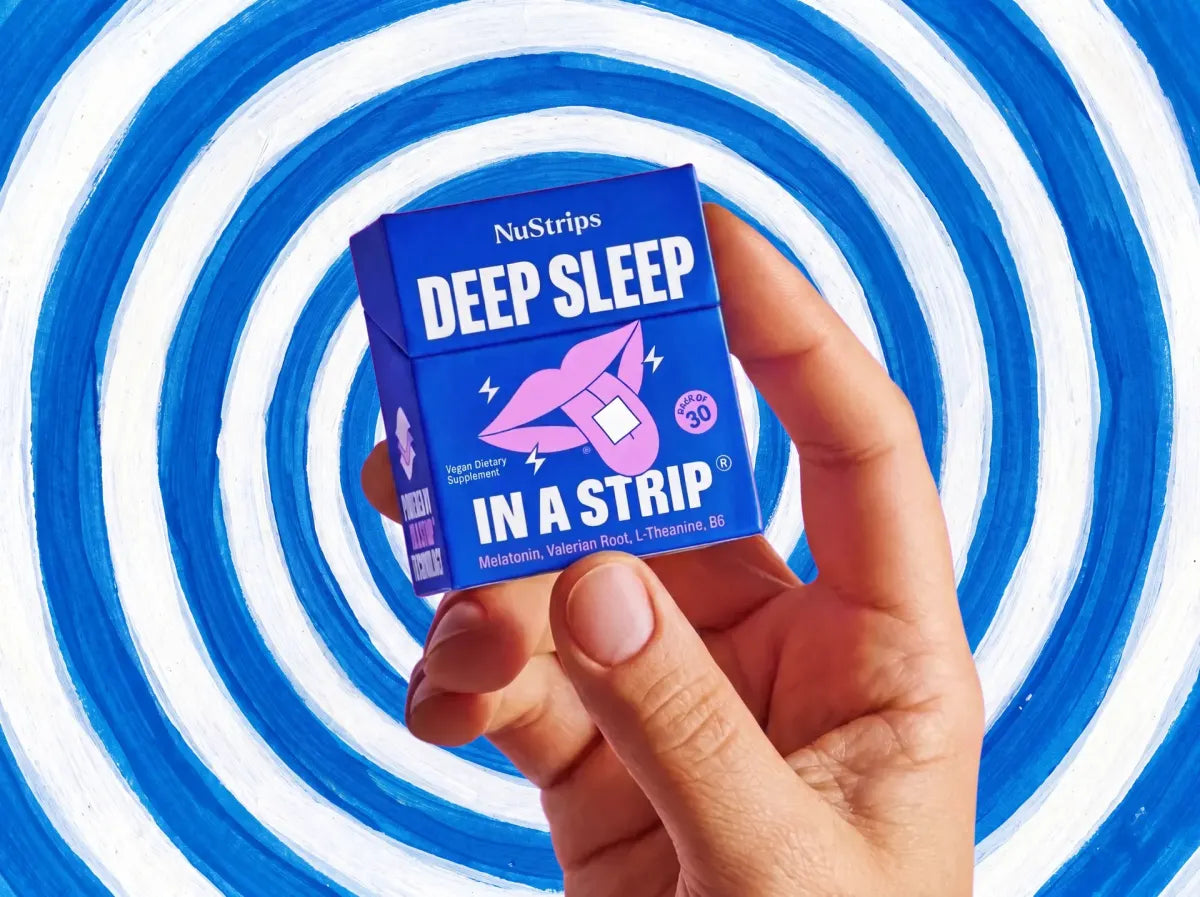
NuStrips Sleep pairs 5mg melatonin, 10mg L-theanine, 15mg valerian root extract, and 5mg vitamin B6 (295% DV) in a single strip. Here's the reasoning behind each, with citations:
- Melatonin (5mg) is your body's own sleep-timing hormone — the same signal your 3am cortisol rise is working against. Taken orally as a pill it's largely wasted: oral melatonin has an absolute bioavailability of only about 3 to 15% because the liver destroys most of it on first pass via the CYP1A2 enzyme (DeMuro et al., J Clin Pharmacol 2000; BMC Pharmacol Toxicol 2016). A strip that dissolves on your tongue routes around much of that loss, which is the basis for the “up to 5x faster absorption”† framing — a melatonin-specific claim, not a blanket one.
- L-theanine (10mg) promotes a calm, relaxed state without sedation — useful precisely when the problem is a racing mind rather than not being tired. In clinical work it's been shown to support relaxation and subjective sleep quality by lowering anxiety rather than knocking you out (Hidese et al., Nutrients 2019; Sleep Medicine Reviews meta-analysis, 2025).
- Valerian root extract (15mg) is a traditional sleep herb; a meta-analysis of 16 randomized trials found a statistically significant benefit for improved sleep quality (relative risk 1.8), with the authors honestly noting methodological limits and possible publication bias (Bent et al., Am J Medicine 2006).
- Vitamin B6 (5mg, 295% DV) is a required coenzyme in your body's own pathway for making serotonin and melatonin, so it supports your natural sleep chemistry rather than overriding it (J Nutr Metab, 2024).
Why a strip specifically for a 3am wake-up? Because at 3am the last thing you want is to turn on a light, find a bottle, and wash a pill down with water — every one of those steps wakes you further. The strip dissolves on your tongue in about 30 seconds with nothing to fumble with in the dark. It's designed to help you wind down and settle back toward restful sleep, not to sedate you; it's non-habit-forming; and it supports — rather than replaces — the light, breathing, and wake-time habits that do the heavy lifting.
“I recommend NuStrips Sleep for patients struggling with sleep disturbances linked to stress. The L-Theanine in this product is clinically proven to reduce anxiety by promoting relaxation and lowering cortisol, which is often elevated during periods of stress. Melatonin, a natural sleep hormone, helps regulate the sleep-wake cycle, facilitating easier sleep onset.” — Chandni P. Sheth, MSN, APRN, FNP-C, Primary Care
It's also independently vouched for: NuStrips Sleep is the #1 clinician-recommended sleep aid on FrontrowMD, shared by 2,265 clinicians, with a customer rating of 4.36★ across 5,034 reviews. That's context, not a promise — the tactics earlier in this article help most people for free, and a strip is simply one gentle option if you want extra support settling back down.
The chart above reflects documented dissolution and absorption pathways — a strip dissolves in ~15–60 seconds and begins oral absorption almost immediately, while a pill must break down in the stomach first. The comparison is format-based and applies to key ingredients like melatonin; it does not imply any product is ineffective.
The bottom line
Waking up at 3am is usually your sleep cycles and your natural cortisol rhythm doing exactly what they're built to do — and the reason you can't fall back asleep is that alertness, a racing mind, and clock-watching pile on top. You break the cycle by lowering alertness, not by fighting for sleep: keep it dark, skip the clock, slow your breathing, cool the room, and hold a consistent wake time. If waking is chronic or wrecking your days, see a clinician. And if you want a gentle, non-habit-forming nudge back toward restful sleep, a melatonin + L-theanine + valerian strip that dissolves on your tongue — with nothing to fumble with at 3am — is one honest option to consider.
See NuStrips Sleep · Explore the full lineup
References
- DeMuro et al., J Clin Pharmacol (2000). Oral melatonin absolute bioavailability ~15%. https://pubmed.ncbi.nlm.nih.gov/10883420/
- BMC Pharmacol Toxicol (2016). Oral melatonin bioavailability ~3% with high variability. https://pmc.ncbi.nlm.nih.gov/articles/PMC4759723/
- Hidese et al., Nutrients (2019). L-theanine 200mg/day reduced anxiety and sleep disturbance. https://pmc.ncbi.nlm.nih.gov/articles/PMC6836118/
- L-theanine sleep meta-analysis, Sleep Medicine Reviews (2025). https://www.sciencedirect.com/science/article/pii/S1087079225000292
- Bent et al., Am J Medicine (2006). Valerian meta-analysis, RR 1.8 for improved sleep. https://pmc.ncbi.nlm.nih.gov/articles/PMC4394901/
- J Nutr Metab (2024). Vitamin B6 in the serotonin-melatonin synthesis pathway. https://pmc.ncbi.nlm.nih.gov/articles/PMC11250910/
Frequently asked questions
Why do I wake up at 3am every night?
Most nightly 3am waking is normal sleep-architecture timing. By about 3 to 4 hours after falling asleep you've completed your deepest sleep, which is front-loaded into the first half of the night, so you're now in lighter stages where waking is easy. At the same time your body begins its pre-dawn cortisol rise, an alerting signal. When light sleep meets rising cortisol, a brief awakening becomes a full one, especially on a stressed night.
Why can't I fall back asleep once I wake at 3am?
The cortisol that helped wake you is still working against sleep, and the moment you notice you're awake and think about how little time is left, you add a stress response on top of it: more adrenaline, a faster heart rate, and a racing mind. That makes you more alert than when you woke. Clock-watching feeds the loop, and at 3am your brain scans for threats without daytime perspective, so worries feel bigger.
What causes waking up at 3am specifically?
Common contributors, usually stacked two or three at a time: sleep-cycle timing (light sleep by the small hours), a natural pre-dawn cortisol rise, an overnight blood-sugar dip that triggers a corrective cortisol/adrenaline release, elevated stress and a racing mind, alcohol (which fragments the second half of the night as it's metabolized), and age, since sleep naturally gets lighter and more broken over the years.
How do I fall back asleep at 3am fast?
Lower your alertness instead of chasing sleep. Keep the lights and screens off, don't look at the clock, and if you're still wired after about 20 minutes, get out of bed and do something dull in dim light until you're sleepy. Slow your breathing with a long exhale (for example inhale 4, exhale 6 to 8), keep the room cool, and anchor a consistent wake time every day. Forcing sleep raises arousal and backfires.
Does alcohol cause 3am wake-ups?
Often, yes. Alcohol is sedating as you fall asleep, which is why a nightcap feels helpful, but as your body clears it over the next few hours it produces a rebound in alertness that fragments the second half of the night. It can also contribute to an overnight blood-sugar dip. A reliable 3am wake-up on nights you drank is a classic pattern.
Can melatonin or a sleep supplement help me fall back asleep at 3am?
It can be one gentle option, alongside the free habits above rather than instead of them. Melatonin is your body's sleep-timing hormone; L-theanine supports calm without sedation, which helps a racing mind; and valerian is a traditional sleep herb with meta-analysis support. A strip that dissolves on your tongue means no light, no water, and no pill to fumble with at 3am. It supports winding down; it isn't a treatment for insomnia, and chronic waking warrants a clinician.
† These statements have not been evaluated by the Food and Drug Administration. This product is not intended to diagnose, treat, cure, or prevent any disease.
Methodology. “#1 Clinician’s Choice,” category rankings, and all clinician counts on this page are based on FrontrowMD’s publicly available clinician-share data as of July 16, 2026. Figures reflect the number of independent clinicians who share each product or brand on FrontrowMD (who are not compensated to do so) and may change over time.