Racing Mind at Night? A Wind-Down Routine That Actually Works
Last updated: July 20, 2026
If your body is exhausted but your brain picks that exact moment to replay every conversation, unfinished task, and worst-case scenario, you are not broken and you are not alone. A racing mind at night is one of the most common reasons people lie awake — and the fix is rarely "try harder to relax." It is a routine: a short, repeatable sequence you run in the last hour before bed that tells your nervous system the day is over. Below is a practical, step-by-step wind-down you can start tonight, plus a printable checklist and a genuinely frictionless final step.
The short answer: to stop your mind racing at night, give it a fixed buffer before bed and a fixed sequence to follow. Dim the lights, put screens away, empty your head onto paper, slow your breathing (4-7-8 works well), cool the room, and skip late caffeine and alcohol. Do the same steps in the same order nightly and your brain learns that this sequence means sleep is coming. A dissolve-on-your-tongue melatonin step can cap the routine without adding a glass of water or a pill to take at the end of your day.†
Why does my mind race the moment I lie down?
During the day, activity, light, and constant input keep your attention pointed outward. The moment you lie down in a quiet, dark room, that external input disappears — and your brain, which has been holding a queue of unprocessed thoughts, finally has the floor. That is why worries, to-do items, and replays surface at bedtime specifically: it is often the first genuinely undistracted moment you have had all day.
Two things make it worse. First, light and screens late in the evening suppress your body's natural rise in melatonin, the hormone that signals "it's night." Second, a hard stop with no buffer — going from a stimulating task straight to lights-out — asks your nervous system to slam on the brakes instantly, which it cannot do. A wind-down routine solves both: it removes the stimulation and gives your body a runway to decelerate.
What is a good bedtime wind-down routine? (Step by step)
Here is a simple, evidence-informed sequence. It takes about 45–60 minutes. You do not need to be perfect — consistency matters far more than any single step. Run the same order nightly and it becomes a signal your brain learns to trust.
1. Set a fixed buffer — pick a "shutdown" time
Choose a time roughly 45–60 minutes before you want to be asleep. That is your hard stop on work, doom-scrolling, and anything stimulating. The buffer is the single highest-leverage step: it is the runway your nervous system needs to slow down. Same time, every night — weekends included as much as you can manage.
2. Dim the lights and go warm
Bright overhead light tells your brain it is still daytime. As soon as your buffer starts, switch to dim, warm lamps — the softer and lower, the better. Lower light lets your natural evening melatonin rise on schedule instead of being held back.
3. Screens off (or at least down)
Phones, laptops, and TVs are both bright and mentally activating — a double hit right when you want to power down. Aim to put screens away at the start of your buffer. If you truly cannot, at minimum dim the display, switch to night mode, and stop anything emotionally charged (news, work email, arguments in comment sections).
4. Brain-dump: empty your head onto paper
This is the direct antidote to a racing mind. Keep a notebook by the bed. In the last part of your buffer, spend five minutes writing down everything circling in your head — tasks, worries, half-thoughts, tomorrow's to-do list. The point is not to solve anything. It is to move the open loops out of your head and onto the page so your brain can stop rehearsing them to avoid forgetting. Writing a short, specific to-do list for the next day is especially effective for people whose racing thoughts are task-driven.
5. Slow your breathing — try 4-7-8
Slow, extended-exhale breathing is one of the fastest ways to shift your body out of "alert" mode. The 4-7-8 pattern is easy to remember: breathe in through your nose for a count of 4, hold for 7, exhale slowly through your mouth for 8. Repeat four cycles. The long exhale is what does the work — it nudges your nervous system toward its "rest" state. If 4-7-8 feels like too much, any breathing where the exhale is longer than the inhale helps.
6. Cool the room
Your core body temperature needs to drop slightly for you to fall asleep, and a cool room helps that happen. Most people sleep best somewhere around 65–68°F (18–20°C). If you run warm, a slightly cooler room, lighter bedding, or a warm shower an hour before bed (which paradoxically helps you cool down afterward) can all help.
7. No late caffeine — and go easy on the nightcap
Caffeine has a long half-life and can linger in your system for hours, so an afternoon or evening coffee, tea, or energy drink can quietly sabotage a wind-down that is otherwise perfect. A useful rule of thumb: no caffeine after early afternoon. Alcohol is the sneakier one — a drink may feel like it helps you drop off, but it fragments sleep later in the night and is a common reason people wake at 3 a.m. with a racing mind. Keeping the evening light on both is one of the simplest upgrades you can make.
8. Cap it with a frictionless supplement step (optional)
If you have done the behavioral steps and still want extra support winding down, a melatonin-based supplement can help signal to your body that it is time for sleep. Melatonin is the hormone your body uses to time sleep; a small dose can reinforce the "it's night" signal your dim-light routine is already building.† The catch with most sleep supplements is friction: a pill and a glass of water is one more task at the exact moment you are trying to power down — and getting up for water can undo the calm you just built.
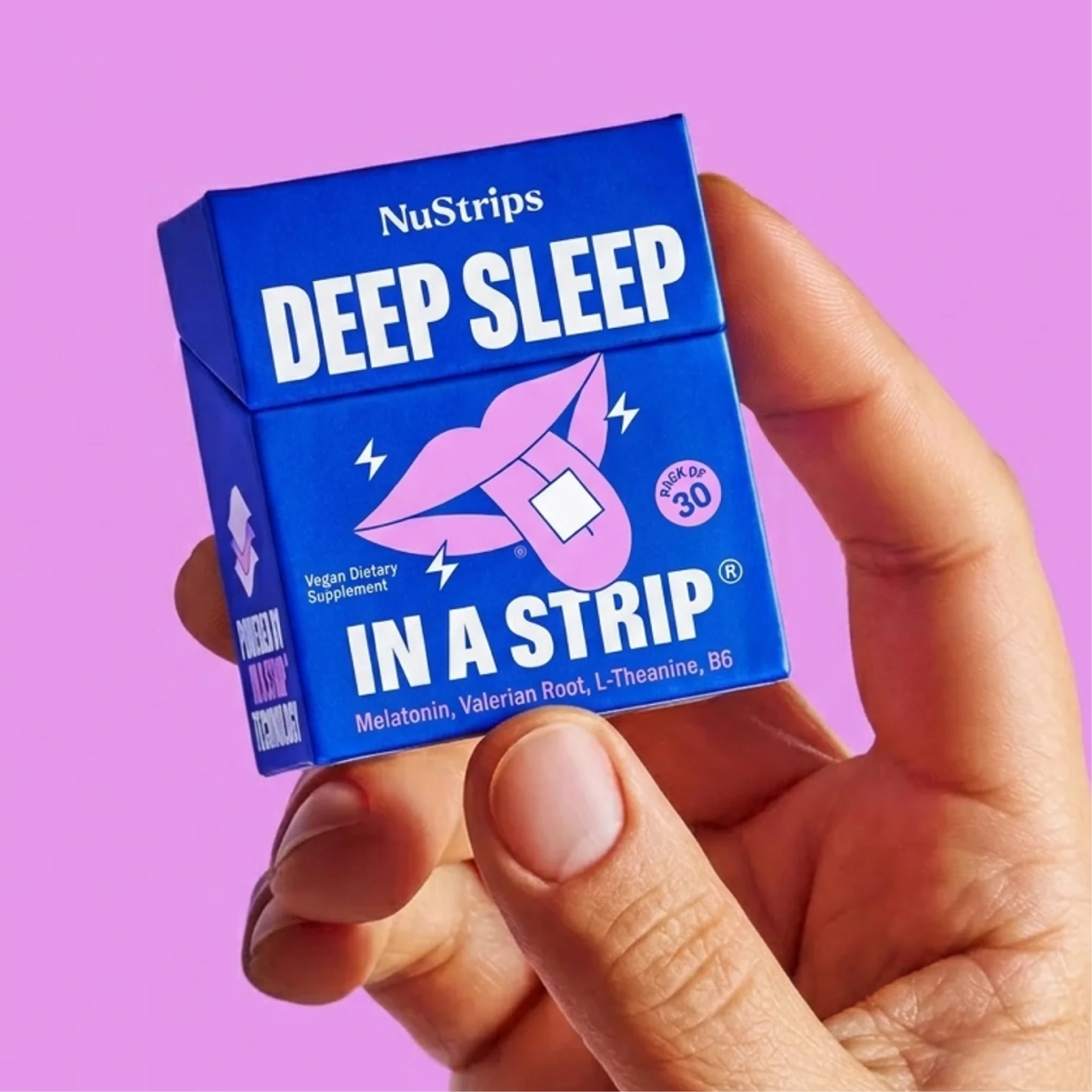
This is where a dissolve-on-your-tongue format fits the routine cleanly. NuStrips Sleep is a thin strip that dissolves on your tongue in seconds — no water, no pill to take to end your day. It pairs 5mg melatonin with 10mg L-theanine, 15mg valerian root, and 5mg vitamin B6 — a combination aimed at calm, on-time sleep rather than a knockout.† You can place it on your tongue the moment you turn out the light, which makes it a natural last step in a wind-down sequence.



Your one-page wind-down checklist
Print this or keep it on your nightstand. The goal is to run the same steps in the same order until the sequence itself becomes your brain's cue that sleep is coming.
| # | Step | Why it works |
|---|---|---|
| 1 | Set a fixed shutdown time (45–60 min before sleep) | Gives your nervous system a runway to slow down |
| 2 | Dim the lights, go warm | Lets natural evening melatonin rise on schedule |
| 3 | Screens off (or dimmed + night mode) | Removes bright, mentally activating input |
| 4 | Brain-dump onto paper (5 min) | Moves racing thoughts out of your head onto the page |
| 5 | 4-7-8 breathing (4 cycles) | The long exhale shifts you toward "rest" mode |
| 6 | Cool the room (~65–68°F) | Supports the core-temperature drop sleep needs |
| 7 | No late caffeine; go easy on alcohol | Both quietly fragment or delay sleep |
| 8 | Optional: melatonin, dissolve-on-tongue | Reinforces the "it's night" signal — no water, no pill† |
How do I stop my mind racing at night, right now?
If you are already in bed and your mind is spinning, you do not have to lie there and lose. Try this in order:
- Do the brain-dump anyway. Turn on a dim light, grab the notebook, and write down whatever is looping. Getting it onto paper is often enough to release the loop.
- Run 4-7-8 breathing. Four slow cycles, long exhales. It gives your mind a single, simple thing to hold onto instead of the spiral.
- Get up if you have been awake ~20 minutes. Lying in bed frustrated trains your brain to associate the bed with being awake. Go to another room, keep the lights low, do something calm and boring, and return only when you feel sleepy.
- Do not check the time. Watching the clock and doing the "if I fall asleep now I'll get X hours" math is pure fuel for a racing mind. Turn the clock away.
These are rescue moves. The routine above is the real fix — the more consistently you run it, the less often you will need the rescue.
Where does a supplement fit — and what makes NuStrips Sleep different?
A supplement is the last step, not the first. Light, screens, caffeine, and a buffer do the heavy lifting; a melatonin-based aid is there to reinforce the signal once the behavioral pieces are in place.† What makes the NuStrips format suited to a wind-down routine is that it removes the friction most sleep aids add. There is no pill to take and no water to fetch — it dissolves on your tongue in seconds, so it slots in at the exact moment you turn out the light.
The formula is built for calm, on-time sleep rather than sedation: 5mg melatonin to signal night, plus 10mg L-theanine (an amino acid associated with relaxed, calm focus), 15mg valerian root (traditionally used for sleep), and 5mg vitamin B6 (a cofactor in your body's own melatonin-synthesis pathway).† NuStrips Sleep is also the #1 clinician-recommended sleep aid on FrontrowMD, recommended by 2,265 clinicians, and carries a 4.36★ rating across 5,034 reviews.


The bottom line
A racing mind at night is a signal that your brain never got a runway to slow down — not a personal failing. Give it one. Pick a fixed shutdown time, dim the lights, put the screens away, empty your head onto paper, slow your breathing, cool the room, and keep the evening light on caffeine and alcohol. Run the same steps in the same order and the sequence itself becomes the cue that sleep is coming. When you want a frictionless final step, a melatonin strip that dissolves on your tongue — no water, no pill — caps the routine cleanly.† Start tonight. Your checklist is above; the strip is at nustrips.com.
† These statements have not been evaluated by the Food and Drug Administration. This product is not intended to diagnose, treat, cure, or prevent any disease.
Methodology. “#1 Clinician’s Choice,” category rankings, and all clinician counts on this page are based on FrontrowMD’s publicly available clinician-share data as of July 16, 2026. Figures reflect the number of independent clinicians who share each product or brand on FrontrowMD (who are not compensated to do so) and may change over time.
Frequently Asked Questions
How do I stop my mind racing at night?
Give your brain a runway to slow down instead of a hard stop. Set a fixed shutdown time 45–60 minutes before bed, dim the lights and go warm, put screens away, and do a five-minute brain-dump — write every looping thought and tomorrow's to-do list onto paper so your brain can stop rehearsing it. Then slow your breathing with the 4-7-8 pattern (in for 4, hold 7, exhale 8, four cycles). Running the same sequence nightly trains your brain to read it as a cue that sleep is coming.
What is a good bedtime wind-down routine?
A simple, repeatable 45–60 minute sequence: (1) set a fixed shutdown time, (2) dim the lights and go warm, (3) put screens off or on night mode, (4) brain-dump onto paper, (5) do 4-7-8 breathing, (6) cool the room to around 65–68°F, (7) avoid late caffeine and go easy on alcohol, and (8) optionally add a melatonin step. Consistency matters more than perfection — same steps, same order, every night.
Does the 4-7-8 breathing technique actually help you sleep?
Slow, extended-exhale breathing helps shift your body out of alert mode toward its rest state, and 4-7-8 (breathe in for 4, hold for 7, exhale slowly for 8, repeat four cycles) is an easy pattern to remember. The long exhale is the active ingredient. It also gives a racing mind a single, simple thing to focus on instead of the spiral. If 4-7-8 feels awkward, any breathing where the exhale is longer than the inhale helps.
Should I get out of bed if I can't sleep?
Yes — if you have been lying awake for roughly 20 minutes, get up. Staying in bed frustrated trains your brain to associate the bed with being awake. Go to another room, keep the lights low, do something calm and boring, and return only when you feel sleepy. And do not check the clock: the "if I fall asleep now I'll get X hours" math is pure fuel for a racing mind.
Does melatonin help with a racing mind, and how much should I take?
Melatonin is the hormone your body uses to time sleep, so a small dose can reinforce the "it's night" signal your dim-light, screens-off routine is already building — it is best used as the last step after the behavioral pieces are in place, not as a substitute for them.† NuStrips Sleep uses 5mg of melatonin paired with L-theanine, valerian root, and vitamin B6, in a strip that dissolves on your tongue in seconds so there is no water or pill at the end of your day.
Why does caffeine and alcohol make it harder to quiet my mind at night?
Caffeine has a long half-life and can linger for hours, so an afternoon or evening coffee, tea, or energy drink can keep you wired well past bedtime — a good rule is no caffeine after early afternoon. Alcohol is sneakier: a nightcap may feel like it helps you drop off, but it fragments sleep later in the night and is a common reason people wake around 3 a.m. with a racing mind. Keeping the evening light on both is one of the simplest wind-down upgrades.
References
- https://pmc.ncbi.nlm.nih.gov/articles/PMC4759723/
- https://pubmed.ncbi.nlm.nih.gov/10883420/
- https://pmc.ncbi.nlm.nih.gov/articles/PMC6836118/
- https://pubmed.ncbi.nlm.nih.gov/25759004/
- https://pmc.ncbi.nlm.nih.gov/articles/PMC4394901/
- https://pmc.ncbi.nlm.nih.gov/articles/PMC7585905/
- https://pubmed.ncbi.nlm.nih.gov/16636399/