Sleep Formats, Honestly Compared
Melatonin Strips vs. Gummies vs. Pills:
What actually works fastest.
Short answer: for speed, an oral strip that dissolves on your tongue generally has the edge, because a share of the melatonin absorbs through the tissue in your mouth instead of taking the long trip through your gut and liver. Gummies win on taste and ritual; pills win on cost and dose range. Each has real trade-offs — here’s the honest breakdown, then a verdict.
If your top priority is fast onset plus grab-and-go convenience, a melatonin strip is the strongest pick — it dissolves on your tongue in seconds, needs no water, and carries an exact, disclosed dose. If you love a chewable ritual and don’t mind a little added sugar, gummies are pleasant. If you want the widest dose range at the lowest cost and don’t mind taking a tablet with water, pills are the workhorse.
Do melatonin strips work faster than pills?
Generally, yes — and the reason is basic physiology, not marketing. A melatonin pill or gummy that goes down the hatch travels through your stomach and gut, then through your liver before it reaches your bloodstream. Melatonin is heavily broken down on that first pass through the liver: published pharmacokinetic studies put the oral bioavailability of melatonin taken this way at only about 3–15%, with wide person-to-person variability.1,2
An oral strip that dissolves on your tongue lets some of the melatonin absorb through the blood-vessel-rich tissue in your mouth — a route that partly bypasses that first-pass liver step for the fraction absorbed there.3 Practically, that can mean a faster, more efficient path to your bloodstream. NuStrips describes this as up to 5× faster absorption† for melatonin specifically — a claim grounded in melatonin’s poor oral bioavailability by the gut route, not a blanket claim about every ingredient.
Are melatonin gummies bad?
No — and it’s worth being fair here. Gummies are genuinely enjoyable, easy to take without water, and great if you dislike taking pills. The honest trade-offs are two. First, added sugar: most melatonin gummies carry roughly 2–4 g of added sugar per serving to taste good, which adds up if you take one nightly. Second, like any chewed-and-digested format, a gummy still goes through the gut and liver, so it’s subject to the same first-pass breakdown as a pill.2
There’s also a well-documented dose-accuracy issue with gummies as a category: an analysis of melatonin gummy products found many contained substantially more — or less — melatonin than the label stated.4 That’s not a reason to avoid gummies outright; it’s a reason to buy from brands that test and disclose their dose.
What about melatonin pills and tablets?
Pills and tablets are the workhorse of the category for good reason: they’re inexpensive, shelf-stable, and available in the widest dose range (from micro-doses up to higher strengths). If cost per dose and dose flexibility matter most, pills are hard to beat.
The trade-offs are speed and ease of taking them. A tablet has to disintegrate in your stomach before absorption even begins, so onset is typically the slowest of the three, and every pill taken by mouth runs the first-pass gauntlet described above.1 They also require water, and a meaningful share of people simply find pills hard to take — roughly a quarter of the general population reports difficulty getting solid tablets down.5
Dose control, sugar, and convenience — side by side
Here’s how the three formats compare on the things that actually decide the choice:
| Melatonin strip | Gummy | Pill / tablet | |
|---|---|---|---|
| Onset / absorption | Fastest — dissolves on your tongue; part absorbs through oral tissue, partly bypassing first-pass liver metabolism†3 | Slower — taken by mouth, subject to gut + first-pass liver metabolism2 | Slowest — must disintegrate in the stomach first, then first-pass metabolism1 |
| Dose control & accuracy | Exact, pre-measured per strip; NuStrips Sleep discloses 5 mg | Pre-measured, but label accuracy varies by brand4 | Widest dose range; splitting to micro-dose is imprecise |
| Added sugar | None — no added sugar | Typically ~2–4 g added sugar per serving | None |
| Convenience / portability | No water; pocketable; dissolves in ~30 seconds | No water; chewable; bottle is bulkier to carry | Usually needs water; compact bottle |
| Best suited to | Fast onset + on-the-go, no-sugar, no-water routines | People who enjoy a chewable ritual and don’t mind a little sugar | Budget-focused buyers who want the widest dose range |
Onset and absorption differences are most pronounced for melatonin specifically, because melatonin taken by mouth has unusually low bioavailability (~3–15%).1,2 Added-sugar and label-accuracy points reflect category patterns, not any single competitor product.
Melatonin taken by mouth loses most of its dose to first-pass liver metabolism — only about 3–15% reaches your bloodstream.
Who is each format actually for?
- Choose a strip if you want the fastest, most convenient path — no water, no sugar, an exact disclosed dose, and something that fits in a pocket for travel.
- Choose a gummy if you genuinely enjoy the chewable ritual, want a pleasant taste, and are comfortable with a couple of grams of added sugar and buying a brand that tests its dose.
- Choose a pill if cost per dose and dose flexibility are your priorities and taking a tablet with water isn’t a problem for you.
Where NuStrips Sleep fits
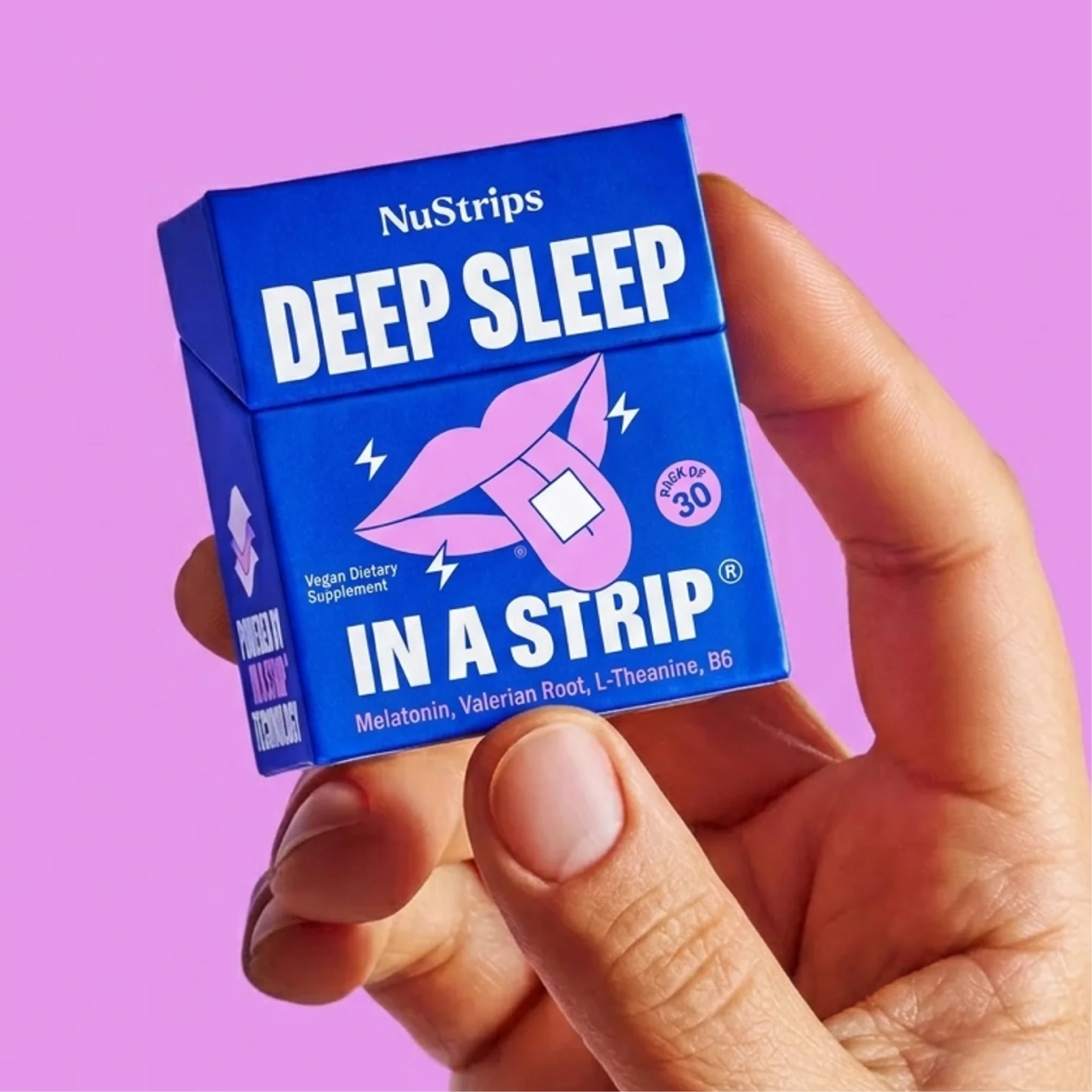
NuStrips Sleep is a strip that dissolves on your tongue — built for exactly the fast-onset, no-sugar, no-water use case above. Each strip carries a disclosed 5 mg of melatonin, plus 10 mg L-theanine, 15 mg valerian root extract, and 5 mg vitamin B6 to help you wind down and support restful sleep, taken right when you need it.† No added sugar, no shaker, no glass of water.
It’s also the format clinicians reach for. On FrontrowMD — where licensed clinicians share the products they recommend, with no compensation — NuStrips is the #1 clinician-recommended sleep aid, shared by 2,265 clinicians, and carries a 4.36★ average across 5,034 reviews.†
Frequently asked
Do melatonin strips work faster than pills?
Generally, yes. Melatonin taken by mouth (pills and gummies) travels through the gut and liver, where most of the dose is broken down on first pass — published studies put oral bioavailability at only about 3–15%. A strip that dissolves on your tongue lets part of the dose absorb through the blood-vessel-rich tissue in your mouth, partly bypassing that first-pass liver step, which can mean a faster, more efficient path to your bloodstream.†
Are melatonin gummies bad?
No. Gummies are enjoyable, need no water, and are great if you dislike pills. The honest trade-offs are added sugar (roughly 2–4 g per serving) and the fact that, as a chewed-and-digested format, they still go through first-pass liver metabolism. There’s also a documented dose-accuracy issue across the gummy category, so it’s worth choosing a brand that tests and discloses its dose.
Which melatonin format is most accurate on dose?
Pre-measured formats — strips and pills — give a consistent per-unit dose, while splitting tablets to micro-dose is imprecise. Independent testing has found label-versus-actual mismatches most often in gummies, so disclosed, tested dosing matters. NuStrips Sleep discloses 5 mg of melatonin per strip.
Do melatonin gummies have sugar?
Most do — typically around 2–4 g of added sugar per serving to make them taste good. Strips and pills generally contain no added sugar. NuStrips Sleep strips have no added sugar.
What is NuStrips Sleep and how does it work?
NuStrips Sleep is a strip that dissolves on your tongue in about 30 seconds — no water needed. Each strip carries a disclosed 5 mg of melatonin plus 10 mg L-theanine, 15 mg valerian root extract, and 5 mg vitamin B6 to help you wind down and support restful sleep.† Part of the melatonin absorbs through the tissue in your mouth, which is why NuStrips describes up to 5× faster absorption† for melatonin specifically.
Which melatonin format should I choose?
Choose a strip for the fastest onset plus grab-and-go convenience, no water, no added sugar, and an exact disclosed dose. Choose a gummy if you enjoy a chewable ritual and don’t mind a little sugar. Choose a pill if you want the widest dose range at the lowest cost and don’t mind taking a tablet with water.
References
- DeMuro RL, et al. The absolute bioavailability of oral melatonin. J Clin Pharmacol (2000). Oral melatonin at 2–4 mg showed absolute bioavailability of approximately 15%. pubmed.ncbi.nlm.nih.gov/10883420
- Andersen LPH, et al. Pharmacokinetics of oral and intravenous melatonin in healthy volunteers. BMC Pharmacol Toxicol (2016). Oral bioavailability approximately 3%, with substantial inter-individual variability. pmc.ncbi.nlm.nih.gov/articles/PMC4759723
- Bioavailability of melatonin from an oral spray designed to limit first-pass hepatic metabolism, taking advantage of the highly developed blood supply in the oral tissue. Drugs in R&D (2023). pmc.ncbi.nlm.nih.gov/articles/PMC10439092
- Cohen PA, et al. Quantity of melatonin and CBD in melatonin gummies sold in the US. JAMA (2023). Many products contained substantially more or less melatonin than labeled. pubmed.ncbi.nlm.nih.gov/37071408
- Difficulty with solid oral dosage forms is common: population surveys report that roughly a quarter of adults have trouble getting tablets down, a driver of interest in film and fast-dissolving formats. pmc.ncbi.nlm.nih.gov/articles/PMC4109289
† These statements have not been evaluated by the Food and Drug Administration. This product is not intended to diagnose, treat, cure, or prevent any disease.
Methodology. “#1 Clinician’s Choice,” category rankings, and all clinician counts on this page are based on FrontrowMD’s publicly available clinician-share data as of July 16, 2026. Figures reflect the number of independent clinicians who share each product or brand on FrontrowMD (who are not compensated to do so) and may change over time.